Thursday, 12 April 2012

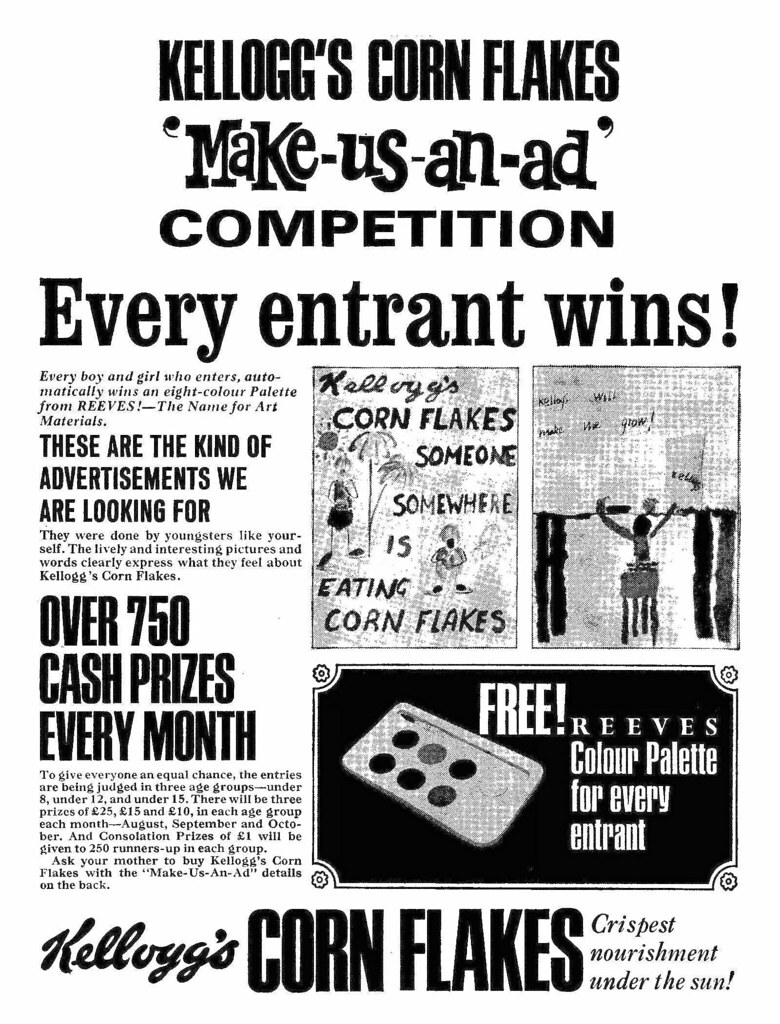
Make-us-an-ad: Kelloggs Corn Flakes (1966)


This classic ad for Kelloggs Corn Flakes dates back to 1966 and is encouraging the youngsters of the day to create advertisements expressing in words and pictures what they feel about Kelloggs Corn Flakes.  There were three age groups, under 8 - under 12 and under 15.  there were three prizes of £25, £15 and £10 with 250 runners up each receiving prizes of £1

Sunday, 8 April 2012

Sacha Distel on the TV Times (1972)


Sacha Distel graces this classic TV Times cover from 1972. Accompanying Sacha on the cover are the late Susannah York & (The Bitch) Joan Collins in a production of Noel Coward's Fallen Angels.
Fallen Angels is a play that opened at the Globe Theatre (now called the Gielgud Theatre) in 1925 and starred Tallulah Bankhead.

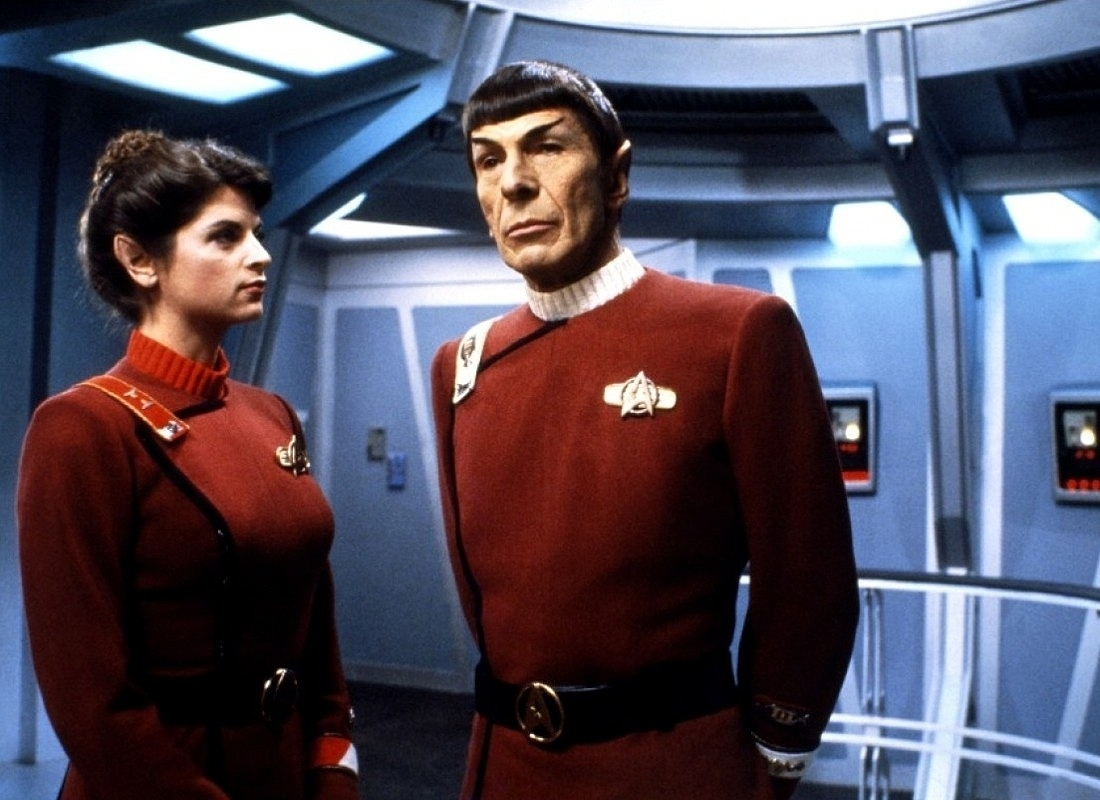
The Vulcan's Vulcan - Remembering Mr Spock


First portrayed by Leonard Nimoy in the original Star Trek series, Mr Spock also appeared in the animated Star Trek series, two episodes of Star Trek; The Next Generation, seven of the Star Trek feature films, and numerous Star Trek books, comics, and video games. In the 2009 film Star Trek, Leonard Nimoy reprised his role alongside Zachary Quinto, who played a younger, alternate-timeline version of the character and Jacob Kogan playing Spock as a child.
Spock serves aboard the Starship Enterprise, serving as science officer and first officer, and later as commanding officer of two iterations of the vessel. Spock's mixed human-vulcan heritage serves as an important plot element in many of the character's appearances. Along with James T Kirk and Leonmard McCoy, he is one of the three central characters in the original Star Trek series and its films. After retiring from Starfleet, Spock serves as a Federation ambassador, contributing toward the detente between the Federation and the Klingon Empire. In his later years, he serves as Federation ambassador to the Romulan Empire and becomes involved in the ill-fated attempt to save Romulus from a Supernova.
The character was initially depicted as the USS Enterprise's science officer for the original pilot, "The Cage" (1964). Although "The Cage" did not air, Spock's eleven years of service under the command of Captain Christopher Pike are referenced and depicted in "The Managerie" (1966) and other episodes. The character's first broadcast appearance is in "The Man Trap" (1966), which introduces him as the ship's science officer and first officer under Captain James T Kirk (William Shatner). Star Trek depicts a "troika" of Spock, Kirk, and Doctor Leonard McCoy (De Forest Kelley); while McCoy often acts as Kirk's conscience, Spock offers the captain an emotionally detached, logical perspective. The character also offers an "outsider's" perspective on "the human condition".
Star Trek also presents elements of Spock's upbringing and family. "Journey to Babel" (1967) depicts his parents: Sarek (Mark Lenard), the Vulcan ambassador to the Federation, and Amanda Grayson (Jane Wyatt), a human. Spock's decision to join Starfleet, rather than attend the Vulcan Science Academy, ran contrary to his father's wishes. The relationship between Spock and Sarek is strained and often turbulent, although rooted in an underlying respect and carefully restrained love for each other. The 1973 animated series episode "Yesteryear" shows seven-year-old Spock choosing to pursue a Vulcan lifestyle devoted to logic and suppressing emotion.
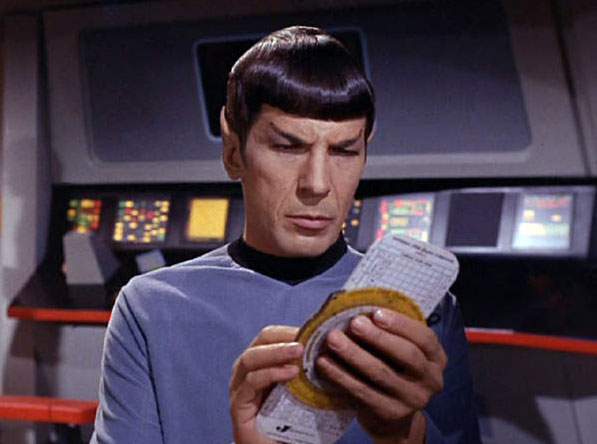
At the beginning of Star Trek: The Motion Picture (1979), Spock is no longer in Starfleet, having resigned and returned home to pursue the Vulcan discipline of Kolinhar. Spock is unable to complete the Kolinahr ritual after he senses the coming of V'ger, and rejoins Starfleet to aid the Enterprise crew in their mission. Spock, promoted to captain, is commanding officer of the Enterprise at the beginning of Star Trek 2: The Wrath of Khan (1982).
At the film's end, he transfers his "Katra" – the sum of his memories and experience – to McCoy, and then sacrifices himself to save the ship and its crew from Khan Noonien Singh (Ricardo Montalban). The sequel, Star Trek 3 - The Search for Spock (1984), focuses on his crewmates' quest to recover Spock's body, resurrected by the Genesis matrix in the previous film. At the film's conclusion, Spock's revived body is reunited with his katra. Spock is next seen in Star Trek 4 - The Voyage Home (1986), which depicts his recovery from the after-effects of his resurrection. In the film's final scene, he joins the crew of the newly commissioned USS Enterprise - under Kirk's command. In Star Trek 5: The Final Frontier (1989), Spock and the Enterprise crew confront the renegade Sybok, Spock's half-brother. Star Trek 6 - The Undiscovered Country (1991) reunites the Enterprise crew on a mission to prevent war from erupting between the Federation and Klingon Empire. Spock serves as a special envoy to broker peace with the Klingons after a natural disaster devastates their homeworld.
Spock appears in "Unificatoin" (1991), a two-part episode of Star Trek: The Next Generation. Set 75 years after the events of The Undiscovered Country, the episode focuses on Federation Ambassador Spock's attempt to reunite the Romulans with their Vulcan brethren. Filming of The Undiscovered Country overlapped with production of this episode, and the episode references Spock's role in the film.
Spock's next appearance in the live action Star Trek franchise is the 2009 Star Trek film. In the film's prologue (set 19 years after the events of Unification, and as depicted in the graphic novel Star Trek: Countdown), Ambassador Spock (Nimoy) promises the Romulans he will use Vulcan technology to save them from a rogue supernova that threatens to destroy their Empire. The mission is only partially successful, and in the aftermath Spock is pursued into the past by Nero (Eric Bana), a Romulan driven mad by the loss of his homeworld and family, setting into motion the events of the film.
In the film's opening act, Nero's ship emerges in the year 2233, and through its interaction with the inhabitants, inadvertently creates an "alternate, parallel 'Star Trek' universe". Stranded in the alternate past, the prime version of Spock helps alternate, younger versions of himself and Kirk (Zachary Quinto and Chris Pine, respectively) thwart Nero's attempt to destroy the Federation.
The film also features Jacob Kogan in several scenes depicting Spock's childhood, including his abuse at the hands of other Vulcan children due to his half-Human heritage, and his relationship with his parents (Ben Cross and Winona Ryder). The film also depicts Kirk and Spock's initial clashes at Starfleet Academy, and the gradual development of their friendship based on shared mutual respect, what the elder Spock calls "... a friendship that will define [them] both in ways [they] cannot yet realize." A major change in characterization from the primary timeline is alternate Spock's involvement with alternate Uhura (Zoe Saldana), his former student. At the end of the film, the young Spock opts to remain in Starfleet, while his older self stays in the altered universe to aid the few surviving Vulcan refugees, as Nero had destroyed Vulcan, Spock's home planet.
Spock, as originally described in Gene Roddenberry's 1964 pitch for Star Trek, is "probably half Martian, he has a slightly reddish complexion and semi-pointed ears". Early versions had the character ingest energy through a plate in his stomach. Writer Samuel A Peeples told Roddenberry these attributes made Spock too alien, and suggested "he should at least be half-human and have the problems of both sides", believing the human traits made the character more interesting and able to comment on the human condition more believably. Spock's home planet was changed because Roddenberry thought if the show was a success, humans might actually walk on Mars during the series' run.
Roddenberry sought an alien-sounding name when he created "Spock", and did not know until later of Dr.Benjamin Spock, the famous pediatrician and author. In the initial, rejected pilot, "The Cage" (1964), Spock is greenish yellow and from the planet Vulcan. After DeForest Kelley in 1964 stated his non-interest in playing the role, Roddenberry cast Nimoy because he knew him from a guest appearance in his pilot Lieutenant; after Roddenberry saw Nimoy's thin face and sharp features, no other actors were considered. Had Nimoy turned down the role, Roddenberry would have approached Martin Landau.
The "pointy ears" worn by Nimoy while portraying Spock are a form of facial prosthesis, mainly composed from molded and painted syntactic foam. The foam was created by filling a ceramic matrix with hollow particles called microballoons, which result in a low density prosthesis that is easily worn. However, the process of ungluing the ears was painful for Nimoy, and meant that he had to come in an hour and a half early before filming, and stay behind for a half hour each day after filming, to apply and remove the glued pieces. The pain and inconvenience were so great that when producer Robert H Justman jokingly proposed plastic surgery, Nimoy momentarily considered doing so. NBC was concerned about Spock's satanic appearance, however, and asked for the character to be dropped; according to Oscar Katz, the network was worried "the 'guy with the ears' would scare the shit out of every kid in America". Publicity shots of the character were airbrushed so Spock had normal eyebrows and round ears. With Katz's help, Roddenberry was able to keep the character. Throughout the character's television and movie appearances, the shape of Spock's ears has varied, due in part to the different makeup artists applying them.
Spock did not originally have the logical manner which would become associated with the character, this instead being a trait of the character Number One (Majel Barratt). However, Number One was dropped in developing the second pilot, "Where No Man Has Gone Before" (1966). This episode presents a more fully formed Spock, with his trademark logic. Nimoy liked the character's newly logical nature, observing the character is "struggling to maintain a Vulcan attitude, a Vulcan philosophical posture and a Vulcan logic, opposing what was fighting him internally, which was human emotion". Spock's behavior has been described as representing, in part, a type of normative judgment. Spock's Vulcan Salute references a sacred hand position used by the ancient Jewish priestly class. Desilu vice president Herbert Solow believes Nimoy was the key contributor to the character's depiction. Nimoy recalled, "As a Jew from Catholic Boston, I understood what it was like to feel alienated, apart from the mainstream...There were a number of values in 'Star Trek' that I felt very comfortable with as a Jew".
Leonard Nimoy had not intended to join the cast of Star Trek II: The Wrath of Khan, but was enticed back with the promise that his character would be given a dramatic death scene. Leonard reasoned that since The Wrath of Khan would be the final Star Trek film, having Spock "go out in a blaze of glory" seemed like a good way to end the character. In an earlier draft of the script, Spock had died in the first act in a shocking demise that the movie's producer Harve Bennett compared to Janet Leigh's early death in Psycho. Fan reaction to leaked news that Spock would be killed was overwhelmingly negative, and one fan paid for trade-paper advertisements urging Paramount to abandon the plan. Some fans even went so far as to issue death threats against Leonard Nimoy's family. According to Bennett:
"For some reason fans got the impression that he [Nimoy] wanted Spock dead. He'd written a book "I Am Not Spock," and that gave people the idea. Anyway, when a fringe group of Trekkies learned that we were going to kill the Spock character, it was like we'd taken a child of theirs onto the Brooklyn Bridge with the intention of throwing it off. And their reaction was, "let's get Leonard."
By April 1981, a revised script was completed that moved the character's death into the movie's final act. Spock's death scene was shot over three days, during which no visitors were allowed on set.
Spock's death was intended to be irrevocable, but Nimoy had such a positive experience during filming that he asked if he could find a way for Spock to return in a later film. The scene showing Spock's mind meld with McCoy was filmed without actor DeForest Kelley's prior knowledge of what was going on. Test audience reaction to Spock's death and the film's ending (the tone of which was dark and final) was poor, so Bennett made it more uplifting by adding the final scene revealing Spock's casket on the Genesis Planet and Nimoy's closing "These are the voyages" monologue.
Director Nicholas Meyer objected, but did not stand in the way of the changes, and even Nimoy did not know about the new scene until he viewed the film, but before the film opened, the media reassured worried fans that "Spock will live" again.
The Wrath of Khan had its first public screening at a science-fiction convention in Overland Park, KS on May 8, 1982, almost a month before general release. Although Paramount executives were concerned that Spock's death would set the fanbase against the movie, the audience actually applauded following Spock's final death scene. "It was sensational. I hate to be given to superlatives but it absolutely reached everything we wanted it to. I couldn't ask for anything better," said Co-producer Robert Sallin of the audience's reaction at the advance screening.
However, critical reaction to Spock's death was mixed at the time. Film critic Roger Ebert lauded Spock's death: "He makes a choice in STAR TREK II that would be made only by a hero, a fool, or a Vulcan. And when he makes his decision, the movie rises to one of its best scenes, because the 'Star Trek' stories have always been best when they centered on their characters." On the other hand, The Washington Post's Gary Arnold stated Spock's death "feels like an unnecessary twist, and the filmmakers are obviously well-prepared to fudge in case the public demands another sequel."
A quarter of a century later, Spock's death in The Wrath of Khan ranks number 2 on Total Film's list of 25 greatest Star Trek movie moments, and number 1 on IGN Movie's top 10 Star Trek movie moments.
Zachary Quinto was cast in the role of a young alternate-timeline Spock for the 2009 Star Trek film, directed by J J Abrams. Quinto mentioned he heard about the new film and revealed his interest in the role in a December 2006 interview with the Pittsburgh Post-Gazette. The article was widely circulated and he attracted Abrams' interest. Quinto expressed interest in the role because of the duality of Spock's half-human, half-Vulcan heritage, and how the character "is constantly exploring that notion of how to evolve in a responsible way and how to evolve in a respectful way. I think those are all things that we as a society, and certainly the world, could implement."Nimoy subsequently befriended Quinto. Although Quinto watched some episodes of the show during breaks in filming, Nimoy was his main resource in playing Spock.
From early on, the public's reaction to Spock was strongly positive, even fanatical. Headshots of Spock became popular fan souvenirs, with the rare ones of the actor laughing the most valuable. To Nimoy's great surprise Spock became a sex symbol, and teenagers asked questions about current events such as the Vietnam War and LSD as if he were the Vulcan scientist. A fan even asked the actor to lay his hands on a friend's eyes to heal them. Nimoy recalled, more than a decade after the show's cancellation:
The "Star Trek" phenomenon continues to amaze and confound me. It was incredible, and it still is, although it is gentler now than it used to be. For a time, it was hysterical – it was so wild I had to be very careful where I went. If I went to a restaurant, I had to plan my entrances and my exits so I wouldn't be mobbed and hurt. Same thing in hotels and airports – any public place. It isn't that hysterical any more, but it is still a potent force.
NASA made Spock an informal mascot of the space agency. Nimoy was invited to be guest of honor at the March 1967 National Space Club dinner, and to take an extensive tour of the Goddard Space Flight Center in Greenbelt, MD. The actor concluded from the warm and intense reception he received that astronauts like John Glenn and aerospace industry engineers, secretaries, and shareholders alike all regarded Star Trek, and especially the character of Spock, as a "dramatization of the future of their space program".
UGO named Spock one of the 50 greatest TV characters. According to Shatner, much of Star Trek's acting praise and media interest went to Nimoy.
Spock has been parodied by, and has also been the inspiration for, pop culture works in various media. Composer/keyboardist George Duke's 1976 Solo Keyboard Album features two tracks which pay homage to Spock: "Spock Gets Funky" and "Vulcan Mind Probe". Rock guitarist Paul Gilbert wrote the song "Mr. Spock" on his Space Ship One album. Swedish synthpop band S.P.O.C.K. makes music heavily influenced by the Star Trek universe. Even Nimoy got in on the act; assuming the Spock character, Nimoy recorded a number of novelty songs, the first being "Highly illogicall", in which Spock pointed out the foibles of human thought, such as relationships, automobiles, and greed. The second song, "A Visit to a Sad Planet", was darker in tone and told the story of Spock visiting Earth in the future and discovering it had been ruined by war, violence, and environmental irresponsibility. According to comic book writer and editor Bob Budiansky, The Transformers character shockwave as inspired by Spock. Spock's utilitarian perspective that "the needs of the many outweigh the needs of the few" is cited in a legal decision rendered by the Texas Supreme Court.
Spock's physical appearance in the Original Series episode "Mirror, Mirror" (1967) has itself spawned a trope of the "evil twin" archetype found in various fictional genres. In that episode, several members of the Enterprise travel to a parallel universe inhabited by evil versions of themselves. The parallel universe version of Spock is distinguished physically by his goatee.i09 said Spock's beard in the episode introduced "the best shorthand ever for evil parallel universe duplicates". Examples of the evil goatee's appearances in other media include Bender's "evil twin" Flexo in Futurama and a 2009 episode of The Golbert Report featuring Stephen Colbert and congressman Dan Maffei wearing fake goatees while pretending to be evil versions of themselves. The name of progressive rock band Spock's Beard is a direct reference to Spock's goatee in this episode.
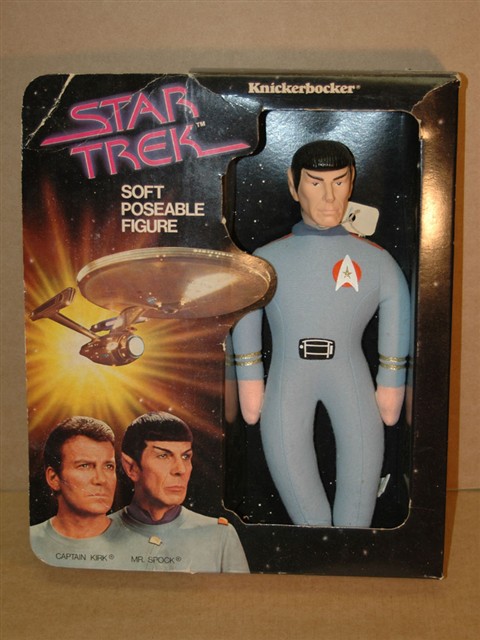
In addition to television, feature films, books, and parodies, Spock has also been portrayed in fan fiction. Since 2004, the online fan production Star Trek: Phase 11 has continued the further voyages of the cancelled initial series. The fan-series' creators feel "Kirk, Spock, McCoy, and the rest should be treated as 'classic' characters like Willy Loman from Death of a Salesman, Gandalf from Lord of the Rings, or even Hamlet, Othello, or Romeo. Many actors have and can play the roles, each offering a different interpretation of said character."
Spock was portrayed by Jeffrey Quinn for the first three episodes of Star Trek: Phase 11. Brandon Stacy, who succeeded Jeffrey Quinn and Ben Tolpin in portraying Spock, also served as a stand-in for Zachary Quinto in the 2009 Star Trek film.

Thursday, 29 March 2012

Melody Maker - Wings on the Run! (1975)

Paul McCartney and Wings,Melody Maker August 1975,UK,Deleted,MAGAZINE,558414
This front cover from the classic Melody Maker dates back to 1975 and on the cover is the late Linda McCartney.  Inside there was a great feature on Paul McCartney and Wings.  There were also news, reviews and features on Genesis, Billy Connolly, Leo Sayer and more.

Wednesday, 28 March 2012

Matthew and Son - Cat Stevens (1967)

Cat Stevens,Matthew & Son - Original Stereo,UK,LP RECORD,159439
"Matthew and Son" was a single written and performed by the great Cat Stevens. It was selected as the title song for his debut album. Stevens, a newly-arrived teenage singer - songwriter, was performing for a youthful audience, but during the mid-1960s, the period of the start of his musical career, was seen by his audience initially in the role of a crooner, or a young, foppish, "swinging" version of older celebrities who sang as television performers. This was in comparison to the newly emerging folk rock genre from the skiffle which had, in part, inspired him to begin writing and performing.
File:Matthew&Son.jpg
The song, according to Stevens, was inspired in part, by the tailor, Henry Matthews, who made suits for Stevens. He thought up the story of the worker that became the main character in the song.
Another theory is that he noticed a shop-front in Trinity Street, Cambridge, called 'Matthew and Son'. It was an up-market shop that sold grocery provisions, cheeses, coffee and household china. It was on the site occupied by Heffer's bookshop today.
Stevens later commented, "I had a girlfriend, and she was working for this big firm, and I didn't like the way that she had to spend so much of her time working. The riff seemed to fit the words, Matthew and Son. There was a bit of social comment there about people being slaves to other people."

Look out for Dick Turpin!


This edition of Junior TV Times, otherwise known as Look-in dates back to February 1980 and on the cover is Richard O'Sullivan as masked highway man Dick Turpin.  Also featured in this edition are colour pin-ups of Abba and the Tourists.  Picture strips of the time included, Worzel Gummidge and Charlie's Angels. 

Tuesday, 27 March 2012

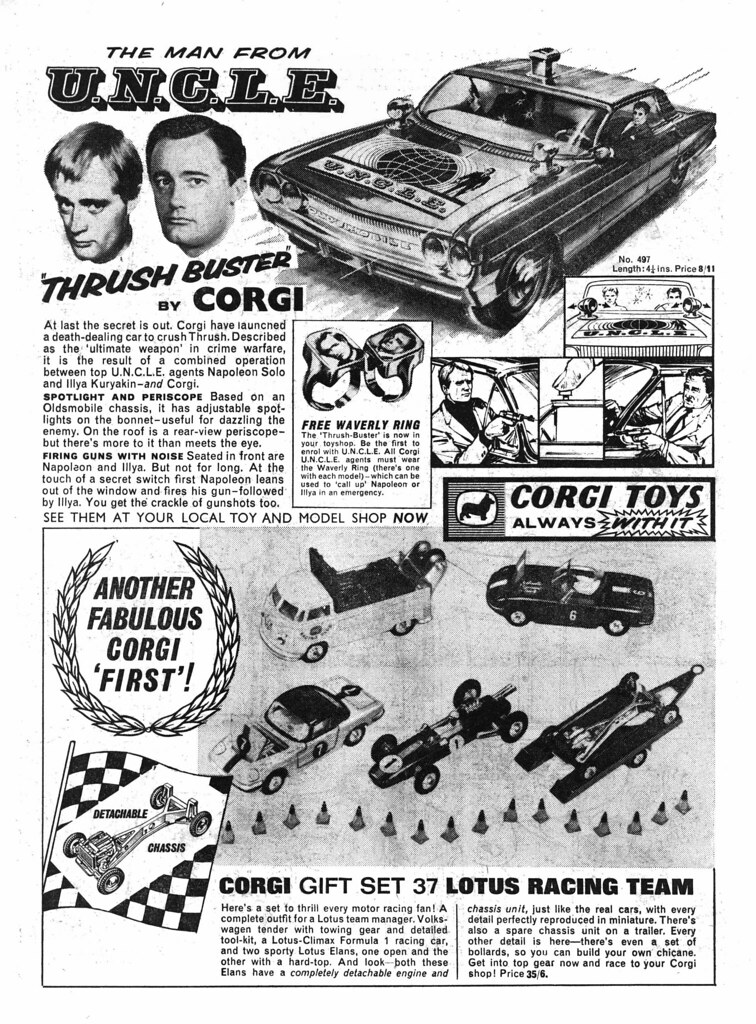
Corgi - The Thrush Buster - The Man From Uncle (1966)


This classic ad dates back to 1966 when Corgi launched the Thrush Buster, a death-dealing car to crush thrush.  Described as the ultimate weapon in crime warfare, it is the result of a combined operation between top U.N.C.L.E. agents Napoleon Solo & Ilya Kuryakin and of course, Corgi!

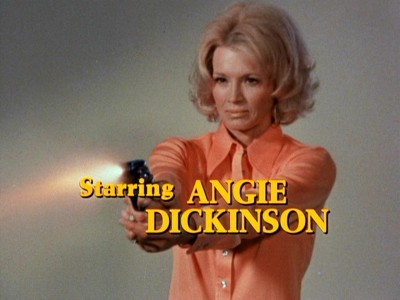
Angie Dickinson is Police Woman (1974-1978)


Police Woman was an American Police drama series that starred the beautiful Angie Dickinson that ran on NBC for four seasons, from September 13, 1974, to March 29, 1978. Based on an original screenplay by Lincoln C. Hilburn, the show revolves around Sergeant. "Pepper" Anderson (Angie Dickinson), an undercover police officer working for the Criminal Conspiracy Unit of the Los Angeles Police Department. Sergeant William "Bill" Crowley (Earl Holliman) was her immediate superior, and Pete Royster (Charles Diekrop) and Joe Styles (Ed Bernard) were the other half of the undercover team that investigated everything from murders to rape and drug crimes. In many episodes, Pepper went undercover (as a prostitute, nurse, teacher, flight attendant, prison inmate, dancer, waitress, etc.) in order to get close enough to the suspects to gain valuable information that would lead to their arrest.

Although Dickinson's character was called Pepper, sources differ as to the legal given name of the character. Most sources give the characters legal name as Suzanne. Others give it as Leanne or Lee Ann. The Police Story episode entitled "The Gamble", which serves as a pPeppilot for Police Woman, gives Dickinson's character's name as "Lisa Beaumont". On the Season 1 DVD release of Police Woman, Dickinson states that she and producers decided not to go with the name Lisa Beaumont when the series first went into production and came up with the name Pepper.

Police Woman became the first "successful" hour-long drama series in American primetime television history to feature a woman in the starring role. This helped to make Dickinson a household name.
Police Woman was a spin-off of the Police Story (1973-1978) anthology series. Police Woman was so successful in its first season in particular, that during the first spring and summer rerun period, the show hit number one in the Nielsen's ratings. The success of Dickinson starring in an hour-long TV drama series gave the networks confidence that women can actually carry an hour-long series. This paved the way for more (albeit fanciful) 1970s shows starring women, such as Charlie's Angels, Wonder Woman and The Bionic Woman, as well as the more serious Cagney & Lacey in the 1980s.
"Police Woman" caused an avalanche of applications for employment from women to police departments around the United States. Sociologists who have in recent years examined the inspiration for long-term female law enforcement officials to adopt this vocation as their own have been surprised by how often "Police Woman" has been referenced.
In February 1976, President Gerald Ford re-scheduled a Tuesday press conference so as not to delay an episode of Police Woman, reportedly his favorite show.

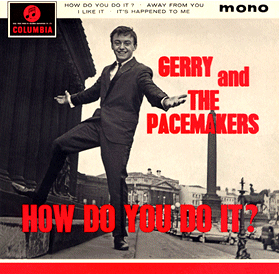
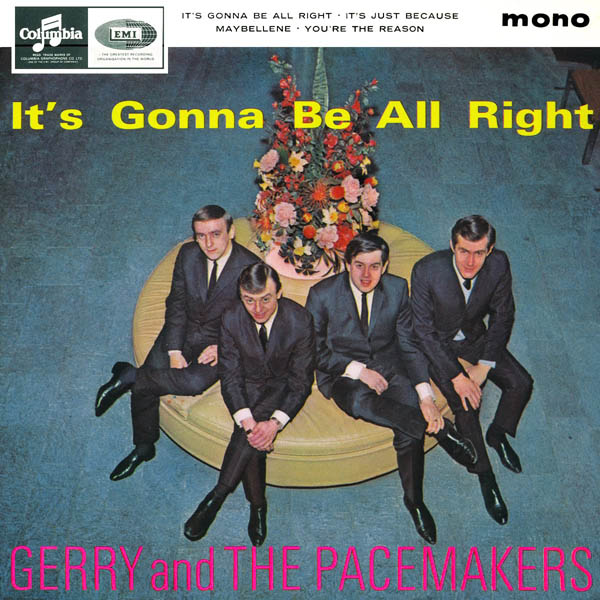
The Mersey Beat - Remembering Gerry & The Pacemakers

File:Gerry and the Pacemakers group photo 1964.JPG
Gerry and the Pacemakers were a British Beat Music group prominent during the 1960s. In common with The Beatles, they came from Liverpool, were managed by Brian Epstein and recorded by George Martin. They are most remembered for being the first act to reach number one in the UK singles chart with their first three single releases. It was a record that was not equalled for 20 years, until the mid-80s success of fellow Liverpool band Frankie Goes to Hollywood. According to Billboard Magazine, the group is the second most successful band to originate from Liverpool next to The Beatles.
Gerry and The Pacemakers - How Do You Do It?
Gerry Marsden formed the group in 1959 with his brother, Fred, Les Chadwick and Arthur McMahon. They rivalled The Beatles early in their career, playing in the same areas of Hamburg, Germany and Liverpool, England. McMahon (known as Arthur Mack) was replaced on piano by Les Maguire around 1961. They are known to have rehearsed at Cammell Laird shipping yard at Birkenhead. The band's original name was Gerry Marsden and The Mars Bars, but they were forced to change this when the Mars Company, producers of the chocolate Mars Bar, complained.
The band was the second to sign with Brian Epstein, who later signed them with Columbia Records (a sister label to The Beatles' label Parlophone under EMI). They began recording in early 1963 with "How Do You Do It?", a song written by Mitch Murray that Adam Faith had turned down and one that The Beatles chose not to release (they did record the song but insisted on releasing their own song, "Please, Please Me"). The song was produced by George Martin and became a number one hit in the UK, the first by an Epstein Liverpool group to achieve this on all charts, until being replaced at the top by "From me to You", The Beatles' third single.
Gerry and The Pacemakers' next two singles, Murray's "I Like It" and Rodgers and Hammerstein's"Youll Never Walk Alone'", both also reached number one in the UK Singles Chart, the latter recorded instead of The Beatles' "Hello Little Girl", which went on to become the first hit for The Fourmost. "You'll Never Walk Alone" had been a favourite of Gerry Marsden's since seeing Carousel growing up. It soon became the signature tune of Liverpool Football Club. To this day, the song remains a football anthem, there and elsewhere, a phenomenon due to Gerry Marsden, rather than its Broadway composers.
Despite this early success, Gerry and The Pacemakers never had another number one single in the UK. Gerry Marsden began writing most of their own songs, including "It's Gonna Be All Right", "I'm the One", and "Ferry Cross the Mersey", as well as their first and biggest US hit, "Don't Let The Sun Catch You Crying", which peaked at No4, and which Gerry Marsden initially gave to Decca recording artist Louise Cordet in 1963. She recorded the song (Decca F11824), but without commercial success. The song, written by all bandmembers, has also been covered by Les Carle, The Lettermen, Jackie Deshannon) This is Jack DeShannon album, 1965), Jose Feliciano, Dr Jonh, Ricky Lee Jones, Gloria Esterfan(Hold Me, Thrill Me ,Kiss Me album) among others.
They also starred in an early 1965 film called Ferry Cross the Mersey (sometimes referred to as "Gerry and The Pacemakers' version of A Hard Day's Night"), for which Marsden wrote much of the soundttrack. The title song was revived in 1989 as a charity single for an appeal in response to the Hillsborough Football crowd disaster, giving Marsden - in association with other Liverpool stars, including Paul McCartney and Frankie Goes to Hollywood's Holly Johnson - another British number one.
In the US, their recordings were released by the small New York record label Laurie in 1963, with whom they issued four singles during 1963 without success (as listed below). When The Beatles broke through in January 1964, Laurie's next regular single release of "Don't Let The Sun Catch You Crying" became a big hit and during 1964 Laurie coupled "How Do You Do It?" with "You'll Never Walk Alone" (Laurie 3261) and "I Like It" with "Jambalaya" (Laurie 3271) with some success.
By late 1965, their popularity was rapidly declining on both sides of the Atlantic. They disbanded in October 1966,] with much of their latter recorded material never released in the UK. Drummer Freddie Marsden born Fredrick John Marsden, 23 November 1940, at 8 Menzies Street, Toxteth, Liverpool died on 9 December 2006 in Southport, age 66.
In 1963 Gerry Marsden was quoted as saying, "The Beatles and ourselves (The Pacemakers) - we let go when we get on stage. I'm not being detrimental, but in the South, I think the groups have let themselves get a bit too formal. On Merseyside, it's beat, beat, beat all the way. We go on and really have a ball."

Sid on the TV Times (1975)


This classic TV Times cover comes from January 4th-7th 1975 and gracing the cover are Sid James & the Carry On gang.  Carry On Laughing appeared for two series on the ITV network this particular year.  The series' comprised of 13 half hour segments of compilations from the Carry On series.

By 'eck chuck. It's Elsie on the TV Times (1964)


By 'eck chuck, it's Pat Phoenix as the legendary Elsie Tanner gracing the cover of this edition of the TV Times from way back in 1964.

Sunday, 25 March 2012

Kelloggs Sugar Smacks (1966)


Back to 1966 and the popular breakfast cereal at that time, Sugar Smacks.  Coming free in the Sugar Smacks packs were these 3-D cut out models of the classic puppet series, Thunderbirds.  To think, these were all the rage back in those days.  Whatever would the sophisticated kids of today make of 'em? 

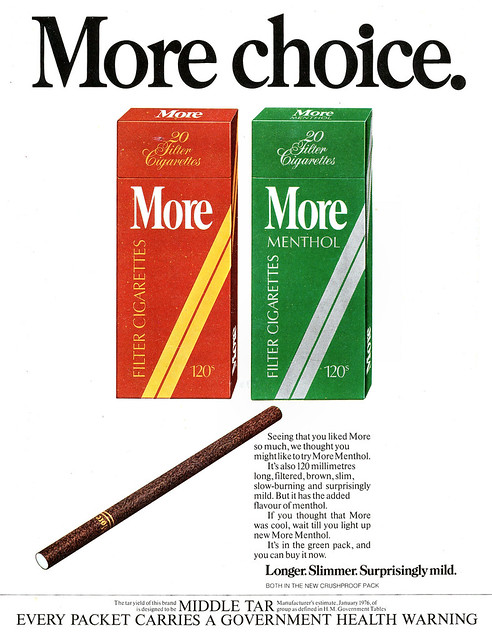
When Life Was One Big Drag! (More Cigarettes - 1976)


Back to 1976 and long before the advertising of cigarettes became illegal.  More cigarettes looked more like liquorice sticks than cigarettes.  I remember the Menthol cigarettes because I used to smoke them, before I gave up the ghost!

Saturday, 24 March 2012

The Matchbox Streakers Set (1975)

Every kid kid growing up in the Seventies had Matchbox cars. This ad comes from 1975. The new Matchbox Streakers set with six models to collect. Altogether, the Matchbox 75 range of superfast Rola-Matic gave you 75 models to collect.

The Persuaders - Episode Eight - Take Seven (1971)


Real or fake? Danny and Brett find it explosively dangerous when trying to help a girl whose long-missing brother apparently has a rightful claim to the estate she has inherited. The outcome is surprising. The legal verdict is clear. Mark Lindley (Christian Roberts) is the man he claims to be - the long-missing brother of Jenny Lindley (Sinead Cusack), who has inherited the wealthy Lindley estate left a number of years back on the death of her parents. Now she has nothing. Under the terms of the will, Mark is the sole legate.

Judge Fulton (Laurence Naismith) is not so sure, though, that theverdict is right. He believes Jenny when she says her brother is dead. Is Markreal or fake? His own story is undoubtedly convincing. And when Danny Wilde(Tony Curtis) and Brett Sinclair (Roger Moore) are persuaded by the Judge toinvestigate, they are also inclined to side with the attractive Jenny - much totheir discomfort, as they soon discover when they meet her and shots are firedthrough the window at them.
Mark, it seems, is ready to use violence to protect his interests. Yet he has a cast-iron alibi for the night of the shooting. Taking it from there, Danny and Brett seek the assistance of a contact known as The Farmer (Victor Platt), who first of all warns them that they are being followed by a private eye named Peter Hayward (Garfield Morgan) and later takes them to the house occupied by the man they are seeking, a professional killer called "The Major" (Colin Vancao). They come close to being his next victim (sic) - then, without warning, he topples forward dead, shot in the back.
Jenny's lawyer David Conron (Richard Hurndall) is the next link in the chain when he 'phones a message to Brett asking him to go to a farm. The farmer is a nephew of the Lindley's former nurse and he has his diary, and although an attempt is made to kill Conron and destroy the diary, it fails.
Meanwhile, Danny has discovered that Jenny has gone to Mark's apartment. He gets this message through to Brett, and both make for the house to find Mark and Jenny engaged in a cat-and-mouse game of murder. By now, Brett knows the truth. The secret has been revealed in the nurse's diary.
But can he and Danny prevent another murder? They also have some reckoning to do with the double-crossing private detective, Peter Hayward.

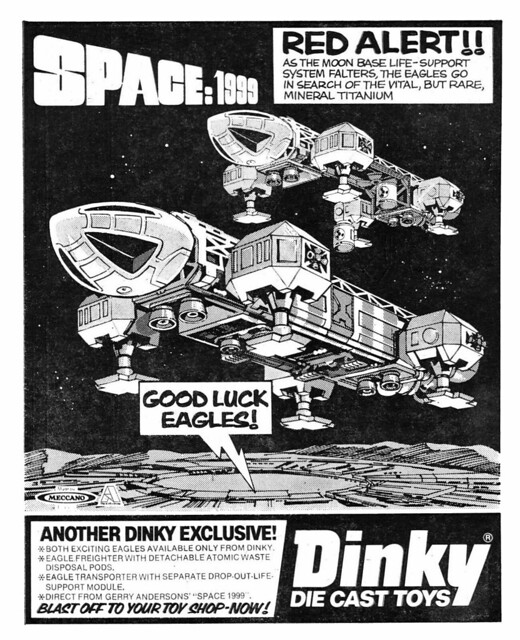
Red Alert! Dinky Eagles (1977)


Do you remember Space 1999?  Of course you do.  This classic ad dates back to the good old days known as 1977 and being advertised are Dinky Die Cast Eagles.  Eagle Freighter with detachable Atomic Waste Disposal Pods.  Eagle Transporter with separate Drop Out Life-Support Module.

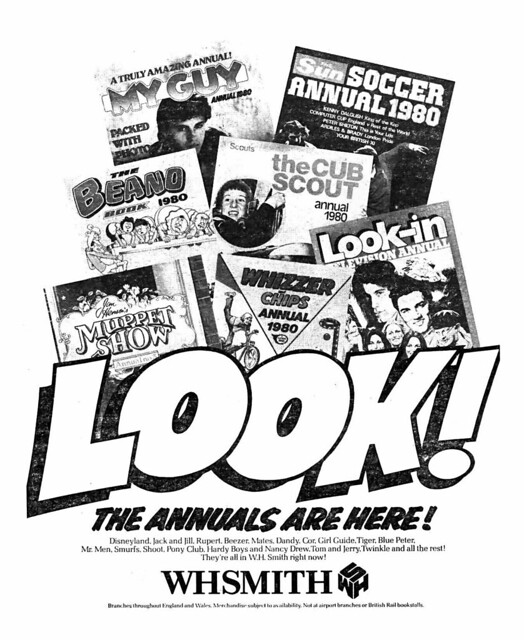
The Annuals are here! (1979)


This classic add for WHSmith dates back to 1979.  Being advertised are Annuals ready for the Yuletide season.  Annuals included are, Look-in Television Annual, The Muppet Show, The Beano, Whizzer & Chips & the Cub Scout.

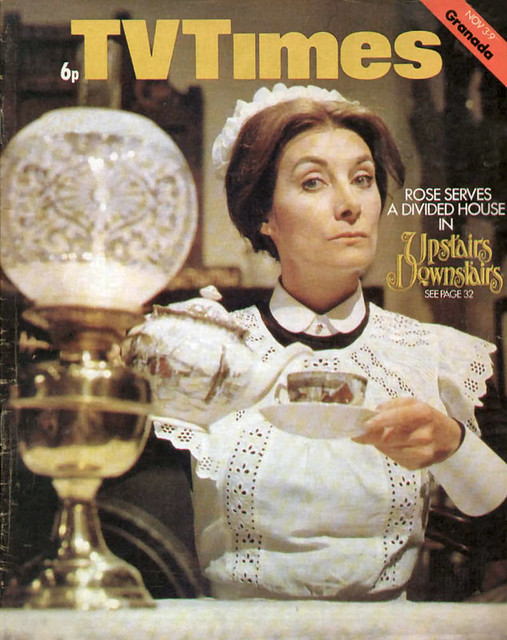
TV Times - Upstairs, Downstairs (1973)


This classic cover from the TV-Times dates back to 1973 and gracing the cover is Jean Marsh as Rose in the classic LWT series. Upstairs, Downstairs.  All this for just 6p!

Tuesday, 20 March 2012

The Day of the Jackal (1973)


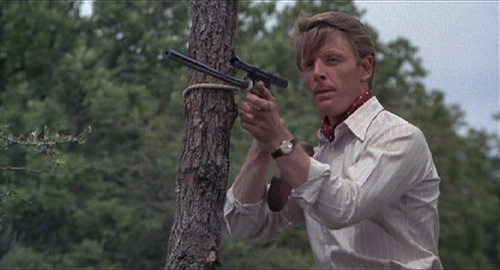
The Day of the Jackal the 1973 Anglo-French film, set in August 1963 was based on the novel of the same name by Frederick Forsyth. Directed by Fred Zinnemann and starred Edward Fox as the assassin known only as "The Jackal" who is hired to assassinate Charles de Gaulle.

The film opens with the recreation of an actual event, the assassination attempt on the President of France, Charles de Gaulle, on 22 August 1962, by the militant French underground organisation OAS in anger over the French government's decision to give independence to Algeria. The group, led by Jean Bastien Thiry, raked de Gaulle's car, an unarmoured Citroen DS, with machine gun fire in the Paris suburb of Petit - Clamart, but the entire entourage escaped without injury. Within six months, Bastien-Thiry and several other members of the plot were caught and executed.
The remaining OAS leadership decides to make another attempt, and hires a professional assassin who chooses the code name The Jackal (Edward Fox). He demands half a million US dollars for his services, so to raise the Jackal's fee, OAS members rob several banks. Meanwhile, the Jackal commissions a rifle disguised as a crutch and fake identity papers. (Notably, he spares the reliable gunsmith but murders the forger who tries to blackmail him.) In Paris, he sneaks an impression of the key to a flat that overlooks a large square (where de Gaulle will make an appearance on Liberation Day).
The French service d'Action Civique (referred to throughout as the Action Service) identify and kidnap the OAS chief clerk, Adjutant Viktor Wolenski (Jean Martin) in Italy. They use torture to extract some elements of the plot, including the word "Jackal", before Wolenski dies.
Interior Minister (Alan Badel) convenes a secret cabinet. The police commissioner recommends the brilliant detective deputy commissioner Claude Lebel (Michael Lonsdale). He will have any resources he needs but must avoid publicity. One of the cabinet members, named St. Clair, unsuspectingly discloses the government's knowledge of the plot to his new mistress (Olga Georges Picot), an OAS palnt who immediately passes this information on to her contact.
Lebel uses an old boy network of police agencies in other countries to determine that suspect "Charles Calthrop" may be travelling under the name "Paul Oliver Duggan" and that Duggan has entered France.

The Jackal decides to carry on with his plan despite the fact that his code name is known. He meets and seduces Colette de Montpellier (Delphine Seyrig) in a Grasse hotel. Slipping away before Lebel arrives, he steals a Peugeot 404 that collided with his Alpha Romeo Guilietta and drives it to Madame de Montpellier's estate. After sleeping with her again and discovering that the police had talked to her, he strangles her. The Jackal then assumes a new identity as a bespectacled Dane, using a stolen passport. He drives Madame de Montpellier's Renault Caravelle to a station and catches a train for Paris.
Once the lady's servants discover her corpse and her car is recovered at the train station, Lebel is able to make an open manhunt for a murderer. But the Jackal makes it to Paris, slips into a cab and, avoiding hotels now, goes to a bath house, where he allows himself to be picked up by a man and taken to the man's flat.
At a meeting with the assembled cabinet, Lebel plays the tape of a phone call made from the house of one of the cabinet members. The cabinet hears St. Clair's mistress passing along information about the manhunt to her OAS contact. St. Clair acknowledges that the call was made from his house and leaves in disgrace. Another cabinet member asks Lebel how he knew which phone to tap, to which he replies that he didn't, so he tapped them all.
Lebel further reveals that the Jackal will most likely attempt to shoot de Gaulle in three days, when the president will make several appearances for Liberation Day.

Meanwhile, the Jackal kills the man who picked him up at the bathhouse after a television news flash reveals him to be wanted for murder.
On Liberation Day, the Jackal, disguised as an elderly veteran amputee, shows his forged papers and is allowed through to enter the apartment building he had cased earlier. He takes up a position at the window of the upper apartment. De Gaulle enters the square to present medals to veterans of the Resistance.
Lebel meets the policeman who met the disguised Jackal and becomes alarmed. As de Gaulle presents the first medal, the Jackal shoots but the bullet misses him because at that moment the president leans over to kiss the recipient on the cheek. Lebel and the policeman burst in to the room, the Jackal turns and shoots the policeman, Lebel uses the policeman's MAT-49 submachine gun to kill the Jackal as he tries to re-load his rifle.
Back in Britain, the real — and completely unrelated to the case — Charles Calthrop (Edward Hardwicke) walks in on the police in his flat. As the Jackal's coffin is lowered into a grave, the authorities wonder, "But if the Jackal wasn't Calthrop, then who the hell was he?"

The film was expensive to produce, as it was filmed in numerous locations throughout Europe. The French government was extremely helpful in the filming of the movie, providing soldiers and use of exclusive locations for the filming of the final Liberation Day sequence. Fred Zinnemann wrote that Adrian Cayla-Legrand, the actor who played de Gaulle, was mistaken by several Parisians for the real thing during filming — though de Gaulle had been dead for two years prior to the film's release. The sequence was filmed during a real parade, leading to confusion; the crowd (many of whom were unaware that a film was being shot) mistook the actors portraying police officers for real officers, and many tried to help them arrest the "suspects" they were apprehending in the crowd.
Although the story takes place in 1962 and 1963, the filmmakers made no efforts to avoid showing car models whose production began later, for example Peugeot 504 (built from 1968), Renault 12 (built from 1969), and a Fiat 128 (1969).

Zinnemann was pleased with the film's reception at the box office, telling an interviewer in 1993, "The idea that excited me was to make a suspense film where everybody knew the end - that de Gaulle was not killed. In spite of knowing the end, would the audience sit still? And it turned out that they did, just as the readers of the book did."
Among those who praised the film was Roger Ebert of the Chicago Sun-Times, who gave the movie his highest rating of 4 stars, writing, "Zinnemann has mastered every detail... There are some words you hesitate to use in a review, because they sound so much like advertising copy, but in this case I can truthfully say that the movie is spellbinding." Ebert would later include the movie at No7 on his list of the Top 10 films of the year.
Some critics have seen visual and thematic similarities between the film and the John F. Kennedy Assassination. These include the shot of the exploding watermelon during the Jackal's target practice, the man being carted away by an ambulance during the parade (recalling a similar incident in Dealey Plaza), and the presence of a magazine with JFK's picture on the cover in the hotel scene. Also, the setting is in August 1963, three months before Kennedy's death. Save the last, these were not evident in the original novel.

Did You Know Your Green Cross Code?


How many of you remember The Green Cross Code Man? The Green Cross Code Man (sometimes known simply as "Green Cross") was a costumed superhero character created in 1975 as an aid to teaching young children the Green Cross Code, and for promoting general road safety. British Actor David Prowse MBE a Bodybuilder and former Mr Universe (and the actor best known for his portrayal of Darth Vader in the Star Wars films) is famous for his realisation of the character in a well-known series of Public Information Films (PIFs) sponsored by the Central Office of Information for the UK Department of the Environment. The light-hearted spots ran on UK Television from 1975 to 1990.

In the films, Green Cross Man character has the power to teleport from his monitoring station at Green Cross Control to any location where youths are in need of pedestrian safety instruction. He accomplishes this by use of a wristwatch-like "Dematerialiser"device. On these missions he is sometimes accompanied by a whimsical robot companion. His signature exclamation of surprise or disbelief is "Green Crosses!" and his slogan is "I won't be there when you cross the road / So always use the Green Cross Code." Green Cross Man, played by Prowse, was later to guest in an episode of BBC2's Fantasy Football League - a Phoenix From the Flames recreation of a goal by Gerry Francis in a Home International against Scotland (the main premise being that Francis tended to look from side to side during interviews - as was advised by Green Cross Man in his adverts).

In 1976, the late, great Jon Pertwee famous as the Third Doctor on the TV series Doctor Who, appeared in a PIF for the Green Cross Code introducing the mnemonic "SPLINK", which appeared to stand for:
  • (Find a) Safe (place to cross)
  • (Stand on the) Pavement
  • Look (for traffic)
  • If (traffic is coming, let it pass)
  • (When there is) No (traffic near, walk across the road)
  • Keep (looking and listening for traffic as you cross).
In 1983, the television adverts employed a "Green Cross Code" rap based on the hit "The Message by Grandfather Flash. The original lyrics of "Don't push me cos I'm close to the edge" were replaced with "Don't step out when you're close to the edge." The advert was re-released for its 10th anniversary in 1993 with slightly different lyrics.