Thursday, 28 April 2011

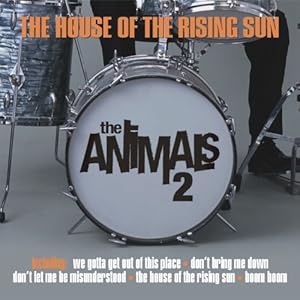
The Animals - House Of The Rising Sun: 1964

The house of the rising sun was recorded and made famous by The Animals in 1964. The Animals were group from Newcastle in the North of England. Their version of this old folk song was to become a classic of the sixties reaching No1 in the charts both in the UK and later that year in the US.

House of the Rising Sun

Recorded in one take it ran to four and a half minutes, far too long for a single according to the standards of the day but Mickie Most, the producer, considered it so good that it had to be released in complete form. The pundits were proved wrong and it did get played on the radio in it's full uncut form.Initially it was released cut down in the US but was later re-released in it's full length version.

The song has fascinated many people partly because it's origins are obscure. People have tried without much success to identify the original house of the rising sun the song referred to and several possibilities have been suggested but the song varies depending on whether it is sung from a male or female perspective so it could refer to a house of ill repute, a gambling den or even a jail.

House Of The Rising Sun

Various versions have been released. The Animals arrangement remains one of my own favorite songs of all time but the hauntingly beautiful version by Sinead O'Conner comes close.

To Sir with love - 1967

To Sir With Love
A 1967 film produced, written and directed by James Clavell and based on the novel by E. R. Braithwaite. The 105 minute British colour film was distributed by Columbia and the music was by Ron Grainger. Braithwaite was born in Guyana and after the war, like many skilled members of an ethnic minority, he had difficulty finding work, so he ended up as a teacher at an East End school. His experiences there were published in his book ‘To Sir With Love’ in 1959.
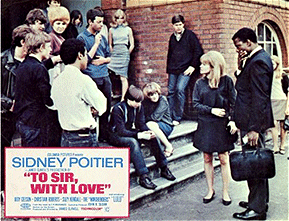
The cast comprised Sidney Poitier as Mark Thackeray, Christian Roberts as Bert Denham, Lulu as Barbara ‘Babs’ Pegg, Adrienne Posta as Moira Joseph, Judy Geeson as Pamela Dare and Suzy Kendall as Gillian Blanchard. The soundtrack was issued on Fontana TL 5446 and contained four songs by Lulu and two by the Mindbenders. In some ways this was a British equivalent of ‘The Blackboard Jungle’, but not as dark. It also featured one of that earlier film’s actors, Sidney Poitier, in the leading role. The musical content, rather than the ‘rebellious’ rock ‘n’ roll of Bill Haley & His Comets, mirrored the sentimentality of the film with Lulu’s rendition of the title song which became a No. 1 hit for her. Lulu also had a small acting role in the film and Manchester group The Mindbenders performed during the end-of-term school dance sequence with ‘Off and Running’ and ‘It’s Getting Harder All The Time.’ The story tells of a young African engineer from British Guyana, unable to find a post in his own profession, mainly because of colour prejudice, who becomes a teacher at North Quay Secondary, an East End school with a classroom of tough 16-year-old youngsters, disillusioned and rebellious because of the limited opportunities before them due to their environment and background.
Even on his first day he is warned of the problems he faces as his predecessor resigned because of the hostile attitude of the kids towards anyone in authority. Thackeray is initially frustrated by their apparent lack of interest and their disruption of his classes: they slam their desk tops, walk out of class without asking for permission and generally show a lack of interest in their lessons.
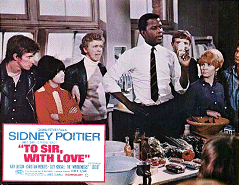
To Sir With Love
When he finds the girls burning tampons in the classroom stove he erupts, sends the boys out of the room and gives the girls a piece of his mind before retreating to the staff room where he feels guilty about losing his temper. As a result he then begins to use unorthodox teaching methods and builds up the youngsters' self respect, treating them as young adults and getting them involved in dialogue. When another teacher, Mr Bell, forces an overlarge boy to jump a hurdle when it is obviously beyond the lad’s capabilities, the boy falls and breaks the hurdle. Furious, another boy attacks the teacher with a broken piece of wood.
Thackeray intervenes, tells the teacher off and advises the boy that he shouldn’t lose his temper. Denham, the most disruptive boy in the class challenges Thackeray to a boxing bout. Thackeray was once a Golden Gloves contender and floors him with a single blow. Thackeray helps him up and begins to gain the boy’s respect. Gradually, teaching his students as young adults and getting them to respect each other begins to pay rewards. There were other little sub-plots – the death of a boy’s mother, who is black, also indicates the racism of the time, but is overcome when the entire class attend the funeral.
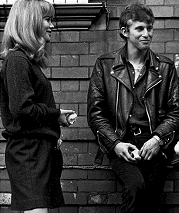
Judy Geeson and Christian Roberts
Thackeray has a mild flirtation with Gillian, one of the other teachers and one of his students, Pamela, has a crush on him.When Thackeray receives a letter offering him a job with an engineering company, he has a decision to make: to work in his chosen profession, or to continue to communicate with youngsters and help them to be better prepared for their future. He decides to stay and at the end of term dance, he is paid a tribute when one of his students, Barbara, sings a song she has written about him, ‘To Sir With Love.’ After bidding his students farewell, he comes across a sullen youngster who declares, ‘I’m in your bleeding class next term’ and realises his work is cut out for him.

To Sir With Love
The soundtrack was issued in 1967 and a CD released on 11th January 2000. The tracks were:
Side One: ‘To Sir With Love’, Lulu; School of Break Dancing; ‘Stealing My Love From Me’, Lulu; Thackeray Meets Faculty, Then Alone; Music From Lunch Break; ‘Off and Away’, The Mindbenders; Thackeray Loses Temper, Gets An Idea; Museums Outings Montage; ‘To Sir With Love’, Lulu.
Side Two: A Classical Lesson; Perhaps I Could Tidy Your Desk; Potter’s Loss of Temper In Gym; Thackeray Reads Letter About Job; Thackeray and Denham Box In Gym; The Funeral; End of Term Dance; ‘It’s Getting Better All the Time’, The Mindbenders; ‘To Sir With Love’, Lulu.

Wednesday, 27 April 2011

The Carry On Legacy - Carry On Nurse: 1958

landscape image
After the unexpected box-office success of Carry On Sergeant (1958), the team of producer Peter Rogers, director Gerald Thomas and screenwriterNorman Hudis quickly came up with another comedy using the same template, this time set in an NHS hospital. Carry On Nurse (1959) was financially even more successful than the first, and a surprise hit in America, leading to a five-year contract for Rogers and Thomas to provide more of the same.
landscape image
They subsequently repeated its popular formula directly in such medically-themed films as the near-remake Carry On Doctor (d. Thomas, 1967), as well as Carry On Again Doctor (d. Thomas, 1969) and Carry On Matron (d. Thomas, 1972).
landscape image
Like the previous film, Carry On Nurse was based on a pre-existing property owned by Rogers - Ring for Catty, written by Jack Searle and actor Patrick Cargill - and once again features a pair of romantic lovers (Shirley Eaton and Terence Longdon, who both appeared in Sergeant), around which a series of comic and sentimental episodes are loosely stitched together. The glue that binds the film is the Greek chorus of character comedians, many of whom simply reprise their roles fromCarry On Sergeant.
landscape image
Once again, Kenneth Williams is the supercilious intellectual, Kenneth Connor is the 'little man', Charles Hawtrey the campy outsider and Hattie Jacques the no-nonsense authoritarian matron. To these are added Leslie Phillips, (who, playing a character named Jack Bell, utters his immortal catchphrase "Ding dong, you're not wrong" when his name is called out), while Joan Sims makes the first of her 24 Carry On appearances as an accident-prone trainee nurse.
landscape image
It is probably best remembered, however, for its notorious final gag, in which the nurses decide to get even with the overbearing Colonel, played by Wilfrid Hyde-White, by replacing a rectal thermometer with a daffodil.
landscape image

THE

MONTHLY FILM BULLETIN

Published by

THE BRITISH FILM INSTITUTE

Volume 26, No.303, April 1959, page 45

CARRY ON NURSE (1958)

The nurses of a men's surgical ward at the Haven Hospital have equal difficulty in resisting the advances of their charges and meeting the demands of their martinet Matron. Individual pursuits among the patients range from nuclear physics to studying racing form, but these are eventually forgotten in the collective pursuit of an unofficial operation on the bunion of a new patient, anxious for a speedy discharge so that he can enjoy a gay weekend. This operation, performed in a general state of intoxication, is not a success, since all concerned succumb to laughing gas.

A somewhat stale farce, mixing slapstick, caricature and crudely anatomical humour, puts life in a public hospital ward into the same cheerlessly rollicking category as the barrack-room. Predictably, the main butt is Matron, and at least one sequence implies a strongly intended criticism of the type of Matron who makes a fetish of details that have no real bearing on the patients' well-being whatever.


The Monthly Film Bulletin was published by the British Film Institute between 1934 and 1991. Initially aimed at distributors and exhibitors as well as filmgoers, it carried reviews and details of all UK film releases. In 1991, the Bulletin was absorbed by Sight and Sound magazine.


Pussycat - Mississippi: 1975


The seventeen and a half year old girls had been telephone operators in Limburg, whilst Theunissen, Wetzles and Coumans were in a group called Scum. Wille played in a group called Ricky Rendall and His Centurions until he married Tonny, and created the group Sweet Reaction that eventually became known as Pussycat.

In 1975 they scored a big European hit with the song "Mississippi". However they had to wait a further year for the single to make the British charts when it climbed to Number One in the UK Singles Chart in October 1976. Penned by Werner Theunissen, the septet became the first Dutch act to top the UK Chart. It is estimated that "Mississippi" sold over five million copies worldwide. It was later followed by "Smile" in 1976, and "Hey Joe" in 1978. Others hits were "If You Ever Come to Amsterdam", "Georgie", "Wet Day in September" and "My Broken Souvenirs". A stellar European career followed that ultimately, at its peak, spanned ten years and included some seventeen albums. By 1978 Hans Lutjens had replaced Coumans on drums, as the band continued to release albums and tour, travelling as far afield as South Africa. They made regular appearances on the West German TV Series, Musikladen, in the late 1970s and early 1980s.

But as the 1980s rolled along, the sisters found it increasingly difficult to finance huge tours with so many Musicians, and replaced their backing band with taped music, and thus Pussycat shifted their image one last time. They continued to play and record through the mid 1980s when they finally disbanded.

Tonny, whose own extra curricular activities had commenced back in 1973 with her own single release "For You" (under the alias Sally Lane), proved especially prolific, unleashing a string of albums, of which New Words to an Old Love Song saw her elected Best Female Country Singer of the Year by the Dutch magazine, Country Gazette.


The Wednesday Play - Cathy come home: 1966

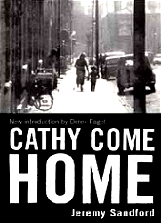
A harrowing television play which generated great controversy when it was first transmitted in Britain on BBC TV in November 1966 as part of the ‘Wednesday Play; series. It was Tony Garnett’s first ‘Wednesday Play’ as a producer and was directed by Ken Loach. Writer Jeremy Sandford had investigated the plight of the homeless and its effect on family life.
Jeremy Sandford's drama about a young family's slide into homelessness and poverty was a defining moment in 1960s television, demonstrating how far drama could influence the political agenda. The controversy generated by Cathy Come Home led to public outrage at the state of housing in Britain, and gave a welcome boost to the (coincidental) launch of the homelessness charity Shelter a few days after the play was first broadcast, as part of the BBC's The Wednesday Play strand.
landscape image

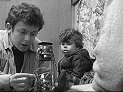
The play follows young lovers Cathy and Reg from the optimism of their early married days through a spiral of misfortune that follows Reg's work accident, leading to eviction and separation, and culminating, in what remains one of TV's most memorable scenes, in a hysterical Cathy having her children forcibly taken away by Social Services.

The success of Cathy established director Ken Loach as a politically committed filmmaker standing apart from the commercial mainstream, and demonstrated again his sensitivity to his usually working-class characters.

With its abandonment of the confines of the studio in favour of location filming, and its innovative use of documentary techniques - owing something to the Free Cinema movement associated with filmmakers likeLindsay Anderson and Karel Reisz - Cathy played an important part in the development of television drama at a time when writers were attempting to take the form into a new territory, distinct from its theatrical origins.Loach himself had been attempting to break free of the usual restrictions of TV drama since the early '60s, notably with the series Diary of a Young Man (BBC, 1963) and an earlier Wednesday Play, 'Up the Junction' (BBC, tx. 3/11/1965), which also starred Carol White (as did his first cinema release, Poor Cow (1967)).

landscape image landscape image

While some critics remained uncomfortable about the blurring of the distinction between drama and documentary, there was little argument about the play's power. If anything, its reputation has grown in the years since it first appeared - in September 2000, Cathy Come Home came in second place in the Britsh Film Institute's TV 100 poll of industry figures, behind Fawlty Towers.

landscape image

Loach returned to similar themes in his 1994 film Ladybird, Ladybird.Sandford continued his crusading approach with the similarly powerfulEdna: the Inebriate Woman (BBC, 1971).

Cloppa Castle: 1978

Cloppa Castle

Cloppa Castle Cloppa Castle
Cloppa Castle oil well Cloppa Castle
Cloppa Castle Cloppa Castle
Shown on ITV back in 1978 this fantastic little puppet series was excellent and I had no idea that it was over Thirty years old. There you go, that old saying about time flying!

Each episode lasted approximately 10 minutes and there were several dozen episodes made. The very first episode has Queen Ethelbruda's ghost appearing and we are shown Cloppa Castle is a state of ruin. I'm not sure why but seeing this again made me a little sad. The Queen decides to show us what the castle used to be like, full of people and ideas even though they were constantly at war.
Each episode concerned the goings on at a fort called Cloppa Castle. The castle is medieval and owned by the Byegones who are under what seems like a permanent siege from the bad guys called Hasbeenes. The Byegones are ruled by Queen Ethelbruda and King Woebegone, although early on it is clear that Ethelbruda wears the trousers in this relationship. King Woebegone is quite happy just to sit back and relax, leaving the more strategic decisions to his wife. One of his main duties that he very often forgets to do is inspecting the troops each day. Occasionally we see him emerge from "ye old wine cellar" in the castle basement or doing a spot of fishing in the local river. The King and Queen have a son called Prince Idelbone presumably named because he rarely gets out of bed before noon. They also have and a bit of a space cadet for a daughter called Princess Tizzibel.
The actual brains and guts of the castle comes next lead by Royal wizard called Mudlin who spends most of his time in his lab beneath the castle grounds. There is a court jester called Jest A Minit who tries very little to crack jokes and those he does crack are not worth hanging around for. The main brains of the outfit is the Royal inventor called Cue-Ee-Dee (the name of the door of his laboratory). The inventor is often helped by a bright young pageboy called Albright. The Royal security and indeed all castle security is managed by the head soldier called Elbow. He orders the other soldiers around especially Osmosis and Kippo. The Castle is set in a kingdom with other castles as one of the more friendly neighbours is King Cedric the Depleted.
The cause of the conflict is oil. The Byegones were digging for water inside the castle when they accidently struck oil. Cue-Ee-Dee constructed an oil Derrick to extract the oil and as a result of the new found wealth of the Byegones, the Hasbeenes are determined to get it for themselves. The Hasbeenes are the arch enemies of the Byegones and are hell bent upon usurping the throne and laying claim to the oil resources found beneath the castle grounds. Hence they spend most of their time outside the castle thinking up plans to get inside.

The Characters
Quen Ethelbruda
(Queen Ethelbruda)

The King Woebegone
(King Woebegone)

Prince Idelbone
(Prince Idlebone)

Princess Tizzibel (Tizzi for short)
(Princess Tizzibel)

Cue-ee-dee - the inventor
(Cue - Ee - Dee)

Albright - clever and quick thinking
(Albrite)

The Court Jester
(Jest a Minit)

Mudlin the Wizard
(Mudlin)

Osmosis - small castle guard
(Osmosis)

Prince Wolfnot - once fiance to Princess Tizzi
(Prince Wolfnot)

The leader of the Hasbeenes is Beosweyne. He is a black bearded warrior, the strongest of his clan. His right hand man is called Hench but the rest of the army are nothing short of a rabble. The rules are simple - all is fair in love and war and the battles commence each day irrespective of time of day or weather. That is until the clock strikes three. Then everything stops for tea for about half an hour before war recommences.

Cloppa Castle credits

Cloppa Castle credits

Cloppa Castle credits

Cloppa Castle credits

Cloppa Castle credits

Cloppa Castle credits

Cloppa Castle credits

Cloppa Castle credits

Cloppa Castle credits