


In a 1950 radio episode of You Bet Your Life, Groucho states that he was born in a room above a butcher's shop on 78th Street in New York City.
The Jewish Marx family grew up on East 93rd Street off Lexington Avenue in a neighborhood now known as Carnegie Hill on the Upper East Side of the borough of Manhattan, in New York City. The turn-of-the-century building that Harpo called "the first real home they ever knew" (in his memoir Harpo Speaks) was populated with European immigrants, mostly artisans. Just across the street were the oldest brownstones in the area, owned by people such as the well-connected Loew Brothers and William Orth.
Groucho's parents were Minnie Schoenberg Marx and Sam Marx (called "Frenchie" throughout his life because of his birthplace, Alsace-Lorraine). Minnie's brother was Al Schoenberg, who shortened his name to Al Shean when he went into show business as half of Gallagher and Shean, a noted Vaudeville act of the early 20th century. According to Groucho, when Shean visited he would throw the local waifs a few coins so that when he knocked at the door he would be surrounded by adoring fans. Marx and his brothers respected his opinions and asked him on several occasions to write some material for them.

Minnie Marx did not have an entertainment industry career, but had intense ambition for her sons to go on the stage like their uncle. While pushing her eldest son Leonard (Chico Marx) in piano lessons, she found that Julius had a pleasant soprano voice and the ability to remain on key. Even though Julius's early career goal was to become a doctor, the family's need for income forced Julius out of school at the age of twelve. By that time, Julius had become a voracious reader, particularly fond of Horatio Alger. Throughout the rest of his life, Marx would overcome his lack of formal education by becoming very well-read.
After a few comically unsuccessful stabs at entry-level office work and other jobs suitable for adolescents, Julius took to the stage as a boy singer in 1905. Though he reputedly claimed that as a vaudevillian he was "hopelessly average," it was merely a wisecrack. By 1909, Minnie Marx successfully managed to assemble her sons into a low-quality vaudeville singing group. Billed as "The Four Nightingales", Julius, Milton (Gummo Marx), Arthur (originally Adolph; Harpo Marx), and another boy singer, Lou Levy, traveled the U.S. vaudeville circuits to little fanfare. After exhausting their prospects in the East, the family moved to La Grange, Illinois, to play the Midwest.
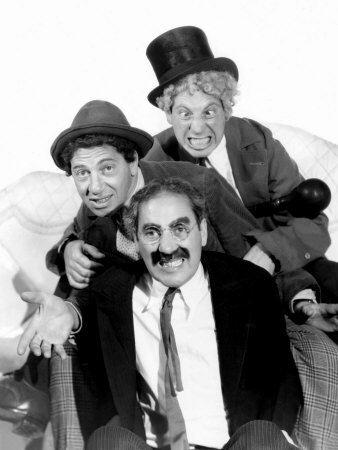
After a particularly dispiriting performance in Nacogdoches, Texas, Julius, Milton, and Arthur began cracking jokes onstage for their own amusement. Much to their surprise, the audience liked them better as comedians than as singers. They modified the then-popular Gus Edwards comedy skit "School Days" and renamed it "Fun In Hi Skule". The Marx Brothers would perform variations on this routine for the next seven years.
For a time in vaudeville all the brothers performed using ethnic accents. Leonard, the oldest, developed the Italian accent he used as Chico Marx to convince some roving bullies that he was Italian, not Jewish. Julius Marx's character from "Fun In Hi Skule" was an ethnic German, so Julius played him with a German accent. However, after the sinking of the RMS Lucitania in 1915, public anti-German sentiment was widespread, and Marx's German character was booed, so he quickly dropped the accent and developed the fast-talking wise-guy character he would be remembered for.
The Marx Brothers became the biggest comedic stars of the Palace Theatre, which billed itself as the "Valhalla of Vaudeville". Brother Chico's deal-making skills resulted in three hit plays on Broadway. No comedy routine had ever infected the hallowed Broadway circuit.
All of this predated their Hollywood career. By the time the Marxes made their first movie, they were major stars with sharply honed skills, and when Groucho was relaunched to stardom on You Bet Your Life, he had already been performing successfully for half a century.

Groucho Marx made 26 movies, 13 of them with his brothers Chico and Harpo. Marx developed a routine as a wise-cracking hustler with a distinctive chicken-walking lope, an exaggerated greasepaint mustache and eyebrows, and an ever-present cigar, improvising insults to stuffy dowagers (often played by Margaret Dumont) and anyone else who stood in his way. As the Marx Brothers, he and his brothers starred in a series of popular stage shows and movies.
Their first movie was a silent film made in 1921 that was never released, and is believed to have been destroyed at the time. A decade later, the team made some of their Broadway hits into movies, including Cocoanuts and Animal Crackers. Other successful films were Monkey Buisiness, Horse Feathers, Duck Soup, and A Night at the Opera. One quip from Marx concerned his response to Sam Wood, the director of the classic film A Night at the Opera. Furious with the Marx Brothers' ad-libs and antics on the set, Wood yelled in disgust: "You can't make an actor out of clay." Groucho responded, "Nor a director out of Wood."
Marx worked as a radio comedian and show host. One of his earliest stints was in a short-lived series in 1932 Flywheel, Shyster and Flywheel co-starring Chico. Most of the scripts and discs were thought to have been destroyed, but all but one of the scripts were found in 1988 in the Library of Congress.
In 1947, Marx was chosen to host a radio quiz program You Bet Your Life broadcast by ABC and then CBS, before moving over to NBC radio and television in 1950. Filmed before a live audience, the television show consisted of Marx interviewing the contestants and ad libbing jokes, before playing a brief quiz. The show was responsible for the phrases "Say the secret woid [word] and divide $100" (that is, each contestant would get $50); and "Who's buried in Grant's Tomb?" or "What color is the White House?" (asked when Marx felt sorry for a contestant who had not won anything). It ran for eleven years on television.

Groucho was the subject of an urban legend about a supposed response to a contestant who had nine children which supposedly brought down the house. In response to Marx asking in disbelief why she had so many children, the contestant replied, "I love my husband." To this, Marx responded, "I love my cigar, too, but I take it out of my mouth once in a while." Groucho often asserted in interviews that this exchange never took place, but it remains one of the most often quoted "Groucho-isms" nonetheless.
Throughout his career he introduced a number of memorable songs in films, including "Hooray for Captain Spaulding" and "Hello, I Must Be Going", in Animal Crackers, "Whatever It Is, I'm Against It", "Everyone Says I Love You" and "Lydia The Tattooed Lady". Frank Sinatra, who once quipped that the only thing he could do better than Marx was sing, made a film with Marx and Jane Russell in 1951 titled Double Dynamite.

In public and off-camera, Harpo and Chico were difficult to recognize by their fans without their wigs and costumes, but it was almost impossible to recognize Groucho without his trademark eye-glasses, fake eyebrows and mustache.
The greasepaint mustache and eyebrows originated spontaneously prior to a vaudeville performance in the early 1920s when he did not have time to apply the pasted-on mustache he had been using (or, according to his autobiography, simply did not enjoy the removal of the mustache every night because of the effects of tearing an adhesive bandage off the same patch of skin every night). After applying the greasepaint mustache, a quick glance in the mirror revealed his natural hair eyebrows were too undertoned and did not match the rest of his face, so Marx added the greasepaint to his eyebrows and headed for the stage. The absurdity of the greasepaint was never discussed on-screen, but in a famous scene in Duck Soup, where both Chicolini (Chico) and Pinky (Harpo) disguise themselves as Groucho, they are briefly seen applying the greasepaint, implicitly answering any question a viewer might have had about where he got his mustache and eyebrows.
Marx was asked to apply the greasepaint mustache once more for You Bet Your Life when it came to television, but he refused, opting instead to grow a real one, which he wore for the rest of his life. By this time, his eyesight had weakened enough for him actually to need corrective lenses; before then, his eye-glasses had merely been a stage prop. He debuted this new, and now much-older, appearance in Love Happy, the Marx Brothers's last film as a comedy team.

Groucho did paint the old character mustache over his real one on a few rare performing occasions, including a TV sketch with Jackie Gleason on the latter's variety show in the 1960s (in which they performed a variation on the song "Positively Mr. Gallagher, Absolutely Mr. Shean," written by Marx's uncle Al Shean) and the 1968 Otto Premiknger film Skidoo. In his 70s at the time, Marx remarked on his appearance: "I looked like I was embalmed." He played a mob boss called "God" and, according to Marx, "both my performance and the film were God-awful!".
The exaggerated walk, with one hand on the small of his back and his torso bent almost 90 degrees at the waist was a parody of a fad from the 1880s and 1890s. Then, fashionable young men of the upper classes would affect a walk with their right hand held fast to the base of their spines, and with a slight lean forward at the waist and a very slight twist toward the right with the left shoulder, allowing the left hand to swing free with the gait. Edmund Morris, in his biography The Rise and Fall of Theodore Roosevelt, describes a young Roosevelt, newly elected to the State Assembly, walking into the House Chamber for the first time in this trendy, affected gait, somewhat to the amusement of the older and more rural Members who were present. Groucho exaggerated this fad to a marked degree, and the comedy effect was enhanced by how out of date the fashion was by the 1920s and 30s.

Groucho's three marriages all ended in divorce. His first wife was chorus girl Ruth Johnson (married February 4, 1920, divorced July 15, 1942). He was 29 and she 19 at the time of their wedding. The couple had two children, Arthur Marx and Miriam Marx. His second wife was Kay Marvis, née Catherine Dittig (married February 24, 1945, divorced May 12, 1951), former wife of Leo Gorcey. Groucho was 54 and Kay 24 at the time of their marriage. They had a daughter, Melinda Marx. His third wife was actress Eden Hatford (married July 17, 1954, divorced December 4, 1969). She was 20 when she married the 63-year-old Groucho.
During the early 1950s, Groucho described his perfect woman: “Someone who looks like Marilyn Munroe and talks like George S Kaufman."
Similar anecdotes are corroborated by Groucho's friends, not one of whom went without being publicly embarrassed by Groucho on at least one occasion. Once, at a restaurant (the most common location of Groucho's antics), a fan came up to him and said, "Excuse me, but aren't you Groucho Marx?" "Yes," Groucho answered annoyedly. "Oh, I'm your biggest fan! Could I ask you a favor?" the man asked. "Sure, what is it?" asked the even-more annoyed Groucho. "See my wife sitting over there? She's an even bigger fan of yours than I am! Would you be willing to insult her?" Groucho replied, "Sir, if my wife looked like that, I wouldn't need any help thinking of insults!"Often when the Marxes arrived at restaurants, there would be a long wait for a table. "Just tell the maître d' who we are," his wife would say. (In his pre-mustache days, he was rarely recognized in public.) Groucho would say, "OK, OK. Good evening, sir. My name is Jones. This is Mrs. Jones, and here are all the little Joneses." Now his wife would be furious and insist that he tell the maître d' the truth. "Oh, all right," said Groucho. "My name is Smith. This is Mrs. Smith, and here are all the little Smiths."
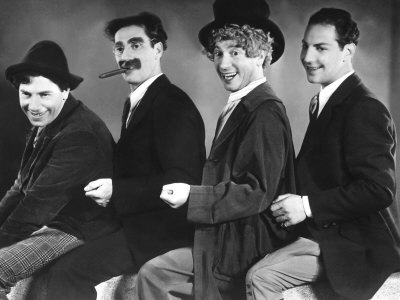
Groucho's son Arthur published a brief account of an incident that occurred when Arthur was a child. The family was going through airport customs and, while filling out a form, Groucho listed his name as "Julius Henry Marx" and his occupation as "smuggler." Thereafter, chaos ensued.
Later in life, Groucho would sometimes note to talk-show hosts, not entirely jokingly, that he was unable to actually insult anyone, because the target of his comment assumed it was a Groucho-esque joke and would laugh.
Off-stage, Groucho was a voracious reader. He often pointed out that he had only a grammar school education, and he compensated for this by reading everything he got his hands on. His knowledge of literature from all eras was extraordinary. Typical of his achievements, this one was discussed only demurely by Groucho himself: "I think TV is very educational," he once said. "Every time someone turns on a TV, I go in the other room and read." His friend Dick Cavett, speaking of Groucho and referencing a certain philosopher's writing, said, "I, with my college education, had merely heard of the book, but Groucho had actually read it." Cavett also remarked that Groucho could never end a letter; there was always at least one postscript. In one letter he recalls, Groucho wrote, "P.S. Did you ever notice that Peter O'Toole has a double-phallic name?

He was also an amateur guitarist, most prominently playing the song "Everyone Says I Love You" on a Gibson L-5 in Horse Feathers. He was considered by Will Rogers to be as good on his guitar as Harpo was on the harp and Chico was on the piano.
Despite this lack of formal education, he wrote many books, including his autobiography, Groucho and Me (1959) and Memoirs of a Mangy Lover (1963). He was personal friends with such literary figures as T.S Elliot and Carl Sandburg. Much of his personal correspondence with those and other figures is featured in the book The Groucho Letters (1967) with an introduction and commentary on the letters written by Groucho, who donated his letters to the Library of Congress.
Although Irving Berlin quipped, "The world would not be in such a snarl, had Marx been Groucho instead of Karl" Groucho's political views were liberal. In his book The Groucho Phile, Marx says "I've been a liberal Democrat all my life", and "I frankly find Democrats a better, more sympathetic crowd.... I'll continue to believe that Democrats have a greater regard for the common man than Republicans do". Marx & Lennon: The Parallel Sayings was published in 2005; the book records similar sayings between Groucho Marx and John Lennon.

Marx's children, particularly his son Arthur, felt strongly that Fleming was pushing their weak father beyond his physical and mental limits. Writer Mark Evanier concurred. Groucho was hospitalized for pneumonia on June 22, 1977 and died on August 19 at Cedars Sinai Medical Centre in Los Angeles.
He was cremated and the ashes were interred in the Eden Memorial Park Cemetery in Los Angeles. Groucho had the longest lifespan of all the Marx Brothers and was survived only by younger brother Zeppo, who outlived him by two years, dying in 1979 at the age of 78. Groucho's death was somewhat overshadowed because it occurred three days after that of Elvis Presley. In an interview, he jokingly suggested his epitaph read: "Excuse me, I can't stand up." But his mausoleum marker bears only his stage name, a Star of David that represents his Judaism, and the years of his birth and death.

Groucho Marx was, and is, the most recognizable and well-known of the Marx Brothers. Groucho-like characters and references have appeared in popular culture both during and after his life, some aimed at audiences who would never have seen a Marx Brothers movie. Groucho's trademark eye glasses, nose, mustache, and cigar have become icons of comedy— glasses with fake noses and mustaches (referred to as "Groucho glasses", "nose-glasses," and other names) are sold by novelty and costume shops around the world.
Actor Frank Ferrante has performed as Groucho Marx on stage for more than two decades. He continues to tour under rights granted by the Marx family in a one-man show entitled An Evening With Groucho in theaters throughout the United States and Canada with piano accompanist Jim Furmston. In the late 1980s Ferrante starred as Groucho in the off-Broadway and London show Groucho: A Life in Revue penned by Groucho's son Arthur. Ferrante portrayed the comedian from age 15 to 85. The show was later filmed for PBS in 2001.
Gabe Kaplan has appeared in a filmed version. Alan Alda often vamped as Groucho on M*A*S*H* and a minor semi-recurring character in the series (played by Loudon Wainwright lll) was named Captain Calvin Spalding in a nod towards Groucho's character in Animal Crackers, Captain Geoffrey T. Spaulding.
Two of the British Rock Band Queen's albums, A Night At The Opera (1975) and A Day at the Races (1976), are named after Marx Brothers films. In March 1977, Groucho invited Queen to visit him in his Los Angeles home; there they performed "'39" a capella. A long-running ad campaign for Vlasic Pickles features an animated stork that imitates Groucho's mannerisms and voice. On the famous Hollywood Sign in California, one of the "O"s is dedicated to Groucho. Alice Cooper contributed over $27,000 to remodel the sign, in memory of his friend.
The BBC remade the radio sitcom Flywheel, Shyster & Flywheel, with contemporary actors playing the parts of the original cast. The series was repeated on digital radio station BBC7. Scottish playwright Louise Oliver wrote a play named "Waiting For Groucho" about Chico and Harpo waiting for Groucho to turn up for the filming of their last project together. This was performed by Glasgow theatre company Rhymes with Purple Productions at the Edinburgh Fringe and in Glasgow and Hamilton in 2007-08. Groucho was played by Scottish actor Frodo McDanie.
| Groucho Marx | |
|---|---|
| Birth name | Julius Henry Marx |
| Born | October 2, 1890 New York City. US. |
| Died | August 19, 1977 (aged 86) Los Angeles. California. US. |
| Medium | Film, television, music |
| Nationality | American |
| Years active | 1919–1972 |
| Genres | Wit & Word Play Slapstick |
| Influenced | Johnny Carson Woody Allen Brendon Smalll Milton Berle Bill Cosby Conan O'Brien Ricky Gervais |
| Spouse | Ruth Johnson (1920-1942) (divorced) Kay Marvis Gorcey (1945-1951) (divorced) Eden Hartford (1954-1969) (divorced) |


 USA