Friday, 22 April 2011

The Carry On Legacy - Carry on Abroad: 1972


Carry On Abroad is the twenty-fourth Carry On Film released in 1972. The film features series regulars Sid James, Kenneth Williams, Joan Sims, Bernard Bresslaw, Barbara Windsor, Kenneth Connor, Peter Butterworth and Hattie Jacques. It was the 23rd and final appearance for Charles Hawtrey. June Whitfield returns after appearing in Carry On Nurse 13 years earlier. Jimmy Logan makes the first of two appearances in the series.

The film opens with pub landlord and frequent holidaymaker Vic Flange (Sid James) openly flirting with the much-married saucepot, Sadie Tompkins (Barbara Windsor) as his battleaxe wife, Cora (Joan Sims), looks on with disdain. Their twitching friend, Harry (Jack Douglas) arrives and lets slip that the package holiday Vic has booked to the Mediterranean island Els Bels (a pun on the slang expression "Hell's Bells") also includes Sadie, much to Cora's outrage. Cora, who avoids holidays because she hates flying, suddenly decides to accompany her boorish husband on the trip, to ensure he keeps away from Sadie.

The next day, the nasally Stuart Farquhar (Kenneth Williams), the representative of Wundatours, and his seductive assistant, Moira Plunkett (Gail Grainger), welcome the motley passengers. Among them the hen-pecked and love-starved Stanley Blunt (Kenneth Connor) and his prudish, overbearing wife, Evelyn (June Whitfield); a drunken, bowler-hatted mummy's boy, Eustace Tuttle (Charles Hawttrey); brash Scotsman, Bert Conway (Jimmy Logan); the young and beautiful Marge and Lily (Sally Geeson) and (Carol Hawkins); and Brother Bernard (Bernard Bresslaw), a young monk who has difficutly fitting into his new path of life.

Unfortunately, the hotel they are to stay in isn't finished as the builders have recently abandoned their jobs half-way through. Distraught manager Pepe (Peter Butterworth) desperately tries to run the place in a myriad of different guises and his shrewish wife, Floella (Hattie Jacques), struggles with the temperamental stove, whilst their Lothario son, Georgio, lazes about behind the bar.

The hotel also hides an assortment of tricks and Pepe is soon overrun with complaints, when Vic discovers Sadie naked in his shower, sand pours out of Moira's taps and the lavatory drenches Bert. Although agreeing to play leapfrog with Tuttle, Lily and Marge have their eyes on other things. Marge takes a shine to Brother Bernard, while Lily lures the dashing Nicholas (David Kernan) away from his jealous (implied) gay friend, Robin (John Clive). While most of the party go off to the village and get arrested for causing a scene at the establishment of Madame Fifi (Olga Lowe). Evelyn is left behind and seduced by Georgio, thus abandoning her frigid ways and resuming her sex life with Stanley. With the last-night bash swinging thanks to a local mixture that blesses the drinker with x-ray vision, the party goes with a bang as the hotel collapses. But all's well that ends well, when the holidaymakers reunite at Vic and Cora's pub.


The Army Game: 1957 - 1961

The Army Game TV.jpg

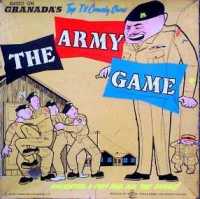
The Army Game was a British sitcom that aired on ITV from 1957 to 1961. Made in black and white, it is about National Service Conscription to the post-war British Army. It was created by Sid Colin. Many stars, like Charles Hawtrey, William Hartnell, Bernard Bresslaw, Alfie Bass and Dick Emery became household names, and appeared in the Carry On films, which began with Carry on Sergeant, virtually a spin-off. It was made for the ITV network by Granada Television.

The creator, Sid Colin, was inspired by a 1956 film, Private's Progress, that starred Ian Carmichael, Richard Attenborough, Terry Thomas and William Hartnell. Many of the cast had recently undertaken military service themselves.
Writers included Sid Colin, Larry Stephens, Maurice W iltshire, Lew Schwarz, John Jowett, John Antrobus, John Foley, Marty Feldman, Barry Took, David Climie, David Cumming, Derek Collyer, Brad Ashton, John Junkin, Talbot Rothwell, Sidney Nelson, Stan Mars, Bob Perkins and Alan Mckinnon. At least three episodes are uncredited.
The show centres on a group of conscripts assigned to the Surplus Ordnance Department at Nether Hopping, Staffordshire. Billeted in Hut 29, the men are determined to work little and have fun. The theme tune was sung by Michael Medwin, Bernard Bresslaw, Alfie Bass and Leslie Fyson. In June 1958, it reached number five in the UK singles chart. Bresslaw's song, Mad Passionate Love, sung in the style of Private Popplewell, also did well in the charts.

A film based on the series, I Only Arsked, appeared in 1958. The plot concentrated on Bresslaw's character and included Hawtrey, Alfie Bass, Rossington and Michael Medwin playing their characters. "I Only Arsked" became Bresslaw's catch-phrase. A paperback was produced, and Granada brought out a board game in 1959. Fraser and Bass's characters turned up in a spin-off, Bootsie and Snudge, between 1960 and 1963 and in 1974.


Thursday, 21 April 2011

The Kojak Buick: 1976


"Who Loves Ya, Baby?"

This Corgi 290 “Kojak Buick” comes still strapped to its inner-carded tray. It was made in Great Britain and the box is marked “1976 The Mettoy Co. Ltd”.

The Buick Regal is 6" long. It is metallic bronze with white interior. The scene shows Kojak and Crocker in a shootout. The car is equipped with a detachable beacon and has a wheel on the rear bumper that rotates to get gun shot sounds, which works great.


Wednesday, 20 April 2011

'Evenin' all' Dixon of Dock Green: 1955 - 1976

DixonofDockGreen.jpg

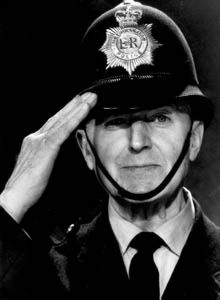
Beginning in 1955 and finally ending in 1976, Dixon of Dock Green was a popular series although its homeliness would later become a benchmark to measure the "realism" of police series such as Z-Cars and The Bill. The series was set in a suburban Police Station in the East End of London and concerned uniformed police engaged with routine tasks and low-level crime. The ordinary, everyday nature of the people and the setting was emphasised in early episodes by the British music-hall song "Maybe it's because I'm a Londoner" with its sentimental evocations of a cosy community, being used as the series theme song. This was composed by Jeff Darnell. Unlike later police series, Dixon focused less on crime and policing and more on the family-like nature of life in the station (and at home) with Dixon, a warm, paternal and frequently moralising presence, being the central focus where crime was little more than petty larceny. Dixon lived in a small mid-terraced house on a busy road. He liked a drink, as did his police friends.

landscape image
However as the 1960s and the early 1970s brought more realistic police series from both sides of the Atlantic to the British public, Dixon of Dock Green seemed increasingly unrealistic, a rosy view of the police that grew out of touch with the times. Yet the writer of the series always maintained to the end of the programme's time that stories were based on fact, and that Dixon was an accurate reflection of what goes on in an ordinary police station. One exception was the 1956 episode The Rotten Apple where Policeman Tom Carr (Paul Eddington) was found to have been burgling houses while on his beat. (A furious Dixon declares there to be nothing worse on Earth than a policeman who commits crimes, and forces Carr to take off the uniform jacket he is "not fit to wear".)

The police station featured in the opening titles was the previous Ealing police station, located at number 5 High Street, just north of Ealing Green.

landscape image

The main character, Police Constable George Dixon, played by Jack Warner, was an old-style British "bobby" (Police Man). The character first appeared in a 1950 British film by Ealing, The Blue Lamp, in which he was shot and killed by a criminal played by Dirk Bogarde. However, it was decided to bring him back to life for a television series, written by Ted Willis. Designer was Laurence Broadhouse.

If Dixon was known to the public, the actor Jack Warner was even better known. Born in London in 1896, Warner had been a Comedian in radio and in his early film career. Starting in the early 1940s, he broadened his range to include dramatic roles, becoming a warmly human character actor in the process. But as well as playing in films with dramatic themes, such as The Blue Lamp, Warner continued to play in comedies such as the successful Huggett family programmes on BBC Radio and films made between 1948 and 1953.

landscape image

In Dixon of Dock Green, Dixon is a "bobby" on the beat - lowest-ranking policeman on foot patrol. With the inevitable heart of gold, Dixon was a widower raising an only daughter Mary (Billie Whitelaw in early episodes, later replaced by Jeanette Hutchinson).

Subtitled in the early days: Some Stories of a London Policeman, each episode started with Dixon speaking to the camera. He began with a salute and the greeting "Good evening all", which was changed to "Evening all" in the early 1970s, which has lived on in Britain as a jocular greeting. In similar fashion, episodes finished with a few words to camera from Dixon in the form of philosophy on the evils of crime.

Initially, Dixon continued in the same role as in the film The Blue Lamp, a constable based at the fictitious Dock Green police station in the East End of London. The character of Andy Mitchell (played by Jimmy Hanley), the young constable in the film, became a detective named Andy Crawford (played by Peter Byrne), in the CID at Dock Green, and he was married to Dixon's 23 year old daughter, Mary (who did not appear in the film) in the 19th episode, Father in Law (1st Sept 1956). Dixon sings a few songs at the wedding and wishes the viewers goodbye at the end of the episode (this was the end of series 2 and series 3 was four months away). The couple moved to a flat in Chelmsford.

landscape image

By the final years of the series in the 1970s, Warner was getting elderly and looking increasingly implausible even in a desk job (as he had increasing difficulty moving about, helped slightly by a treatment involving bee stings). In the final series, when Warner was 80, George Dixon was shown as retired from the police and being re-employed as a civilian collator.

In 2005, the series was revived for BBC radio, adapted by Sue Rodwell, with David Calder as George Dixon, David Tennant as Andy Crawford, and Charlie Brooks as Mary Dixon. A second series followed in 2006, with Hamish Clark replacing Tennant owing to the latter's Doctor Who recording commitments.

landscape image

The BBC scheduled Dixon in the family time slot of 6:30 on Saturday night. At the time it started on air in 1955, the drama schedule of the BBC was mostly restricted to television plays so that Dixon of Dock Green had little trouble in building and maintaining a large and loyal audience. In 1961, the series was voted second most popular programme on British television with an estimated audience of 13.85 million. Even in 1965 after three years of the gritty and grimy procedural police-work of Z-Cars, the audience for Dixon stood at 11.5 million. However as the 1960s wore on, ratings began to fall and this, with health questions around Jack Warner, led the BBC to end the series in 1976.

The series was the creation of writer Ted Willis, who not only wrote the series over its 20 years on British television but had a controlling hand in production. Longtime producer of the series was Douglas Moodie whose other television credits include The Inch Man and The Airbase. Dixon was originally produced at the BBC's studios at Lime Grove. Altogether some 430 episodes were made, at first running 30 minutes and later 45 minutes.

landscape image

In 1988, a screenplay called The Black and Blue Lamp was shown on BBC TV. In it two identical criminals named Tom Riley, one from the 1950 film (in which Dixon dies) and one from the 1980s, swap places in time. The one from the 80's experiences the soft policing of the Dixon TV series. Meanwhile, the one from 1950 experiences the very harsh policing of the 80's, represented by a parody of violent police procedurals called The Filth. There he discovers that the Dixon of the divergent Dock Green timeline, who has also just been killed, was as bad as any copper could be.

One of Dixon's closing monologues from Dixon of Dock Green was recycled for the final scene of Ashes to Ashes in 2010. Like The Black and Blue Lamp, characters in Ashes to Ashes and its predecessor, Life on Mars, were seemingly sent into different eras of policing. Moreover, Dixon's 'resurrection' for Dixon of Dock Green, after having been killed in The Blue Lamp, parallels the stories of the principal characters in Life on Mars and Ashes to Ashes, having been explained in the final episode.

Remembering Sarah Jane: Elisabeth Sladen. 1948 - 2011

Elisabeth Sladen(BBC)

Doctor Who actress Elisabeth Sladen has died of cancer at the age of 63, the BBC has confirmed.

Tom Baker and Elisabeth Sladen (PA)
[Elisabeth Sladen is pictured alongside fourth Doctor Tom Baker after he was announced as the new Time Lord. Roger Carey, who represented Lis for many years, said. "She couldn't believe her luck when her career was resurrected in her own series." Lis had been suffering from cancer. She leaves behind a husband, actor Brian Miller, and her daughter Sadie.]

Steven Moffat, Doctor Who's executive producer said: "'Never meet your heroes wise people say. They weren't thinking of Lis Sladen." He added: "Sarah Jane Smith was everybody's hero when I was younger, and as brave and funny and brilliant as people only ever are in stories. But many years later, when I met the real Sarah-Jane - Lis Sladen herself - she was exactly as any child ever have wanted her to be."

Elisabeth Sladen (BBC)

Elisabeth Sladen was born in Liverpool in 1948. She's best known as the companion to the third and fourth Doctors, played by Jon Pertwee and Tom Baker. She left the part on a full-time basis in 1976, but returned to the role on numerous occasions over the years. The Sarah Jane Adventures brought Lis a whole new generation of fans.

Steven Moffat continued: "Kind and gentle and clever, and a ferociously talented actress, of course, but in that perfectly English unassuming way. There are a blessed few who can carry a whole television show on their talent and charisma - but I can't think of one other who's done it quite so politely."

Cast of The Sarah Jane Adventures including Elisabeth Sladen (Image © BBC)
[Elisabeth Sladen is pictured with the cast of The Sarah Jane Adventures. The show's creator Russell T Davies said: "I absolutely loved Lis. She was funny and cheeky and clever and just simply wonderful. The universe was lucky to have Sarah Jane Smith; the world world was lucky to have Lis."]

Moffat added: "I once showed my son Joshua an old episode of Doctor Who, in which Lis appeared. 'But that's Sarah Jane,' he said, confused. 'In old Doctor Who. From years ago. How come she always looks exactly the same?' It's not a comfort today, of course, but children will still be saying that 50 years from now."

Elisabeth Sladen (PA)
Elisabeth Sladen appeared in numerous shows outside of the Doctor Who universe. One of her early roles came in 1970; she featured in six episodes of Coronation Street as a barmaid. Her CV included guest roles in Z-Cars, Some Mothers Do 'Ave 'Em and Special Branch. She was also an accomplished stage actress. She will be missed...

Elisabeth Sladen had been suffering from cancer. She leaves behind a husband - actor Brian Miller - and her daughter, Sadie.

Tuesday, 19 April 2011

The Belles of St Trinians: 1954

landscape image
The Happiest Days of Your Life (d. Frank Launder, 1950) was such a huge success that a follow-up was inevitable - and Ronald Searle's much-loved cartoons about the riotous, thankfully fictional girls' school St Trinian's (1941-52) provided the perfect inspiration.

The Belles of St Trinian's (d. Launder, 1954) reunited Alastair Sim andJoyce Grenfell and threw in a bevy of 1950s character actors. The standout is George Cole as Flash Harry, Arthur Daley's spiritual ancestor, but there's sterling support from Hermione Baddeley, Irene Handl, Beryl Reid, Joan Sims and Sid James, while cameos include Searle and his wife and editor Kaye Webb as concerned parents.

St Trinian's is presided over the genial Miss Millicent Fritton (Sim in drag), whose philosophy is summed up as: "in other schools girls are sent out quite unprepared into a merciless world, but when our girls leave here, it is the merciless world which has to be prepared".

landscape image

The girls themselves come in two categories - the fourth form, most closely resembling Searle's original drawings of ink-stained, ungovernable pranksters, and the much older sixth form (one of them is even married), sexually precocious to a degree that must have seemed somewhat alarming in 1954.

landscape image

Sex, smoking, drinking and especially gambling aren't on the official curriculum, but they're not exactly frowned upon, and one of the most telling moments comes when the spiv Flash Harry is asked if he's a teacher and he replies "In a way" - his role as their bookie has certainly taught the girls plenty about economics.

landscape image

Although much sillier than Launder and co-writer/co-producer Sidney Gilliat's previous films, there are glimpses of more sophisticated satire drawing upon images of (then) contemporary British society. Here, targets include "progressive" education (usually anything but) and the precarious situation faced by private boarding schools in the postwar years, extreme cash shortages affecting not only facilities and staff salaries but also basic necessities like food. It's no wonder Miss Fritton turns to gambling to keep the school afloat - there's precious little else holding it together.

landscape image

Four sequels followed - Blue Murder at St Trinian's (1957), The Pure Hell of St Trinian's (1960), The Great St Trinian's Train Robbery (1966) andThe Wildcats of St Trinian's (1980). All were directed and co-written byLaunder, with both Gilliat's involvement and the films' quality progressively diminishing. Sim dropped out after Blue Murder, Grenfelland Cole after Pure Hell.

The Cast

Alastair Sim (Miss Millicent Fritton/Clarence Fritton); Joyce Grenfell (Police Sergeant Ruby Gates); George Cole (Flash Harry); Hermione Baddeley (Miss Drownder); Betty Ann Davies (Miss Waters)


THE

MONTHLY FILM BULLETIN

Published by

THE BRITISH FILM INSTITUTE

Volume 21, No.249, October 1954, page 142

BELLES OF ST TRINIAN'S, THE (1954)

Miss Fitton is headmistress-proprietor of the unruly and near bankrupt St. Trinians. She is delighted to receive a new pupil, the daughter of a wealthy race-horse owner, but dismayed when her bookmaker brother Clarence plants his daughter Arabella in the sixth form, to pick up racing information from the new girl. Clarence, having heavily backed a horse of his own, learns that Arab Boy, a horse belonging to the new girl's father, is running to much better form. Arabella and the sixth form decide to kidnap Arab Boy, but they are forestalled by the fourth form, whose money, like Miss Fitton's and the entire school funds, is on the horse. The Fourth take Arab Boy to their dormitory, where they are besieged by the Sixth and Clarence's men. The besiegers are finally driven off by St. Trinians' O.G.S., though not before the resourceful Fourth have smuggled Arab Boy out of the school between the shafts of a milk-cart. Arab Boy wins the race and St. Trinians is saved.

It is generally impossible to transmute a creation from one medium to another without loss. This transportation of Ronald Searle's awful school has been effected with the greatest possible success. Only once or twice - the explosion in the stinks lab; the sneak on the rack-does the film directly imitate the original drawings, and it is then at its weakest. For the rest, the quintessential spirit has been distilled, transported and reconstituted in proper film terms. Quite new, but in spirit perfectly faithful to the original, are Miss Fitton (a gigantic creation, superbly played with ineffable majesty and langour by Alastair Sim), her disreputable staff, and George Cole's excellent Flash Harry. The farcical story holds itself together pretty well, and every corner, as in Searle's own drawings, has been filled with wildly imaginative images and incidents: at some corner of the screen there is always a blank lunatic child with bird's-nest hair, or a fiendish innocent peering through banisters, or poor Hermione Baddeley trampled underfoot. Joyce Grenfell's business in the film is best known to herself, but it provides the indispensable picture of her desperate horseback ride to deliver a roll of chequered lino, on which she happens to have written a report to her superiors in the police force. And so on.Belles of St. Trinians is not so much a film as an entertainment on celluloid, a huge charade, a rich pile of idiot and splendidly senseless images.


The Monthly Film Bulletin was published by the British Film Institute between 1934 and 1991. Initially aimed at distributors and exhibitors as well as filmgoers, it carried reviews and details of all UK film releases. In 1991, the Bulletin was absorbed by Sight and Sound magazine.

The Arabian Knights: Episode Two


This episode begins with a small boy on a camel being pursued by two mean looking blokes waving swords. Rasime and Fariek are watching this some way off in the distant (what they are doing together in the middle of the desert is anyone's guess !!). They decide to intervene and so Rasime deals with the bad guys. We then hear that the boy is the son of the Kalif who is being held prisoner by the...yep you guessed it...Bakaar aided by Vangar. The Arabian Knights take the boy back to their hideaway where Turhan decides they must free the Kalif at all cost.

The young boy

Nasty bad guys

Rasime is not to be messed with

He tells them of his problem

Never a camel when you want one - ah well a magic carpet will have to do.

Some animal magic perhaps
They try to free him at night but are seen and so Vangar manages to stop them and take the Kalif to Baghdad. The Arabian Knights thus head for the city of Baghdad. Inside they must use magic and skill to free the Kalif and escape themselves before Vangar and his guards stop them.
The thick guards are easily fooled

Never though of checking a drum for Rebels

A little magic from Fariek

Vangar gets it in the pants once again

Bakaar is not pleased.....you jst can't get the staff

Zazuum breaks his way out

The End