'Water is wonderful, water's superb
- 'Water's too powerful to conquer or curb
- 'Water's at its best when you can chuck it
- 'Over yourself from out of a bucket.'

Hi there and welcome to Ado's Blog. I am obsessed with nostalgia, especially 1960s & 1970s nostalgia and I enjoy nothing more than reflecting on days and times that have sadly long since gone! So join me, as I take a nostalgic gander down Memory Lane and celebrate all things past and occasional present, both good and bad! (All images used that are copyrighted are copyrighted to their respective publishers and are only used here for review purposes.)


The show moves on to a new town and Bronco Billy goes to City Hall to get a permit. While there, he bumps into Antoinette Lily (Sondra Locke) and John Arlington (Geoffrey Lewis), who are there to be married. Antoinette despises her future husband, but has to marry before she is thirty in order to inherit a large fortune. Afterwards, their car breaks down at the motel opposite the Wild West Show. The next morning, Arlington steals all her money and their repaired car. She is left to fend for herself.
Bronco Billy eventually talks Antoinette into becoming his new assistant, "Miss Lily", though she only agrees to do one show. The show of her first performance is unusually successful, although Miss Lily irritates Billy by not sticking to the script.
Leaving the show, Antoinette discovers that Arlington has been arrested for her murder (framed by Antoinette's stepmother and her scheming lawyer friend, who stand to gain her inheritance). Seizing the chance to get even with Arlington, Antoinette rejoins the Wild West Show.


She discovers that none of the performers are real Cowboys: they are mostly ex-convicts or alcoholics (or both). Bronco Billy was a shoe salesman who shot his wife for sleeping with his best friend. Nevertheless, Miss Lily begins to warm to the troupe.
Two of the show's performers announce that they are going to have a baby. The crew goes to a bar to celebrate. One of them gets himself arrested by police who discover that he is a deserter from the Army. Bronco Billy uses the show's meager savings to bribe the sheriff into letting the man go, swallowing his pride and enduring the sheriff's verbal humiliations for his friend's sake. Then the circus tent burns down. Everyone blames Miss Lily for their bad luck, but Bronco Billy defends her and proposes that they rob a train. They try to do this in the standard Western way (riding alongside and jumping on), but a modern train proves to be resistant to such an approach and they give up.


Next, the troupe travels to a mental institution at which they have previously performed pro bono. The head of the institution, who is obsessed with the Wild West, agrees to provide them with accommodation and to supply a new tent, and the inmates sew one out of American flags. Miss Lily and Bronco Billy spend the night together. By chance, one of the inmates turns out to be Arlington (he had been paid by the crooked lawyer to confess to being mentally disturbed when he "murdered" Antoinette). When he sees her, he raises a fuss and gets himself released. Bronco Billy and the show depart without Miss Lily.
Antoinette returns to a luxurious lifestyle, but she is bored and misses Billy, who drowns his loneliness with alcohol. The two reunite when Miss Lily returns to the circus.

| Bronco Billy | |
|---|---|
![]() | |
| Directed by | Clint Eastwood |
| Produced by | Dennis Hackin Neil Dobrofsky |
| Written by | Dennis Hackin |
| Starring | Clint Eastwood Sondra Locke Geoffrey Lewis Scatman Crothers Bill McKinney Dan Vadis Sam Bottoms Sierra Pecheur |
| Music by | Snuff Garrett |
| Cinematography | David Worth |
| Editing by | Joel Cox Ferris Webster |
| Distributed by | Warner Bros. |
| Release date(s) | June 11, 1980 |
| Running time | 116 minutes |
| Country | United States |
| Language | English |
| Budget | $6.5 million |

![[TMT02.jpg]](https://blogger.googleusercontent.com/img/b/R29vZ2xl/AVvXsEjlf3Wggx1pm2Bh8EsnyQbjr54v7y3SIcN8Mksbkdbbj3EZCvmFoEgOCL-U69SLAXGtuDwXIdSuBXkuX2oMy04rWhN-otSAVGFjzsMCfah4qr07zgWiMtR8AnANJ-ncMnlYtGcetF7OmlI/s1600/TMT02.jpg)

Frenzy the 1972 thriller was film directed by Alfred Hitchcock and is the penultimate feature film of his extensive career. The film is based upon the novel Goodbye Piccadilly, Farewell Leicester Square by Arthur La Bern, and was adapted for the screen by Anthony Shaffer. La Bern later expressed his dissatisfaction with Shaffer's adaptation. The film starred Jon Finch, Alec McCowen and Barry Foster. The film also features Billie Whitelaw, Anna Massey, Barbara Leigh-Hunt, Bernard Cribbins and Vivien Merchant. The original music score was composed by Ron Goodwin.
The film was screened at the 1972 Cannes Film Festival, but was not entered into the main competition.


As in several other previous Hitchcock films, the audience is fully aware of the identity of the killer (Bob Rusk, played by Barry Foster) very early in the proceedings, and is also shown how circumstantial guilt is rapidly built up around an innocent man (Richard Blaney, Babs' boyfriend and Brenda's ex-husband, played by Jon Finch). Blaney is duly apprehended by the police and jailed, all the while maintaining his innocence. The investigating detective reconsiders the previous events and begins to believe that he has arrested the wrong man. In several scenes showing the detective's domestic situation, comedy is used to heighten the grisly nature of the death scenes.
The detective and his wife discuss the case and the wife gently points the detective in the right direction with a series of simple but appropriate questions and comments. The innocent man escapes from prison, and the detective knows that he will head to Rusk's flat at Covent Garden to avenge himself for being framed by Rusk and avenge the deaths of his two close lovers who had fallen victim to Rusk, so immediately goes there. Blaney has already arrived to find that the door to Rusk's flat is unlocked. He silently creeps in and sees what he presumes to be the top of Rusk's head, asleep in bed; he strikes the body with a metal bar. Just then the audience is shown the truth: it is not Rusk in bed, but another woman whose hand slips out from under the covers. Blaney pulls the covers back and there both for him and the audience it is confirmed: the face of another victim.


After a pair of unsuccessful films depicting political intrigue and espionage, Hitchcock returned to the murder genre with this film. The narrative makes use of the familiar Hitchcock theme of an innocent man overwhelmed by circumstantial evidence and wrongly assumed to be guilty. Many critics consider Frenzy the last great Hitchcock film and a return to form after his two previous works, Topaz and Torn Curtain.
Hitchcock set and filmed Frenzy in London after many years making films in the United States. The film opens with a sweeping shot along the Thames to Tower Bridge, and while the interior scenes were filmed at Pinewood Studios, much of the location filming was done in and around Covent Garden and was a homage to the London of Hitchcock's childhood. The son of a Covent Garden merchant, Hitchcock filmed several key scenes showing the area as the working produce market that it was. Aware that the area's days as a market were numbered, Hitchcock wanted to record the area as he remembered it. According to the making-of feature on the DVD, an elderly man who remembered Hitchcock's father as a dealer in the vegetable market came to visit the set during the filming and was treated to lunch by the director. The area as seen in the film still exists, but the market no longer operates from there, having relocated in 1974. The buildings seen in the film are now occupied by banks and legal offices, restaurants and nightclubs, such as Henrietta Street, where Rusk lived (and Babs met her untimely demise). Oxford Street, which had the back alley (Dryden Chambers, now demolished) leading to Brenda Blaney's matrimonial agency, is the busiest shopping area in Britain. Nell of Old Drury which is the public house where the doctor and solicitor had their frank, plot-assisting discussion on sex killers, is still a thriving bar. The lanes where merchants and workers once carried their produce, as seen in the film, are now occupied by tourists and street performers. To many people of a younger age, the world depicted in Frenzy shows a London that has all but disappeared.


The English version, with completely different lyrics by Ulvaeus, presents a vision of nostalgia for two veterans reminiscing in old age about a lost battle that they participated in during their younger days fighting under Emiliano Zapata in a battle of the Mexican Revolution of 1910. This was confirmed by Bjorn Ulvaeus in an ABBA special interview screened on December 31, 2008 in Australia.
The B-side to "Fernando" was the song "Hey, Hey, Helen", a track from the group's eponymous 1975 album, although in some countries "Tropical Loveland" (also from the Abba album) was used instead. Some copies of the single use "Rock Me" as a B-side.


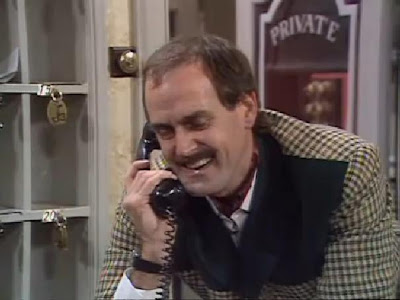
The next morning, Basil arrives to check on the hotel to see if everything is sound. However, he finds that, due to a misunderstanding of the plans, the builders have blocked up the dining room rather than the drawing room, much to his dismay. Moreover, there is now a door in front of the stairs rather than leading into the kitchen. In a combination of rage at the shoddy work and fear over his wife's anticipated reaction, Basil, after tripping over Sybil's gnome, furiously threatens first Polly and then Manuel, before phoning O'Reilly and threatening that if he is not at the hotel in twenty minutes to fix the problem, he will "come over there and insert a large garden gnome in you."
O'Reilly arrives, and while Basil is imploring him to get to work, Sybil - having forgotten her golf shoes - arrives back earlier than expected, spots O'Reilly's van and immediately becomes suspicious. Basil blames the chaos on Stubbs's men. Sybil (dangerously calm) responds to this by telling Basil that she saw O'Reilly's van outside. Basil explains this by saying O'Reilly has come in to fix up Stubbs's mess. Sybil, to Basil's surprise, actually agrees with him, but thinks that, since Stubbs made the mess, he should set it right as there would be no point in paying O'Reilly when Stubbs would have to do it for free. At that moment, Polly calls the front desk from another room impersonating Stubbs's secretary, but is caught by Sybil almost immediately and the game is up, as is Sybil's dander.


Sybil angrily confronts Basil for hiring O'Reilly and vows that she will make him regret it for the rest of his life. Basil continues his attempts to convince her it was "at least partly" Stubbs's fault, but Sybil orders him to halt his lies. Berating herself for letting Basil oversee the arrangements, Sybil assaults Basil, hurls the cash box across the room at him and goes into a furious tirade about all the times he'd hired O'Reilly to do jobs with shoddy, disastrous results. O'Reilly merrily appears and, upon admitting his mistakes, tries to joke about it. He even smiles at her when she's ranting, which terrifies Basil. This really sets Sybil off, as she has no capacity for a man smiling at her when she's angry unfortunately, and gives O'Reilly - and her husband - a harsh beating with an umbrella, and tells him to leave and never return. Sybil calls Stubbs to get him to do the work the next morning. She then storms off, not to return until that time. Unwilling to concede defeat, Basil convinces O'Reilly to stay and do the work anyway.
Sybil arrives in the morning to find the renovations have been completed by O'Reilly, apparently with no problems. As Stubbs arrives, Sybil finds herself in an embarrassing situation at having called on him, seemingly now for nothing. Stubbs looks over the renovations and admits at first that whoever did them did a very good job. Then, in further questioning Basil about the work, Stubbs finds out he was not called in for nought after all; while making a doorway leading into the kitchen, which was on a load-bearing wall , O'Reilly had used a wooden lintel for the support frame rather than a concrete one or Rolled Steel Joist. The supporting wall could give way at any moment, and he will need to repair it immediately, before the building collapses. As Stubbs almost frantically telephones his men to come over and help with this job, Basil leaves and marches down the driveway with Sybil's garden gnome; he calls back to Sybil, in a vengeful tone, "I'm going to see Mr. O'Reilly, dear." Presumably, he is about to make good on his threat to insert said gnome into the builder. "...Then I think I might go to Canada," he adds, under his breath.


David Stubbs has rated The Builders as the weakest Fawlty Towers episode due to its reliance on stereotypes such as the battleaxe wife (indeed, this is the only episode to depict Sybil as a physically abusive and domineering wife), the feckless Irish labourer and the dimwitted Spaniard.
John Cleese himself named "The Builders" as "the least good" of the Fawlty Towers episodes that were filmed, owing to a general lack of laughter in the studio on recording day. He recalls that members of the Icelandic Broadcasting Corporation were visiting the studio that day and many of them were in the front row seats, apparently not entirely amused.

This was a collectable Dodge Charger Diecast Model Car (The General Lee from The Dukes of Hazzard.)
Based on the hit television series that ran from 1979-85, The Dukes of Hazzard is written by Jonathan Davis, with revisions by John O'Brien and Broken Lizard. Set in present day, the story follows the adventures of "good old boy" cousins, Bo (Seann William Scott) and Luke (Johnny Knoxville) Duke, who with the help of their eye-catching cousin Daisy (Jessica Simpson) and moonshine running Uncle Jesse (Willie Nelson), try and save the family farm from being destroyed by Hazzard County's corrupt commissioner Boss Hogg (Burt Reynolds). Their efforts constantly find the "Duke Boys" eluding authorities in "The General Lee," their famed 1969 orange Dodge Charger that keeps them one step ahead of the dimwitted antics of the small southern town's Sheriff Roscoe P.Coltrane (M.C.Gainey).