Friday, 24 June 2011

Peter Falk R.I.P.

I am saddened this evening to hear of the passing of the great Peter Falk aka Columbo.
Peter Falk as Columbo(Rex)

According to reports, he died on Thursday night at his home in Beverly Hills.

Family members have so far declined to discuss the cause of death.

However, he had been suffering from dementia and Alzheimer's disease, according to his adopted daughter, Catherine Falk.

The archetypal man in a raincoat, Lieutenant Columbo is a creation that straddles the hard-boiled private detective genre of the 1930s and the modern-day TV investigator.

In terms of influence, there are few other TV detectives that can hold a candle to him, and none that can crack a case as thoroughly.

He remains utterly unique. ITV continues to air Columbo and millions continue to enjoy.

The man behind the shambolic, yet steely Lieutenant was actor Peter Falk. Born in New York City.

It's fair to say that throughout his life, Peter Falk built his career on his innate acting skills rather than his looks. Depression was starting to exert its grip, Falk's father was Hungarian-Polish and his mother was Russian. Peter Falk fell into acting at an early age, appearing in a stage production of The Pirates of Penzance before reaching his teenage years. This course was perhaps first set for him when, at just three years of age, he had to have his right eye removed due to a malignant tumour. However at Ossining High School, the young actor became better known for his sporting prowess than his stage presence.

After leaving school, Falk was knocked back for service in World War II due to his glass eye. But undeterred and with an appetite for action, he served as a cook in the United States Merchant Marine.

After a year or so in what turned out to be a less exciting job than imagined, he returned to the US and tried unsuccessfully to join the CIA. Instead, he had to settle for the job of management analyst with the Connecticut State Budget Bureau.

And there he stayed until his 29th year, all the while performing in his spare time with community theatre group the Mark Twain Masquers.

Eventually, the momentous decision was made to quit the day job. As the 1950s drew to a close, Falk prepared to join the breadline with all the other aspirant stage actors.

Just one more thing, Peter Falk - wherever there are TVs, there will be Columbo.

Peter Falk, actor, born 16 September 1927; died 23 June, 2011

Whistle Down the Wind (1961)

Mary Hayley Bell, wife of actor John Mills, used their three children, Hayley, Juliet and Jonathan as the inspiration for the main characters in her 1957 novella Whistle Down the Wind. It was probably inevitable that the film version directed by Bryan Forbes in 1961 would star Hayley Mills: not only was she at that point the most popular child star in the world, but the film's producer Richard Attenborough was also a good friend of the family. In it she gives perhaps her subtlest and most naturalistic performance, although Alan Barnes, playing her brother Charles, steals every scene he's in.
landscape image
landscape image
Originally set in Sussex, the story was relocated to North Lancashire after Attenborough asked writers Willis Hall and Keith Waterhouse, in their words, to 'northernise' it. This helps to make the simple and delicate story more plausible by grounding it in a more harshly realistic setting. But the more overtly Christian parallels, such as the playground denial of Christ and the stranger standing in the shape of the cross while being searched, are less well integrated.
landscape image
landscape image
Forbes, making his directorial debut, deftly handles both the adult and child performers, with Bernard Lee giving an understated and nuanced portrayal of the gruff but loving father. Filming mostly on location, with some interior scenes shot at Pinewood, Forbes contrasts location shots of the children dwarfed in the vast countryside with scenes filmed in the cramped studio barn. This is particularly effective in the film's climactic dialogue scene between Kathy and the stranger. The alternating shots of Hayley Mills and Alan Bates - she outside the barn and he inside, with only a small high window to communicate through - help make the sense of disappointment and vanquished innocence almost palpable.
A major part of the film's charm lies in the score composed by Malcolm Arnold, which features a jaunty arrangement of the traditional carol 'We Three Kings' which he humorously links to the three children. For the original soundtrack recording, the memorable theme tune was actually whistled by Richard Attenborough. Having already inspired a music video in the 1980s, in 1998 the novel and the film were turned into a West End musical by Andrew Lloyd Webber.
THE

MONTHLY FILM BULLETIN

Published by

THE BRITISH FILM INSTITUTE

Volume 28,No.332,September 1961,pages 126-7

WHISTLE DOWN THE WIND (1961)

Kathy Bostock, her younger sister Nan and brother Charles, their ages ranging from about fourteen to six respectively, live on a lonely Lancashire farm. Their father is a busy widower; his sister Dorothy, who runs the household, is a cross-patch. Deprived of unstinting affection, the children live a private life of their own; they rescue three kittens from drowning and a Salvation Army girl tells Charles that Jesus will look after his kitten if only Charles believes in Him. They hide the kittens in a barn and during the night Kathy returns to see if they are safe. Entering, she stumbles upon an injured man. Taking his startled cry of "Jesus Christ" as proof of the stranger's identity, she quickly recruits Nan and Charles to share her belief. The bearded man is in fact a murderer, hunted by the local police; and while he is glad to have the children's help with food and drink (bread and a bottle of Bostock's wine), he is perplexed when one of them gives him the Bible and calls it "his book". Soon the secret leaks out to all the neighbouring children and the barn is besieged by little Magi. Charles gives the man his kitten to look after, but it dies and Charles's faith is badly shaken. Finally, during Charles's birthday party, Nan unwittingly betrays the man's presence to Aunt Dorothy and the game is up. He surrenders to the police and is seen by Kathy being frisked in a crucified posture against the skyline. "He'll come again", Kathy assures a child who has arrived too late to see "Jesus".

There are two themes here. One, an embarrassingly explicit allegory of Christ's betrayal, comes straight from Mary Hayley Bell's novel. The other is the film's own illustration of a childhood world, secret and fantastic and sufficiently sturdy to withstand the intrusion of a good deal of pretentious symbolism (the identification of the village children with the disciples; the three betrayals with their echo of the apostle Peter). Fortunately, these complications emerge quite late in the film; while the first hurdle, Kathy's belief that the fugitive is Jesus Christ, appears logical enough in context, the way being neatly prepared by a series of credibly related incidents clear of all possible whimsy and offence. In addition there is some tough, laconic dialogue by Keith Waterhouse and Willis Hall; the adults come in for an invigorating dose of castigation, notably the pretty Sunday school teacher without a clue how to communicate her opinion on the eventuality of a Second Coming, and the smug vicar obsessed with the theft of lead from his church roof; above all, most of the scenes shared by the three children are observed with insight and vivid humour.

Though Bernard Lee and Elsie Wagstaffe are excellent as the father and the aunt, the best moments are provided by Alan Barnes as the six-year-old with a bleak, firm line in scepticism; and by Diane Holgate as his snootily unshakable sister. Hayley Mills, caught half-way between the child's faith and the adult's disillusion, fails, through no fault of her own, to bridge the gap. The split is in the script, and she conceals the tedium which must have accompanied the brilliant coaching of the younger children with a potent, concentrated professionalism. Arthur Ibbetson's photography endows the hedges, ditches, ponds and muggy weather of the moorland locations with a beauty all their own. Bryan Forbes, directing for the first time, reveals a painstaking, often incisive talent for behaviour rather than a marked personal style. But he knows the texture of North Country life, and only becomes paralysed into inaction or overstatement where the exigencies of the scriptural parallels put too great a strain on his and his audience's belief.


The Monthly Film Bulletin was published by the British Film Institute between 1934 and 1991. Initially aimed at distributors and exhibitors as well as filmgoers, it carried reviews and details of all UK film releases. In 1991, the Bulletin was absorbed by Sight and Sound magazine.

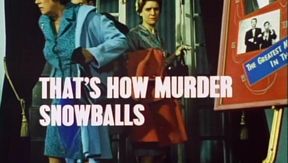
Randall & Hopkirk (Deceased) - Episode Five: That's How Murder Snowballs!

RandallHopkirk5.jpg
That's How Murder Snowballs is the fifth episode of the classic 1969 ITC series, Randall & Hopkirk (Deceased) starring Mike Pratt, Kenneth Cope and Annette Andre. Directed by Paul Dickson and written by Ray Austin, the episode was first broadcast on 19 October 1969 on ITV.
Jeff and Jeannie find themselves in the audience of "The Fabulous Fernandez and Abel" at the Palace Theatre. While performing a stage act that involves a loaded gun, the Mind Reader Fernandez is killed by his assistant Abel (David Jason), causing Jeff to go undercover to try to track down the murderer.
Joining forces with the police, Jeff adopts a mindreading act (with Marty's help) and is hired by the theatre. Jeff discovers that one of the performers, Gloria Marsh, was the wife of Fernandez, aka Ronay Thompson. Some years ago she had been involved in a drunken car accident whereby she had killed someone and Fernandez took the blame to save her from prison. With this hold over her, he refused to allow her a divorce when they grew apart, and demanded money from her while cheating on her with a string of other women. When Gloria takes a lover of her own, choreographer Kim, in order to remove the obstacle of her husband, he plots to kill Fernandez by dressing as a woman in the audience and placing a loaded bullet in the gun's chamber during the act. When Gloria is about to spill the beans under the force of Randall, Kim kills her to try and protect his secret. In trying to escape detection, the choreographer goes on a murderous rampage attempting to kill the ticket booth operator, one of the show girls and then Randall several times. Finally he is apprehended by police, performers and an intrepid Randall who is injured falling from a stage rope and confined to a hospital bed as a result.

In this episode themes of morality are raised when after Fernadez is murdered Jeff tips off a newspaper contact named Barry Jones who pays him well for story information. Jeannie on the other hand shows some moral compunction by questioning Jeff's ethics in selling a story. "Well, did you get your blood money?" she demands of Jeff.

We also learn that Jeff once paid Jeannie with a gold earring "in lieu of salary" again revealing his financial difficulties.

Jeff is hit many times in this episode. He is coshed over the head, shot at four times, nearly hit with a large sandbag and a thrown revolver, and worst of all is knocked out by a shelf tipped on him in the basement as he is searching for clues.

Meanwhile in this episode Marty acquires a taste for dining at the finest restaurants, remarking that he had recently dined at the Savoy with Harold Wilson.

File:Randall and Hopkirk Deceased titlecard.jpg

Fabulous 208 (November 4th 1967)

Another classic cover from Fabulous 208. This cover dates back to November 4th 1967 and on its cover were, George Harrison & Pattie Boyd. Inside were pin-ups of, The Flowerpot Men, Lulu, Sonny & Cher & Mike Nesmith.

Whisky Galore! (1949)

When a Scottish island falls prey to a whisky shortage, the islanders are desolate. But when by chance a ship is sunk with a cargo of 50,000 cases of whisky, they see their salvation. But first they must outwit the English Home Guard commander who is determined to protect the cargo at costs.

Whisky Galore! was the second of three films released in 1949 - the others were Passport to Pimlico (d. Henry Cornelius) and Kind Hearts and Coronets (d. Robert Hamer) - which forever linked 'Ealing' and 'comedy' in the public imagination. It also marked the directorial debut of Alexander Mackendrick, previously a screenwriter and storyboard artist on several Ealing films.

Whisky Galore! was adapted by Compton Mackenzie and Angus MacPhailfrom Mackenzie's novel, itself based on the true story of a famous incident in 1941, in which the SS Politician - whose cargo included 22,000 cases of whisky - was wrecked near the Hebridean islands of Eriskay and South Uist. Dozens of boats from every nearby island soon set upon the wreck, rescuing some 7,000 cases from a watery end.

landscape image

landscape image

The novel, and Mackendrick's film, relocates the story to the fictional island of Todday, and is not only a celebration of the islanders' single-mindedness, but a homage to the restorative powers of Scotch, which magically restores a community in deep depression for want of a 'wee dram'. Producer Monja Danischewsky called the film "the longest unsponsored advertisement ever to reach cinema screens the world over."

landscape image

Despite a difficult production beset by often appalling weather, and a slow start at the English box-office, it became a worldwide hit and Ealing's most profitable film. It is also one of its most fondly remembered, particularly in Scotland. Its success owes much to its remarkable feeling of authenticity: with the exception of Basil Radford and Joan Greenwood most of the cast were Scots, with the extras coming from among the islanders of Barra where much of it was filmed. The constant attentions of the islanders helped the cast to perfect their accents.

landscape image

landscape image

Unlike the gentle comedy of Passport to Pimlico, Whisky Galore!'s humour has an often cruel bite, most of it at the expense of the pompous English Home Guard commander, Waggett (Radford), whose efforts to frustrate the islanders' pursuit of whisky result only in his own undoing.

Waggett's qualities - innocent, decent, not too clever - would have chimed perfectly among the Burgundians of Passport to Pimlico (in which Radford also appeared). But it's exactly these qualities which mark him out as the victim of the wily Todday islanders. The hapless Waggett is comprehensively defeated, and his final humiliation absolute - even his wife bursts into laughter at his fate.

THE

MONTHLY FILM BULLETIN

Published by

THE BRITISH FILM INSTITUTE

Volume 16, No.187, July 1949, page 117

WHISKY GALORE! (1949)

Hebridean Comedy. The island of Todday lies off the west coast of Scotland in the Outer Hebrides. It is 1943 and the islanders are plunged in gloom; there is no whisky, or, as they call it in Gaelic, the water of life. Paul Waggett, an Englishman in command of the local Home Guard, cannot understand the listlessness of his troops. Sergeant Odd, another Englishman, comes to help him instruct them. Joseph Macroon at the post-office, his daughters Peggy and Catriona, his friend the Biffer, and George Campbell all feel the loss most keenly. Then a ship carrying a cargo of 50,000 cases of whisky is wrecked off Todday. It is the Sabbath and the islanders cannot begin to salvage, but after twenty-four hours of suspense - for Captain Waggett has plans to defend the looting - the whisky is landed and the dawn breaks on a new island. A double betrothal ceremony is held, with a seven-gallon jar of whisky as a centrepiece, to celebrate the forthcoming marriages of George Campbell and Catriona, Sergeant Odd and Peggy. But Captain Waggett discovers the main supply of whisky hidden in a cave and reports to the nearest Excise Officer. When the Excise men appear, however, the whisky has vanished, and only Captain Waggett is implicated.

The story is adapted from the novel by Compton Mackenzie, who is also part author of the screen play and who plays a small part in the film. It was filmed entirely on the island of Barra, and has been produced and directed with a refreshing sense of comedy and an understanding of Anglo-Scots relationships. The central joke may soon be tired of, but the situations it illuminates have a variety of their own. and a talented cast sees to it that no island character study shall go unnoticed. Basil Radford as Captain Waggett, Jean Cadell as Mrs. Campbell, Gordon Jackson as George, and Joan Greenwood as Catriona make the most of their opportunities. There is some beautiful outdoor photography.


The Monthly Film Bulletin was published by the British Film Institute between 1934 and 1991. Initially aimed at distributors and exhibitors as well as filmgoers, it carried reviews and details of all UK film releases. In 1991, the Bulletin was absorbed by Sight and Sound magazine.

Thursday, 23 June 2011

1919 Chicklets Candy Coated Chewing Gum

1919 Chicklets Gum #001651
This advertisement originates from America and dates back to 1919. The ad is for Chicklets Candy Coated flavoured Chewing Gum!

Cockleshell Bay: Episode Four - The Grand Old Duke of York

Fury being fed
The children are in the kitchen making lots of noise singing the nursery rhyme "The Grand Old Duke of York." They are so busy using pots and pans that they do not hear the grown ups. The grown ups eventually come down and ask the children to stop.
Mr Ship plays the fiddle
The children go and see Mr. Ship. They find him playing the violin which he picked up in South America many years ago when he was sailing round the world. They then ask him if they can play some music using his kitchen pots and pans.
The children want to play

Queen - Sheer Heart Attack!

QUEEN Sheer Heart Attack (2011 issue UK Deluxe Edition 18-track digitally remastered 2-CD album set - Originally released in 1974, 'Sheer Heart Attack' experimented with a variety of musical genres, including music hall, heavy metal, ballads and ragtime. At this point, Queen started to move away from the progressive tendencies of their first two releases into a more radio-friendly, song-orientated style. This 2-disc edition comprises the 13-track album featuring the single, 'Killer Queen', 'Flick Of The Wrist', 'Lily Of The Valley' and 'Now I'm Here'; plus a Bonus 5-track CD including a live version of 'Now I'm Here' recorded at Hammersmith Odeon in December 1975, BBC Session recordings of 'Flick Of The Wrist' & 'Tenement Funster', a 2011 acapella mix of 'Bring Back That Leroy Brown' and 'In The Lap Of The Gods… Revisited' recorded at Wembley Stadium in July 1986).
Queen,Sheer Heart Attack,UK,DOUBLE CD,531753
1. Brighton Rock
2. Killer Queen
3. Tenement Funster
4. Flick Of The Wrist
5. Lily Of The Valley
6. Now I'm Here
7. In The Lap Of The Gods
8. Stone Cold Crazy
9. Dear Friends
10. Misfire
11. Bring Back That Leroy Brown
12. She Makes Me (Stormtrooper In Stilettos)
13. In The Lap Of The Gods... Revisited


Bonus CD:
1. Now I'm Here - Live At Hammersmith Odeon, December 1975
2. Flick Of The Wrist - BBC Session, October 1974
3. Tenement Funster - BBC Session, October 1974
4. Bring Back That Leroy Brown - A-Cappella Mix 2011
5. In The Lap Of The Gods… Revisited - Live At Wembley Stadium, July 1986

The Long Good Friday (1979)

It might not have quite the iconic value of Get Carter (d. Mike Hodges, 1971) or the brash energy of Lock, Stock and Two Smoking Barrels (d. Guy Ritchie, 1998), but for many The Long Good Friday represents the high-water mark of the British gangster film, its reputation resting not just on a startling central performance from Bob Hoskins, but on its near-prophetic illustration of emerging 1980s values.

For while Hoskins' Harold Shand's gangland empire is recognisably in the mould of the notorious Kray brothers' 1960s reign, his brand of ruthless, thrusting capitalism makes him an archetype, albeit an exaggerated one, for the Thatcher government's enthusiastic sponsorship of individual enterprise (in a bid for legitimacy, Shand calls his domain the Corporation). This parallel is reinforced by Harold's choice of London's then still largely derelict Docklands area for his ambitious business project - anticipating the massive investment that transformed that region during the 1980s.

Harold is a truly monstrous figure: a corrupt political player with senior policemen and politicians on his payroll, a brutal overlord who responds to the unknown threat to his empire - in one of the film's most memorable scenes - by suspending rival gang bosses upside down on meathooks in an abbatoir, and who, faced with the betrayal of right-hand man (and surrogate son) Jeff, enacts revenge with ferocious violence. Yet in his fall, thanks to Hoskins' flawless playing, he becomes almost a tragic 'great man' of Shakespearean proportions. The increasingly wanton destruction enveloping him leaves him panicked and bewildered, and in the tender moments he shares with girlfriend Victoria we see a vulnerable, reduced and strangely pitiable Harold.

As Victoria, Helen Mirren is every inch Hoskins' equal, transforming the passive gangster's moll of genre convention (Mirren demanded extensive rewrites of the character) into a genuine power behind the throne - a tough, shrewd negotiator with equal and absolute commitment to the cause, whose ingenuity and resourcefulness crucially balance Harold's ruthlessness and discipline.

Originally funded by Lew Grade's Black Lion Films, The Long Good Friday fell into the lap of Handmade Films when Grade, who had taken exception to the IRA plotline, ordered his own re-cut for television, which added up to what producer Barry Hanson called "about 75 minutes of film that was literal nonsense". Handmade's outlay was some £200,000 less than the film's production cost, an investment that was handsomely repaid.


Wednesday, 22 June 2011

Randall & Hopkirk (Deceased) - Episode Four: Never Trust A Ghost!

RandallHopkirk4.jpg
Never Trust a Ghost was the fourth episode of the classic 1969 ITC British Television Series, Randall & Hopkirk (Deceased) starring Mike Pratt, Kenneth Cope and Annette Andre. The episode was first broadcast on 12 October 1969 on ITV and was Directed by Jeremy Summers.

While out on a late-night stroll Marty Hopkirk witnesses the murder of a Mr. Howarth by the hitman, Rawlings as Howarth enters his home.

He travels back to Jeff's apartment to wait for him, whereupon Jeff turns up in the early hours of the morning with a beautiful girl in tow. Marty demands Jeff send his date home and call the police, which he eventually begrudgingly does, travelling with Inspector Clayton to the house where the murder took place. However, when they arrive they find his wife and it appears that Mr. Howarth is back alive and well.

Jeff leaves after Howarth threatens to sue him, only to arrive back the next morning to apologise to Mrs. Howarth, again at Marty's insistence. Marty sees Rawlings in the study and calls Jeff in, by which time Rawlings has disappeared into the secret room branching off it. Engrossed with the case, Marty spends time in the Howarths' house, whereby he learns that both Mr and Mrs Howarth have been murdered and replaced by impostors. Insisting Jeff returns after he locates the bodies in the basement, Jeff returns to the house again, only to find the bodies are no longer there.

Jeff now in serious trouble uses Jeannie as an alibi to escape a third police warning, but is growing increasingly concerned by Marty's behaviour. He visits a psychic medium Professor Plevitt at the British Museum who convinces Jeff that Marty like all ghosts is hallucinating. Driving home, as a result of Plevitt's advice Randall disbelieves Marty's warning that Rawlings is out to kill him, only convinced when he narrowly avoids being shot in his car. Later Rawlings turns up at Jeff's office pretending to be a James Wenworth-Smith of Westminster". However, Marty warns Jeff and the two struggle, whereupon Jeff is knocked unconscious by the highly physically trained Rawlings and tied up back at the Howarths', with their plan to frame him for the murders.
However, under Jeff's guidance Marty visits Professor Plevitt in order to get him to call the police. The process takes a great deal of time and Marty finds it extremely difficult to convince the medium that he is an extraordinary ghost with excellent capabilities. It appears that disguises were being used to impersonate the murdered Howarths (the female agent's name is revealed as "Karen"), and that Mr. Howarth was in charge of savings for the Secret Service. His murder meant that the enemy impersonators had access to the full names and details of every undercover agent in the UK. The police arrive and arrest all three, though Marty winds up Jeff by pretending to hallucinate for seeing a body in a cupboard, getting his revenge on Jeff for his disbelief.