This is the Follyfoot Annual from 1976. Above is the front cover and below a picture strip entitled, "One Good Turn" that appeared in the annual.


Hi there and welcome to Ado's Blog. I am obsessed with nostalgia, especially 1960s & 1970s nostalgia and I enjoy nothing more than reflecting on days and times that have sadly long since gone! So join me, as I take a nostalgic gander down Memory Lane and celebrate all things past and occasional present, both good and bad! (All images used that are copyrighted are copyrighted to their respective publishers and are only used here for review purposes.)


Directed by Frank Launder and Sidney Gilliat to a script by Sidney and Leslie Gilliat, it was the fourth in a series of five St. Trinian's films. However it retained only George Cole, Richard Wattis and Eric Barker from the earlier films. Several new actors were brought in, including Frankie Howerd as Alfred (Alphonse) Askett, Reg Varney as Gilbert, and Dora Bryan as Amber Spottiswood, the headmistress. Although asked twice, Joyce Grenfell refused to appear again as Sergeant Ruby Gates. She was later reported to have said that she regretted appearing in the St Trinian's saga.
Raymond Huntley appeared as the "Minister of Schools" (a fictional title), and Cyril Chamberlain appeared as Maxie.

The first colour St. Trinian's film takes its inspiration from the notorious real-life mail train robbery of 1963, and is the fourth entry in the series based on Ronald Searle's cartoon schoolgirls.
"Alphonse" Askett (Frankie Howerd) is a hairdresser who is also the operational leader of a gang of crooks who are led behind the scenes by an invisible mastermind (Stratford Johns). He gives instructions to Askett about the robbery, Operation Windfall, using a variety of almost James Bond-like communications devices -- including a converted showerhead.
The crooks hide the loot in a deserted country mansion, and after waiting for the hue and cry to die down return to collect the numerous mailbags which contain £2.5 million (the same amount as in the real robbery). However, following a Labour Party election triumph, the house has been converted into a new home for St. Trinian's School for Girls. The crooks decide to infiltrate the school by sending Askett’s delinquent daughters, Lavinia and Marcia Mary, to St. Trinian’s to find out where the money is concealed. The crooks' subsequent attempt to retrieve the mailbags on Parents' Day, disguised as caterers, results in a climactic train chase between the robbers and the girls.


The film focuses on 15-year-old Billy Casper, who has little hope in life and is bullied both at home, by his physically and verbally abusive half-brother, Judd, as well as at school. He is mischievous himself; he steals milk from milk floats, gets other students into trouble and generally fights and misbehaves. Billy comes over as an emotionally neglected boy with little self-respect. Billy's mother refers to him in the film as a "hopeless case". His father is dead.
The film shows scenes of Billy's school. The headmaster canes a group of boys who were caught smoking. One scene of comic relief in an otherwise bleak film is of a gym teacher (played by Brian Glover) taking part in a football game, fantasising about himself as Bobby Charlton and commentating on the match in his head.

Outside cadging money and day-dreaming at school, Billy has no positive interests. His greatest fear is ending up working down the pit as a coal miner (at that time, British miners were amongst the lowest paid workers in the developed world), but he has no apparent escape route from what would ultimately be his fate. That is until he finds an outlet from his pitiful existence through training a kestrel that he takes from a nest on a farm. His interest in learning falconry prompts Billy to steal a book on the subject from a secondhand book shop as he cannot get a borrower's card for the public library.
As the relationship between Billy and "Kes", the kestrel, during the training improves so does Billy's outlook and horizons. For the first time in the film Billy receives praise, from his English teacher after delivering an impromptu talk on his relationship with the bird.


Kes was Ken Loach's second feature film, and marks his move away from the self-conscious experimentalism of his earlier work.
As before, Loach developed a close partnership with the author of the source work, in this case Barry Hines, on whose novel A Kestrel for a Knave the film is based. Loach worked with both Hines and producer Tony Garnett to adapt it as a film script.
The dominant theme of Kes is the way in which the education system stifles the talents of many young working-class children, offering them little choice but to follow the narrow path laid out for them by an industrial capitalist society which sees them as fit only for unskilled manual or office work. This theme runs through much of Loach's work.

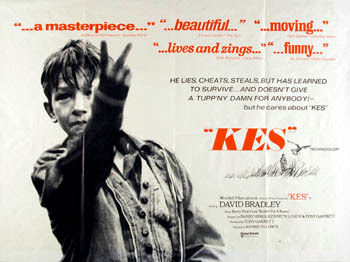
| Kes | |
|---|---|
 | |
| Directed by | Ken Loach |
| Produced by | Tony Garnett |
| Screenplay by | Barry Hines
Ken Loach Tony Garnett |
| Based on | A Kestrel for a Knave by
Barry Hines |
| Starring | David Bradley
Freddie Fletcher Lynne Perrie Colin Welland Brian Glover |
| Music By
| John Cameron |
| Cinematography | Chris Menges |
| Editing by | Roy Watts |
| Distributed by | United Artists |
| Release date(s) | 1969 |
| Running time | 110 minutes |
| Country | United Kingdom |
| Language | English |