Thursday, 4 August 2011

The Servant (1963)

Adapted from a short story by Robin Maugham, The Servant (1963) was the first of three collaborations between Joseph Losey and Harold Pinter. It was followed by two further quintessentially English films Accident(1967) and The Go-Between (1971).

The Servant is a savage indictment of the English class system, and its waning hold over all aspects of the working and cultural life of Britain. Set almost entirely within the smart new townhouse of foppish aristocrat Tony (James Fox), the film plays out the struggle for power and dominance ignited by his duplicitous manservant Barrett - an energetic and genuinely ominous Dirk Bogarde.

landscape image

The opening sequence of stark, leafless trees outlined against a cold English sky suggests the clinical austerity of 1960s Britain and hints at the cold manipulations that follow. The first shot of Barrett, leaving Thomas Crapper Sanitary Engineers (presumably his previous workplace), slyly insinuates the theme of the film as the 'flushing away' of the old order. His clipped appearance and punctuality tells us he means business, while the first shot of Tony (a 'businessman') finds him vulnerable, asleep in a chair.
landscape image
The drama revolves around issues of both class and gender, and the relationship between the two. While Barrett slowly insinuates himself in the house and manipulates his master by slyly rearranging the decor, it is through sex (in the shape of his alluring and sexually permissive 'sister', Vera (Sarah Miles)) that he finally brings about Tony's downfall. The calculating allure of Vera, in contrast to the stuffy, over-bred Susan (Wendy Craig), cuts through the class barriers and brings Tony down to the same level as his servant. Soon the boundaries between master and servant break down, as Tony succumbs to the will of his stronger adversary.
Belonging to an era of filmmaking which for the first time dealt explicitly with issues never before seen on screen, The Servant (in common with many of the contemporary British New Wave) is also artistically ambitious. Several scenes (particularly those between Tony, Barrett and Susan) are seen through the distortion of the big, round, convex mirror which sits on the living room wall, reflecting the unnatural, misformed relationships between the people in the room. Each shot is directed with precision, often framing Susan or Vera between Tony and Barrett, or positioning one of the two men close to the camera while his rival lingers in the background.
THE

MONTHLY FILM BULLETIN

Published by

THE BRITISH FILM INSTITUTE

Volume 30,No.359,December 1963,page 169

SERVANT, THE (1963)

Tony, a rich young man engaged to Susan, takes on a manservant, Barrett. Barrett seizes the opportunity to make Tony's Georgian ruin of a home as elegant inside as out. He becomes indispensable, running not only the house but his spineless employer. Meanwhile Susan's instinctive antagonism to him flares into open war. Barrett deals with the threat by moving in his girl-friend, Vera, as a temporary maid, and passing her off as his sister. Tony is seduced by her. When the truth comes out, Susan leaves, and Tony dismisses Barrett and Vera. The house, and Tony, rapidly deteriorate, so that a "chance" meeting between ex-servant and master in a pub leads quite smoothly to Barrett's reinstatement. But the relationship undergoes a subtle and rapid switch, with Barrett in deliberate and destructive command of a corruptible employer, Susan defeated, Vera hovering in the background, and drugs and orgies a nightly commonplace.

Though by no means perfect, The Servant is Joseph Losey's most impressive film since The Prowler. Significantly, it has the same concentration and economy (Reginald Mills's editing is smoothly elliptical), much the same themes of power, corruption and personality change. Set mostly in a London Georgian house, it is an ambitiously planned comédie noire about class and sex, written by Harold Pinter from a standpoint reminiscent of, though more detached than, Hugh Walpole at his most satanic. The relationship between servant and master, and the double threat of fiancée and maid, occupy the first half, with some brilliantly tart asides involving two aristocratic fossils (Catherine Lacey and Richard Vernon) and the various odd customers, including a bloody-minded Bishop, in an expensive restaurant. Then stealthily, if not always so effectively, the narrative takes on a Faustian dimension. Awkwardly staged seduction and confrontation lead on to sinister farce, with the two men playing hide-and-seek and smashing the staircase ornaments, then to a bloodless orgy rather too unconvincing, too abrupt and posed, to support the atmosphere of a Black Mass which one suspects is being intimated.

One can appreciate what Pinter intends and applaud a great deal of Losey's execution. The writing confirms Pinter as a vivid stylist with a flair for tensely ambiguous dialogue ("I've been keeping an eye on the workmen", Barrett assures Tony; "Have you?" Tony replies, with an air of loaded interest). Losey, for his part, reveals a command of rhythm, visual description and actors which he has never before equalled. Dirk Bogarde gives the performance of his career as the equivocal, catlike Barrett, and James Fox is perfect as the vulnerable golden boy sapped by inbred fatuity. By comparison the two girls are faintly unbelievable (though Wendy Craig is excellent), partly because they have an unjustly large part to play in bridging the gap between the film's two halves.

What is missing, in fact, is the cohesive control, the sure-footed development, of Walpole's multi-layer explorations into sadomasochism together with the more metaphysical elements of satanic destruction. It is perfectly credible that Tony should be reduced to a puppet; less credible when a whole roomful of orgiasts file out sheeplike through the door at Barrett's cursory order. And there are one or two other examples of the higher silliness. One senses a certain arbitrary schematism about the denouement which gives The Servant the air more of artifice than organic growth. Even so, it remains consistently gripping in its imagination and overall tact, and there is less evidence of straining after a tour de force than Losey has ever shown before.


The Monthly Film Bulletin was published by the British Film Institute between 1934 and 1991. Initially aimed at distributors and exhibitors as well as filmgoers, it carried reviews and details of all UK film releases. In 1991, the Bulletin was absorbed by Sight and Sound magazine.

Look-In - Space 1999 (1975)

This edition of Look-In was printed back in September 1975 and carried terrific features and picture strips of all your ITV favourites. The Cover and articles below originate from Space 1999.
click for larger image (512754 bytes) click for larger image (512754 bytes)
click for larger image (279934 bytes) click for larger image (197792 bytes)
click for larger image (377180 bytes) click for larger image (330816 bytes)

Basil, a Branch and an Austin 1100!


The limited edition Corgi Austin 1100 Estate Fawlty Towers car was exclusively released by PBS stations in conjunction with the 30th anniversary of Fawlty Towers actually is the correct replica of the car Basil loved to hate.
These highly collectible cars are only available through PBS stations, and the set (pictured above) includes the car, Basil Fawlty figurine, complete with branch, and a numbered Certificate of Authenticity.

Tuesday, 2 August 2011

The Beatles: With The Beatles (1969)

The Beatles,With The Beatles - 4th - B/Y - Mint,UK,Deleted,LP RECORD,491246
THE BEATLES With The Beatles (Rare 1969 UK fourth pressing 14-track LP on the
black & yellow Parlophone label with
'The Gramophone Co' text but without 'Sold In The UK'.
This was one of the last pressings to use the
black & yellow label design & is now very
hard to find indeed.

The Beatles,With The Beatles - 4th - B/Y - Mint,UK,Deleted,LP RECORD,491246
1. It Won't Be Long
2. All I've Got To Do
3. All My Loving
4. Don't Bother Me
5. Little Child
6. Till There Was You
7. Please Mr. Postman
8. Roll Over Beethoven
9. Hold Me Tight
10. You Really Got A Hold On Me
11. I Wanna Be Your Man
12. Devil In Her Heart
13. Not A Second Time
14. Money

People Weekly - Sonny & Susie (1975)

Click to enlarge Click to enlarge

This edition of People Weekly published in the US was published back in 1975 and features an interview with Pop Icon, Sonny Bono. You can read the full interview below.

When Cher says I taught her everything she knows, it's true," says Sonny Bono in his 20-room Bel Air mansion. The house is strangely austere and quiet now that Cher has moved a few blocks away into a larger but similar mansion (which, like Bono's, once belonged to Tony Curtis). "But," adds Sonny, her ex-husband and packager, "I did not teach her everything I know."

Curiously, since Cher's ricochet romances post-Bono, America is taking Sonny virtually as seriously and sympathetically as he does himself. He is no longer to be confused with the goofball goombah, the leaning tower of pizza, of the act that once made the Bonos the first family of prime time. Simultaneously, too, Sonny and Cher have helped restore the thrill of marital misadventure to Hollywood where it belongs. So much for Lee Salk, Christina Onassis and Ann Landers.

For months it seemed Sonny was on the skids after Cher walked out of their 10-year union in favor of record executive David Geffen. Worse, perhaps, Sonny got the first crack at a solo flight on the airwaves—and promptly nosedived, only to be put down by the Geffen-orchestrated revival of Cher's own highly successful TV show.

Now, Cher's amorous experiments have revived the dormant Hollywood sport of tag-team marriage. Immediately after their divorce became final, Cher married laid-back rock star Gregg Allman. Nine days later, it was all a "mistake," and she filed for divorce. Then she rushed off to Buffalo to rejoin Allman, who was, according to some accounts, in a "wasted condition." Sonny suspects she will give it one more try. Meanwhile, Cher was a week late reporting back for the season's tapings, and her producer George Schlatter said, "Working with her is just like it used to be with Judy Garland."

Bono meanwhile had been an adoring if moping part-time father to their 6-year-old Chastity. His love life was ultra-dim. Then two months ago along came a stunning 21-year-old model named Susie Coelho whose parents were born in India. Suddenly, it was Bono, the son of a factory worker and a beautician from lower middle-class Inglewood, Calif., and not Cher, whose act was truly together.

Exuberantly affectionate with both his lady and his daughter, Sonny has also maintained a close friendship with Cher, who has relied on him throughout their breakup for counsel and support ($32,000 a month). It is a familiar role for Sonny, 40, who over the years has been father, husband and brother to Cher, now 29. "People don't understand our relationship," he says. "I talk to her all the time. We're closer than anyone will suspect."

Bono has not only helped keep Cher's faculties intact since the breakup, but also worked himself out of his own depression. Last week he shared the bill with Dionne Warwick at the Westbury Music Fair outside New York City, and is now developing a TV sitcom starring himself for ABC. Then, there is Susie. "I feel real good about her. She's the first girl since Cher who contributes to my emotional being. I've been lonely until Susie. Now, I feel strong. I've got some things in the emotional bank."

There was a parental (and at first, Platonic) thread with Cher from the beginning. "Cher was more mature at 16 than she is now. She is getting to do a lot of things that she didn't get to do then," he says. That was in the mid-'60s when Sonny, father of a 5-year-old girl, met Cher, the pouty, but worldly-wise waif who had been perfecting her autograph for stardom since she was 12. After Cher moved in, they developed a complicated arrangement to fool her mother when she visited: "She would take all my clothes and throw them out the window, onto her friend's patio. It was really a bore, collecting them," he says.

Soon they were ooh-ing and ah-ing in producer Phil Spector's studios as backup vocalists, the prelude to their monstrously lucrative string of hits written by Sonny on shirt cardboards and beginning in 1965 with I Got You, Babe. But by the late '60s acid rock had drowned out their two-part harmonic whine, and Sonny guided them into two trite movies—and massive debt. ("I never let Cher know we were in trouble. I took out a loan on our furniture. I was borrowing money from our chauffeur.") He was "sure she was a star" and convinced her to go on the road with him, developing the rapid-fire put-down repartee that led to Las Vegas and, then, to their TV hegemony in 1971.

"Cher wants me to do her show now, but it would have to be part of an overall settlement," he says. One obstacle is the $24-million suit Sonny has brought against Cher and her ex-Svengali, Geffen, whom he charges with inducing an impressionable Cher to break her contract with Sonny. "I can't fight with her on one front and perform with her on the other."

Yet Sonny adds, "I wish her well, I really do. Our 10 years were the happiest of my life. I don't regret a moment of it. I love her. I ate, lived, breathed the three of us. But I understand when something is over, it's over." The phone rings through the empty house in Bel Air. Chastity races from Sonny's lap and picks up the phone. It is Cher in New York. "She always calls when she's in trouble," he says, hitching up his pants before answering. "She always calls."

It's a Knockout - 1976

Radio Times article, 15th - 21st May 1976
It's a Knockout returned to screens in 1976 and this edition of the Radio Times, 14th - 21st May carried the above article.
Bill Tidy cartoon, Radio Times, 7th - 13th August 1976
The above article is taken from the Radio Times, 7th - 13th August.
Reader's letter, Radio Times, 25th September - 1st October 1976
This article is taken from the Radio Times, 25th September - 1st October.

Monday, 1 August 2011

1967 General Electric

1967 GE Mr. Magoo
1967 General Electric Soft White Light Bulbs original vintage advertisement. With celebrity endorsement by Mr. Magoo. Illustrated in vivid color.

Randall & Hopkirk (Deceased) - Episode Thirteen: But What A Sweet Little Room

RandallHopkirk13.jpg
"But What a Sweet Little Room" is the thirteenth episode of the classic ITC series, Randall & Hopkirk (Deceased) that starred Mike Pratt, Kenneth Cope and Annette Andre. The episode was first broadcast on 14 December 1969 on ITV and was Directed by Roy Ward Baker.
Jeff investigates the disappearance of a wealthy young woman's aunt. When she too is killed he is led to the regular meetings of a medium, Madame Hanska, and uses Jeannie as a decoy to foil a thieving operation in which a gang of three middle class men murder and rob rich middle aged widows by taking them on an apparently innocent excursion to a cottage in the county.

In this episode Marty contacts a phony psychic medium who claims to be able to contact the dead husbands and wives of well heeled middle aged widows and widowers. To the fake medium's extreme surprise he is then able to materialise as a ghost in front of her (the first real ghost she has ever seen in her long career) and gets her to confess to receiving money from the gang of three middle class men in return for setting up seances at which they target wealthy widows and lure them to their deaths. She shows a genuine sense of fear and remorse over her wrong-doing when confronted by Marty the ghost.

This is a particularly macabre episode (very different from the almost slapstick comedic atmosphere of The Ghost of Monte Carlo) with the sudden unexpected grisly death of the widow in and air-tight toom, initially masquerading as a delightful cottage drawing room or study (the room that gives its name to the episode title), shown in graphic detail at the start of the program. Only later on in the episode does it become clear why such a bizarre and elaborate means of murdering the widows has been constructed by the script writers when Jeff is also nearly gassed to death in the same room only to be saved at the last moment with Marty's usual spiritual assistance.

File:Randall and Hopkirk Deceased titlecard.jpg

Sunday, 31 July 2011

Elvis at the Cow Palace, San Fransisco: November 28th 1976

Elvis Presley Cow Palace, San Francisco, Ca 8.30pm - Novembr 28, 1976
Cow Palace (originally California State Livestock Pavilion) is an indoor arena, in Daly City, California, situated on the city's border with neighboring San Fransisco. The 28th November 1976 and the King of Rock himself, Elvis, played to a sell out crowd.

Village of the Damned (1960)

John Wyndham came up with an original alien invasion in his novel The Midwich Cuckoos (1957); Wolf Rilla's film, from a script by the American Stirling Silliphant (who uses a few Yank expressions that should have been changed - 'general store' for 'village shop'), is a low-key dramatisation and all the better for it.

The first half covers the Midwich blackout, so the business with the children - which takes place over years of plot-time - is sometimes a little rushed. There are a lot of secondary characters to cope with and the splendid Barbara Shelley (most caring of the mothers) gets pushed into the background so her scientist husband (George Sanders) can shoulder dramatic weight.

landscape image

landscape image

The sleeping village set-up is classic Quatermass stuff - a tractor grinding around in a circle, an iron burning a hole in a dress, a record stuck in a groove, a cow collapsed in a field. Everyone wakes up in convincing embarrassment, which gets odder as the pregnancies are announced, delivering the sort of emotions American s-f films, pitched at kiddies, didn't do in the 1960s: the awkward joy of the Zellabys at an unexpected event, the meek terror of the teenage virgin confessing to a doctor, the mute rage of the sailor home after a year abroad to find his wife knocked up, the quiet solidarity of a pregnant mother and daughter who visit the clinic at the same time.

landscape image

landscape image

Once the kids are born, it becomes a monster movie in which the threat is a malign higher intelligence with no moral grounding. What works is the shape the threat comes in: the Midwich Children are the creepiest ever seen on film, with identical blonde wigs (an unsettling effect is achieved by casting real-life brunette kids whose colouring is subtly wrong for their hair) and staring eyes (in some prints, a glowing effect was added). The polite spokesman for the group mind is played by Martin Stephens (also notable as Miles in The Innocents (d. Jack Clayton, 1961)) but dubbed by a grown woman. Rilla hints at the children's human side (they all solve a puzzle box to get chocolates) as well as a malevolence that is scary from an alien but might be even scarier from a human kid (Stephens' flicker of an almost-smile after forcing a motorist to kill himself is one of the nastiest shots in British cinema).

landscape image

In spread-the-unease form, it ends with one of the first it-may-not-be-over endings (later a genre cliché): the glowing eyes, superimposed over the fire, zap off into the skies, suggesting that killing the kids' bodies may not have wiped out their disembodied intelligence.

landscape image

THE

MONTHLY FILM BULLETIN

Published by

THE BRITISH FILM INSTITUTE

Volume 27,No.318,July 1960,page 102

VILLAGE OF THE DAMNED (1960)

When, for several hours, all life in the village of Midwich comes to a cataleptic stop, the authorities investigate. Two months pass before the implications of that eventful day become apparent, however. Six boys and six girls are born, each with the same flaxen hair and strangely powerful eyes, to women unable to account for their pregnancy. Time passes, and by the age of nine the twelve children are not only intellectual giants, but also seem to have supernatural powers. When two men oppose the children and die in mysterious circumstances, physicist Gordon Zellaby is forced to admit that the children, one of whom was born to his own wife, must in some way be responsible. Realising that there is no limit to the evil power of these children, already planning to spread out and multiply, Zellaby decides that he alone, whom they have come to trust, must be responsible for their destruction. And yet the children have long since proved themselves able to read his mind...

The solution of this excellent adaptation from John Wyndham's The Midwich Cuckoos can be recommended for its ruthless ingenuity, the story is original as these things go and has grip, the village background is pleasing and Wolf Rilla's direction (except for some irksome glimpses of George Sanders' marital bliss) both sharp and discreet. Altogether, in fact, with chillingly effective performances from the children to add to the tension, this is probably the neatest science fiction film yet to have come out of a British studio.


The Monthly Film Bulletin was published by the British Film Institute between 1934 and 1991. Initially aimed at distributors and exhibitors as well as filmgoers, it carried reviews and details of all UK film releases. In 1991, the Bulletin was absorbed by Sight and Sound magazine.

The Daily Star: 17th September 2001

Daily Star - 17th September 2001
This edition of the Daily Star was published on 17th September 2001 and follows on from the atrocities on the World Trade Centre in New York.

1967 Smirnoff Vodka

1967 Smirnoff Vodka #001765
1967 Smirnoff Vodka original vintage advertisement. With celebrity endorsement by Zsa Zsa Gabor. "Don't Darling Me if it's not Smirnoff". Photographed in vivid color.
1967 Smirnoff Vodka - Phil Silvers #004241
1967 Smirnoff Vodka original vintage advertisement. With endorsement by Phil Silvers dressed in costume from his feature film "A Funny Thing Happened On The Way To The Forum."
1967 Smirnoff Vodka Skyball #004259
1967 Smirnoff Vodka original vintage advertisement. With instructions for making a Skyball: add tonic to Smirnoff on the rocks and lime. Nothing on earth more delicious.

Saturday, 30 July 2011

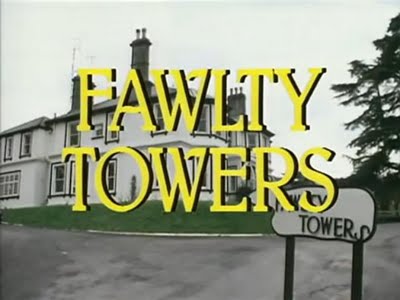
Fawlty Towers - Series One, Episode Five - Gourmet Night (1975)


Fawlty Towers has a new chef named Kurt who has been found for them by André, Kurt's culinary trainer and a friend of the Fawltys, just ahead of a gourmet night that Basil, ever eager to attract the upper crust of clientéle in Torquay, is intending to host at the hotel. Kurt has taken a liking to Manuel. Basil, meanwhile, is having trouble with his Austin 1100 Estate car. Despite Sybil's insistence that he take the car to be mended, the miserly Basil tries to fix the car himself. Unfortunately, when the gourmet night arrives, only four people turn up (Colonel and Mrs. Hall, both JPs and Lionel Twitchen, one of Torquay's leading rotarians, along with his wife, Lotte) due to Basil including a "no riff-raff" notice in his advertisement after a rude and pampered boy brands the hotel a "dump" simply because his chips weren't the shape he preferred and they didn't have any salad cream (to which Basil responds by "accidentally" elbowing him in the head and comparing him to "Henry Kissinger"). A party of four, the Coosters, was supposed to be in attendance, but are forced to cancel at the last minute due to one of them getting ill. When Basil learns of this, he snidely remarks "let's hope it's nothing trivial."

As the episode unfolds it is revealed that Kurt is a homosexual alcoholic and his interest in Manuel is actually on a romantic scale, but Manuel, who is straight, is not interested, so Kurt seeks solace in alcohol and ends up drunk to the point of being unable to cook, unbeknownst to Basil, as the dinner guests are arriving.

Basil displays his extreme social awkwardness as he becomes over sensitive to Colonel Hall's introduction to the other guests. The Colonel has a nervous twitch which causes his neck and head to convulse violently. When Fawlty attempts to introduce the two couples he gets hung up on the name of "Lionel Twitchen", so as not to offend the Colonel, and is unable to introduce them, thereby causing maximum embarrassment for himself. Mr Twitchen, upon seeing the Colonel's twitch, realises what has happened and gives his surname as "Twychen'.

Basil is horrified to realise that Kurt passed out, and after he vomited, now doesn't have a chef. Fortunately, André, who was aware of Kurt's alcoholism, is on hand to help Basil. However, as André's restaurant has a restricted availability, the 'gourmet' menu ends up with only three possible dishes for Basil's guests to choose from - all consisting of various forms of duck: Duck with orange, duck with cherries, or 'duck surprise' (duck without oranges or cherries). When Basil is asked what happens if they don't like duck, he responds "If you don't like duck... then you're rather stuck!" (to which Mrs. Hall responds that she loves it).

Basil's attempts to obtain the food are complicated. The first duck is ruined when Basil accidentally drops the tray and Manuel's foot gets lodged in it, so Basil ends up having to ask André for another. The second attempt is hampered by Basil's car, which finally breaks down on his way back with the food; the scene ends with what is arguably one of the most famous sequences: Basil screaming at the car and giving the vehicle fair warning, followed by a "damn good thrashing" with a tree branch after it finally completely refuses to start.

The staff try to stall for time while waiting for Basil to return with the duck: Manuel plays Flamenco tunes on his guitar, Polly sings "I Can't Say No" from the musical Oklahoma!, and Sybil drunkenly recounts an anecdote about "uncle Ted and his crate of brown ale." Basil manages to get back to the hotel on foot and the guests are finally presented with the "duck" which they have so eagerly awaited, only to discover that, due to a mix-up in Andre's kitchen, it has turned into a Bombe Surprise when Basil removes the cloche. Basil is so surprised that he searches through the trifle with his hands to see if there is a hidden duck. When asked to explain this, Basil deadpans "Duck's off, sorry."

A 1999 poll for NatWest car insurance voted the scene in this episode where Basil attacks his car with a tree branch as "most momentous motoring moment".