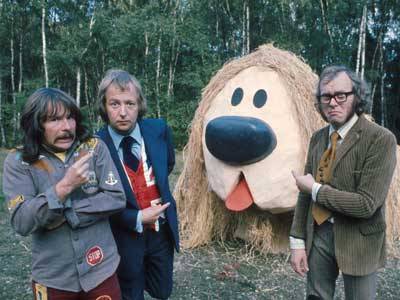
Sunday, 18 March 2012

Goodies! Goodie, Goodie, Yum, Yum! Remembering The Goodies (1970 - 1982)


What can you say about the Goodies? Other than they were fuckin' brilliant! So join me as I pay homage to one of the greatest, legendary, classic shows of the 1970s.
The Goodies was a British television comedy series of the 1970s and early 1980s.
The series, which combined surreal sketches and situation comedy, was broadcast on BBC2 from 1970 until 1980 — and was then broadcast by the ITV company London Weekend Television for a year, between 1981 to 1982. The show was co-written by and starred Tim Brooke - Taylor, Graeme Garden and Bill Oddie (together known as "The Goodies"). Bill Oddie also wrote the music and songs for the series — while "The Goodies Theme" was co-written by Bill Oddie and Michael Gibbs. The directors/producers of the series were John Howard Davies, Jim Franklin and Bob Spiers.
An early title which was considered for the series was Narrow Your Mind (following on from Broaden Your Mind) and prior to that the working title was Super Chaps Three.

The series' basic structure revolved around the trio, always short of money, offering themselves for hire — with the tagline "We Do Anything, Anywhere, Anytime" — to perform all sorts of ridiculous but generally benevolent tasks. Under this loose pretext, the show explored all sorts of off-the-wall scenarios for comedic potential. Many episodes parodied current events, such as an episode where the entire black population of South Africa emigrates to Great Britain to escape apartheid. As this means that the white South Africans no longer have anyone to exploit and oppress, they introduce a new system called "apart-height", where short people (Bill and a number of Jockeys) are discriminated against.
Other story lines were more abstractly philosophical, such as an episode in which the trio spend Christmas Eve together waiting for the Earth to be blown up by prior arrangement of the world's governments. The "Christmas Eve" episode titled "Earthanasia" was one of the two episodes which took place entirely in one room. The other, "The End", occurred when Graeme accidentally had their office encased in an enormous block of Concrete. These episodes were made when the entire location budget for the season had been spent, forcing the trio to come up with a script shot entirely on the set that relied entirely on character interaction - episodes known in the industry as bottle episodes.

A special episode, which was based on the original 1971 Goodies' "Kitten Kong episode, was called "Kitten Kong Montreux 72 Edition", and was first broadcast in 1972. The Goodies won the Silver Rose in 1972 for this special episode at the Festival d'or held in Montreux, Switzerland. The Goodies also won the Silver Rose in 1975 at the Festival Rose d'Or for their episode "The Movies".
The show featured extensive use of slapstick, often performed using sped-up photography and clever, though low-budget, visual effects, such as when they built a railway station together, and awoke the next morning to discover that the construction equipment outside (steam shovel,bulldozer, backhoe) had come to life, and were lumbering, growling, and battling like dinosaurs.
Other episodes featured parodies of contemporary pop music composed by Oddie, some of which went on to substantial commercial success in the British charts, among them the hit single "Funky Gibbon" as well as character-based comedy. Some early episodes were interrupted by spoofs of contemporary tv commercials.
The Goodies opening Waikato
The group also acknowledges their debt to the usage of music in silent movies. In "The Movies" episode, they buy an old movie studio, and attempt to make their own epic film, MacBeth Meets Truffaut The Wonder Dog. After several 'takes', they argue and each begins to make his own movie in a different style. The episode finished with an extended silent movie segment, in which each movie comically interferes with the others.
The characters are based on the personae of the three characters: Garden, a bright but bizarre "mad scientist"; Brooke-Taylor as a conservative, vain, sexually-repressed, upper-class royalist; and Oddie as a scruffy, occasionally violent, left-leaning rebel from Lancashire. The group have suggested that the characters of Graeme, Tim, and Bill represent the Liberal, Conservative and Labour wings of British politics or Middle-Class, Upper-Class, and Working-Class stereotypes respectively. The characters played up to their stereotypes, but were not necessarily based on the actor playing the character, even though the actors played characters with their own names, and had some minor characteristics in common. In reality, Garden is a medical doctor, Brooke-Taylor is a lawyer who is not at all conservative ("But I had the double-barrelled name so I was always going to play the Tory") and Oddie is a pacifist, Ornithologist and active Environmentalist.

The Goodies was a consistently very popular show in the UK, although, because it seemed to appeal particularly to younger viewers, some critics dismissed it as juvenile in comparison to the other contemporary UK "alternative" comedy hit, Monty Python's Flying Circus. In fact, whilst this comparison irritated them, Oddie, Garden and Brooke-Taylor were old university friends of the Monty Python cast, and had worked with them in the past, so there was considerable mutual respect between the rival shows. This led to several gentle parodies of Monty Python appearing on The Goodies.
Goodies episodes, in which Monty Python's Flying Circus was either parodied or alluded to, included the following:
  • "The Goodies and the Beanstalk" — At the end of this episode, John Cleese portrays a geenie in the guise of a Monty Python character and uses the Python catchphrase "And now for something completely different". When spotted and told to "Push off!" by Tim, he shouts dismissively: "Kids' programme!" before vanishing.
  • "Invasion of the Moon Creatures" — the opening credits of "Monty Python's Flying Circus" can be seen when Graeme switches on the television. Graeme immediately switches off the television in disgust because he has missed what he wanted to see (Moira Anderson).
  • "Fleet Street Goodies" — in which the Liberty Bell March (the theme for "Monty Python's Flying Circus") can be heard.
  • "Scatty Safari" — in which four Gumbies are featured.
  • "The Goodies Rule – OK?" — in which two Gumbies are seen on Skid Row.
  • "U Friend or UFO?" — Bill plays the Python theme on the trombone with the aliens.
"Kitten Kong" (episode seven from season two) is the only Goodie episode that is officially missing from BBC archives. However, an expanded, more elaborate version of the episode called ‘Kitten Kong: Montreux '72 Edition’, especially made for 1972 Montreux festival, does exist, and is said to have only minor differences with its 1971 prototype. The Goodies were awarded the Silver Rose at the 1972 Montreux festival for this special episode. Several other episodes that were originally screened in colour are also missing, but exist as black and white telerecordings made for overseas sales.

All Aboard Chopper One (1974)

Chopper One was the short-lived ABC drama/adventure television series in early 1974 depicting the activities of a California police helicopter team. The program aired in a half-hour time slot on Thursdays at 8 p.m. Eastern. It aired adjacent to Firehouse, an action-drama series about a Los Angeles fire station.Chopper One was cancelled after six months and Firehouse ended in the following month.
File:LAPD Bell 206 Jetranger.jpg
Chopper One was directed by E.W. Swackhamer and was about two flying police officers (a pilot and an observer) and their adventures in a police helicopter. The helicopter was a Bell 206 Jetranger. It starred Jim McCullen as Officer Don Burdick and Dirk Benedict as officer Gil Foley. Benedict would later earn fame as Lt. Starbuck int the original 1978 TV show Battlestar Galactica and as Lt. Templeton 'Faceman' Peck in the TV show The A - Team. Ted Hartley played their boss Capt. McKeegan and Lou Frizzell played Mitch, the crusty mechanic.

The officers were assigned helicopter duty and to make things more easier these guys were given the task to catch and apprehend dangerous criminals in tight places the police couldn't get to so with the guys up in the air they can get a description of the suspect whether he is located with the help of the local authorities. Their adversaries included chasing automobiles,bank robbers,rooftop snipers,renegade cyclists,kidnappers, muggers in the park and other desperadoes foolish enough to work out in the open. The series produced 13 episodes for ABC-TV from January 17, 1974 until the series finale on July 11,1974. The show,which ran a half-hour was on Thursday night and despite the ratings it received was right in the same time slot against a ratings powerhouse drama "The Waltons" which was on a rival network.

Saturday, 17 March 2012

Bernard Lee - The Original M (1962 - 1979)


James Bond's boss M was originally played by Bernard Lee from the first Bond movie, Dr .No, until Moonraker (1979) and remains the series greatest M. In Dr. No, M refers to record in reducing the number of operative casualties since taking the job, implying someone else held the job recently before him. The film also saw M refer to himself as head of MI7; Lee had originally said MI6, but was overdubbed with the name MI7 prior to the film's release. Earlier in the film, the department had been referred to as MI6 by a radio operator.


A number of Bond scholars have noted that Lee's interpretation of the character was in line with the original literary representation; Cork and Stutz observed that Lee was "very close to Fleming's version of the character", whilst Rubin commented on the serious, efficient, no-nonsense authority figure. Smith and Lavington, meanwhile, remarked that Lee was "the very incarnation of Fleming's crusty admiral."

Bernard Lee died of cancer in January 1981, four months into the filming of For Your Eyes Only and before any of his scenes could be filmed. Out of respect, no new actor was hired to assume the role and, instead, the script was re-written so that the character is said to be on leave, with his lines given to either his Chief of Staff Bill Tanner or the Minister of Defence, Sir Frederick Gray. Later films referred to Lee's tenure as head of the service, with a painting of him as M in MI6's Scottish headquarters during the 1999 instalment The World Is Not Enough.

Friday, 16 March 2012

The World According to Mrs Bridges! Remembering Upstairs, Downstairs (1971 - 1975)


I have just been viewing the excellent 1970s period drama Upstairs, Downstairs on freeview this morning and it has reminded me just what a truly excellent series this was. I vaguely remember the original broadcasts from the 1970s when I was knee high to a grasshopper and watching them again has just brought those memories flooding back, so much so, I thought it would be good to pay homage to this wonderful series with a series of posts. The first post pays tribute to the wonderful cook, Mrs Bridges payed by the late Angela Baddeley.

Kate Bridges (1858–?) was the cook at 165, Eaton Place throughout the whole series. She was portrayed by Angela Baddeley, who was nominated twice for an Emmy (Outstanding Continuing Performance by a Supporting Actress). Information given on-screen about the marital status of Mrs Bridges is contradictory.

In the first series episode "Why is her door locked?", Mrs Bridges mentions a husband who died fifteen years previously; and in the episode featuring a visit to the house by King Edward VII, Lady Marjorie states their cook is not a French chef but "a temperamental widow from Bristol."

However in the third series finale "The Sudden Storm", Mr Hudson states that there was never a "Mr Bridges", but that the "Mrs" is a courtesy title customarily applied to a cook in a gentleman's household. In the final episode, she and Hudson are married and move to open a seaside boarding house. Kate was still alive and well in 1931 (Rose wrote to 'Mrs Hudson' that year according to the second TV Times UD special).

Joe 90 -Top Secret - Number 13 (1969)

Joe 90 Top Secret No. 13
Features are W.I.N. Field Agents Foto-File (readers' photographs), The B.I.G. R.A.T. Tells The Story Of Earthquakes, a competition to win 100 Corgi Commer Mobile Camera Vans, World Intelligence Network (quizzes and jokes),Champions Of Sport - Henry Cooper, Joe's Hobbies (The Story Of Space Travel Told In Stamps No. 13), and Great Britain Eleven No. 3 Centre Back - Mike England.

Thursday, 15 March 2012

"Here is a box, a musical box, wound up and ready to play. But this box can hide a secret inside. Can you guess what is in it today?


The legendary Camberwick Green produced by the BBC in 1966 was a British Childrens' Television series, originally seen on BBC One, featuring stop - motion puppets. It was one of the first British television series to be filmed in colour.

The series was written and produced by Gordon Murray and animated by Bob Bura, John Hardwick and Pasquale Ferrari. Music was by Freddie Phillips, and narration and song vocals were provided by the legendary Brian Cant. There are 13 fifteen-minute colour episodes produced by Gordon Murray pictures. The inspiration for the name is believed to have stemmed from the East Sussex village of Wivlesfield Green supported by the nearby villages of Plumpton (Trumpton) and Chailey (Chigley).
Each episode begins with a shot of a Musical Box which rotates while playing a tune. It is accompanied by the following narration:
"Here is a box, a musical box, wound up and ready to play. But this box can hide a secret inside. Can you guess what is in it today?"

The lid of the box then opens and the puppet character that is central to the particular episode emerges. After a brief introduction, the background appears and the story begins.
The series is set in the small, picturesque (and fictitious) village of Camberwick Green, Trumptonshire, which is inhabited by such characters as Police Constable McGarry (Number 452), Mickey Murphy the baker, Dr Mopp (who makes house calls in his vintage car), and the town gossip, Mrs Honeyman, who is always seen carrying her baby. Just outside the village lives Jonathan Bell, owner of a "modern mechanical farm", who has a friendly rivalry with Windy Miller, owner of a clanking old - but nevertheless efficiently functional - Windmill and a firm believer in old-fashioned farming methods. Mr Dagenham, a travelling salesman who drives an open-topped convertible occasionally appears, as do the staff and cadets of Pippin Fort, a nearby Military Academy run by Captain Snort and Sergeant-Major Grout. Almost all the characters have their own theme songs. There is one other character who never appears in the stories: an unnamed Clown or Pierrot who turns a roller caption to display the show's Closing Credits.
Each week the villagers undergo such domestic crises as a shortage of flour; a swarm of bees; a water shortage; and rumours of an unwanted electrical sub-station being built in the village. At the end of each episode the narrator bids farewell to the puppet character who was seen at the beginning, and the latter disappears back into the musical box.
Camberwick Green is notable for having no overt fantasy content (apart from the musical box). For the most part it is simply about ordinary people doing everyday things, and perhaps for that reason it has remained popular to this day. Unfortunately the original masters seem to have been lost; most of the surviving episodes tend to suffer from scratched, wobbly or grainy picture quality and a muffled soundtrack.Camberwick Green is available on DVD along with Trumpton and Chigley, its two sequels in a similar vein.

Camberwick Green was spoofed for a 1988 edition of Spitting Image, as "Gamberwick Greenbelt". The 90-second sketch had a puppet Nicholas Ridley, described as "Old Nicky Ridley, the village idiot", demolishing the village for redevelopment with the aid of a bulldozer.
The character Windy Miller and his famous windmill appeared in September 2005 along with some other Camberwick Green characters in commercials for Quaker Oats on UK television. The puppets and setting are all re-creations because Murray destroyed the originals in the 1970s. The original narrator, Brian Cant, auditioned to do the voiceover for the commercials, before the job was instead given to Charlie Higson.
Episode five of the second series of the BBC's Life on Mars features a recreation of the opening of Camberwick Green, with a puppet of the show's main character, Sam Tyler (John Simm), emerging from the musical box and despairing over his colleague, Gene Hunt (Philip Glenister), who can be seen in puppet form "kicking in a nonce" at the end. This later leads to Sam to threaten Hunt, telling him to "Stay out of Camberwick Green!". It emerges that Sam is tripping after being accidentally overdosed in his hospital bed. Again the voice-over was not supplied by Brian Cant, but is delivered in a similar style. It differs from the original by saying: "This is a box, a magical box, playing a magical tune. But inside this box there lies a surprise. Do you know who's in it today?"

The narration was provided by Brian Little, the co-founder of Hot Animation, the company that created the sequence. His recording was supposed to be a temporary guide track to help the animators time the shots, but the producers of Life on Mars were content to retain it for the final version. The one-minute sequence was designed and animated by Paul Couvela, the supervising animator of Bob the Builder
Chippy Minton features in the opening and closing sequences of the 2009 BBC Children in Need charity single Peter Kay's "Animated All Star Band" video when Peter Kay as Roary the Racing Car's Big Chris asks Postman Pat over the phone if Chippy is "ex-directory". Big Chris acts in a 'Bob Geldof' role to recruit characters from children's TV shows, past and present, to star in a Band Aid style video covering a range of songs by the Beatles to Take That. Windy Miller and Miss Lovelace also appear.

The Major Characters


Mickey Murphy the baker

Mickey lives on Camberwick Green with Mrs Murphy and their children Paddy and Mary. His bakers shop sells delicious walnut cakes at 5 shillings each.
Mr Murphy is a master baker,
Pudding pies and pastry maker,
Biscuits buns or birthday cake,
Everything is marvellous that Murphy makes.
Camberwick Green

Windy Miller

Windy lives in Colly's Mill, a windmill which has its own particular rhythmic sound when turning. Windy is very adept at walking between the turning sails. As well as being a character in Camberwick Green, he also appears in the series Chigley, the fictional neighbouring village to Camberwick Green. Windy is known for brewing his own cider, which makes him very 'sleepy'. He rejects modern ways and prefers to live a self sufficient life. He keeps a cow for milk and free range chickens for eggs. Windy is superstitious and believes in whistling for the wind and that touching a chimney sweep's collar brings good luck.
Windy Miller, Windy Miller sharper than a thorn,
Like a mouse he's spry and nimble when he grinds the corn.
Like a bird he'll watch the wind and listen for the sound,
Which says he has the wind he needs to make the sails go round.
Camberwick Green

Farmer Jonathan Bell

Farmer Bell runs his farm using modern machinery and practices. He is very proud of his milking machine and forklift loader. In this he is the very opposite of Windy Miller who he often teases about his old-fashioned ways. Despite this they are good friends.
A go ahead farmer is Jonathan Bell
Who works his farm and he works it well
He doesn't hold much with the good old days.
In modern times use modern ways.
Electric mechanical all that is new
Which does the work that men used to do.
He swears by it all and he proves it too
On his modern mechanical farm.
Camberwick Green

PC McGarry number 452

Police constable McGarry is the local 'bobbie'. He rides around on his motorbike and talks to HQ on the bike's radio.
Here comes the policeman,
The big friendly policeman,
PC McGarry number 452.
Lost dogs, thick fogs,
Don't know what to do.
Then get the policeman,
The big friendly policeman.
PC McGarry number 452. Here comes the policeman,
The big friendly policeman,
PC McGarry number 452.
Lost a key, cat up a tree,
Baby lost a shoe.
Then get the policeman,
A big friendly policeman.
PC McGarry number 452.
Camberwick Green

Mr Carraway the Fishmonger

Mr Carraway runs the fishmongers shop on Camberwick Green. He enjoys fishing in the river that runs behind his shop.
Fresh fish! fine fresh fish!
Herring, plaice, mackerel turbot,
Whiting, cod, halibut, dab,
Prawn, crabs, crayfish and lobster,
In green parsley and set upon a slab.
Fresh fish, fine fresh fish.
Camberwick Green

Peter the Postman

Peter Hazel is a postman who empties the postbox and delivers the mail. He travels on foot with the mail in a large sack upon his back.
Peter the postman is a very busy man
He empties the boxes as quickly as he can
He puts all the letters in a great big sack
And whistles as he marches with his load upon his back.
Camberwick Green

Mr Crockett the garage owner

Mr Crockett operates a petrol station and on the outskirts of Camberwick Green. He also does automotive repairs and runs a breakdown truck.
If your car is needing petrol, if your van is broken down,
If your motorcycle engine starts to stick,
Then go to Crockett's garage, to Mr Crockett's garage.
He will do the work and he'll do it very quick. Fill her up, fill her up, the petrol pumps are working,
Pump them up, pump them up, you know what tyres are.
Hurry up, hurry up, there is no time for shirking,
If you want a very super sort of car.
Camberwick Green Doctor Mopp

Doctor Mopp

Doctor Mopp drives a vintage car (reg 1901) and wears a top hat and beard.
If you want a doctor,
Get Doctor Mopp,
For he can stop
A sneeze or a wheeze,
Or a lump or a bump,
A headache or a sprain,
Or rheumaticy pain. So if you're feeling sickly,
Please call him quickly.
He can cure all ills,
With his pale pink medicine,
And sugar coated pills.
Camberwick Green Roger Varley The Sweep

Roger Varley the chimney sweep

Roger would travel around on his motorbike & sidecar.
Sweep all,
Here comes Roger Varley,
As black as a crow,
To sweep all your chimneys,
Which stand in a row. Big chimneys, small chimneys,
Low chimneys tall chimneys.
Chimneys so straight and chimneys awry,
With his rod, brush and sack,
And his suit shiny black,
He'll purl and twirl his brush,
Up the flues to the sky. Sweep all.
Camberwick Green Mr Dagenham The Salesman

Mr Dagenham the salesman

Mr Dagenham is a travelling salesman and drives a red sports car. He sells everything from table lamps to forklift loaders. In one episode he tries to sell a helicopter to Farmer Bell.
Our Mr Dagenham, he can sell anything,
Anything, anything money can buy.
A tea set or a jacket,
A pram or tennis raquet,
A telly or a toaster,
A trumpet or a trike,
An overcoat, a motor boat,
A holiday in Africa,
A bathtub or a button,
A bugle or a bike.
Our Mr Dagenham, he can sell anything,
Anything, anything money can buy.
Camberwick Green Captain Snort

Captain Snort

Captain Snort runs a military academy for boys located in Pippin Fort. Members of the academy all wear red shirts in the style of the British Empire.
Captain Snort is a soldier man,
Scarlet and gold a soldier man.
He'll work a boy as hard as he can,
To turn him into a soldier man.
Captain Snort is a soldier man,
Who lives in Pippin Fort.
Camberwick Green Mrs Honeyman and her Baby
Mrs Honeyman
Mrs Honeyman is the Chemist's wife and always appears carrying her baby. She is the local gossip.
Chatter chatter have you heard the latest gossip?
Not a word to anyone...
But do you know that natter natter well my dear
You could have knocked me over with a feather.
I was shocked !

Wednesday, 14 March 2012

Yesterday Once More - The Carpenters (1973)

File:Yesterday Once More (single).jpg
"Yesterday Once More", written by Richard Carpenter and John Bettis, was a hit song by The Carpenters from their 1973 album, Now & Then. Composed in the key of E, "Yesterday Once More" preceded an "Oldies Medley" on the album, consisting of nine songs from the 1960s. At the end of the song a motorcycle engine transitions into the first song of the medley, "Fun, Fun, Fun". The motorcycle was deleted on the version appearing on The Singles: 1969-1973.
The song peaked at No2 on the Billboard Hot 100 chart and No1 on the easy listening chart, becoming their eighth No1 on that chart in four years. It is the Carpenters' biggest selling record worldwide and their best-selling single in the UK, peaking at No2. Richard Carpenter admitted on a Japanese documentary that it is his favorite of all the songs he's written. He has performed an instrumental version at concerts.
Carpenters,Yesterday Once More,Japan,Deleted,LAZER DISC,61307 
According to Cash Box Magazine, on June 2, 1973, "Yesterday Once More" was the highest-debuting single, at No41. By August 4, it had reached No1.
Dionne Warwick, a close friend of The Carpenters, performed it live in Las Vegas the night before Karen Carpenter's untimely death in 1983

Tuesday, 13 March 2012

The Elvis Monthly - 29th Year (1988)

Elvis Presley,Elvis Monthly - 29th Year,UK,Deleted,MAGAZINE,418077
Elvis Presley: Elvis Monthly celebrated its 29th year in 1988.  Below are the front covers from all that years magazines, issues 336 to 347 inclusive.  Each magazine measures 5" x 7" & has over 50 pages packed with information & debate onThe King with illustrations in colour & monochrome.
 Elvis Presley,Elvis Monthly - 29th Year,UK,Deleted,MAGAZINE,418077

Sunday, 11 March 2012

The Persuaders - Episode Seven - The Old, The New & The Deadly (1971)

A fanatical ex-Nazi, a girl who is trying to clear her father's name of a wartime stigma and the statuette of a bird combine to put Danny's life in peril. There are startling repercussions for the unfortunate Danny Wilde (Tony Curtis) when he spots the glamourous Suzanne Wager (Anna Gael) with her newly-wed husband Frank (Gary Cockrell). He collides with a man named Denton (Michael Segal) whose despatch case falls to the hotel floor and bursts open. A newspaper picture being taken at the time shows him picking up a statuette of a German eagle.
The newspaper photograph is of great interest to an aged Frenchman, Le Comte Marceau (Patrick Troughton) a fanatical ex-Nazi who shifted his own guilt on to Suzanne Wager's father, whose name now has the stigma of having collaborated with the Nazis.
The photograph is Danny's execution warrant. Marceau orders, in the belief that he is the possessor of the statuette: "I want him dead." And one attempt after another is made on Danny's life, each time foiled by the alertness of Brett Sinclair (Roger Moore).
In the meantime, Suzy has been approached by Denton who tells her that he will sell her evidence which will clear her father's name. Suzy rebels at having to ask her husband for so much money, and appeals to Danny for advice. Unfortunately, her husband jealously (and with a thump on Danny's jaw) breaks up the conversation before she has managed to tell him much. The thwarted Marceau then hires another killer, Groski (Derren Nesbitt), who 'phones Danny with the warning that the attempts on his life have not ended but has a proposition to make.
The two men meet up with Brett nearby. It then becomes obvious that the lines are getting crossed. Danny has no idea what Groski is talking about when he says he wishes to buy the statuette. Once again, Brett is able to help Danny out of his latest predicament, and they now know that the statuette is the key to the mystery.
Close examination of the original newspaper photograph shows an address on some headed notepaper that had fallen out of the suitcase. Danny and Brett lose no time in making for the address, and arrive to find that Suzy has been lured there. But they are too late. Denton has been killed and the statuette is missing.
They have only one clue to work on. Brett has spotted a very old Rolls Royce several times. It provides the much-needed common factor. Once they can trace the owner, they can find.

Saturday, 10 March 2012

Beggar My Neighbour (1967 - 1968)


The first series that reunited Reg Varney and Peter Jones saw something of a role reversal to the characters they had played in the long running 'The Rag Trade.' First shown as part of the BBC's popular 'Comedy Playhouse' on 24th May 1966, 'Beggar My Neighbour', written by Ken Hoare and Mike Sharland, took the theme of keeping-up-with-the-Jones's (in this case the Butt's) and turned out a first class sitcom that ran for three series. Rose Garvey (June Whitfield) and Lana Butt (Pat Coombs) were married sisters who lived next door each other in Larkworthy Road, Muswell Hill, North London. While Rose's husband Gerald (Jones) was an underpaid junior executive who had to struggle to make ends meet, Lana's husband, (Harry) was an overpaid fitter who enjoyed foreign holidays, flashy cars and all mod-cons. However, Gerald's upbringing had made him something of a snob and he constantly refused to admit that his brother-in-law could afford the things that he couldn't. This led to problems as the Garvey's tried to keep up with the Butt's, especially Lana, who would often put on airs and graces, which in turn would lead even the usually reserved Rose to make exaggerated boasts about their lifestyle, which they would then have to try and live up to.
Although the series was instantly popular with the public, Peter Jones left after the first season saying that he didn't want to get stuck with another long-running role as he had with 'The Rag Trade.' For series two and three Desmond Walter-Ellis played Gerald. The series ran from March 1967 to March 1968 and a short special was shown as part of 'Christmas Night With The Stars' on 25th December 1967. David Croft produced the pilot and series one and two, Eric Fawcett the remainder.
Beggar My Neighbour
FormatTelevision Sit-com
StarringPeter Jones
June Whitfield

Desmond Walter - Ellis
Reg Varney
Pat Coombs
Rosemary Faith
Country of originUnited Kingdom
No. of episodes23 + 1 short
Production
Running time30 minutes
Broadcast
Original channelBBC
Original run24 May 1966 – 26 March 1968