Friday, 12 August 2011

Death of a Legend (1991)

This edition of the Sun newspaper comes from 1991 and carries the news of Freddie Mercury's passing.

TV-Times (1961)

This cover of the TV Times dates back to 1961 and features as its front cover, Griffith Jones & Vivien Merchant in the Television Playhouse, "The Collection."

Top of the Pops Annual (1978)


This Top of the Pop's annual originates back to 1978. Features inside include, David Essex, Queen,Bay City Rollers, Thin Lizzie, Tina Charles, 5000 volts, Slik, G Band, Sailor, Kursal Flyers, ELO, Abba, Wings, Rubettes, Showaddywaddy and lots more.

Fawlty Towers - Series One, Episode Six - The Germans' (1975)


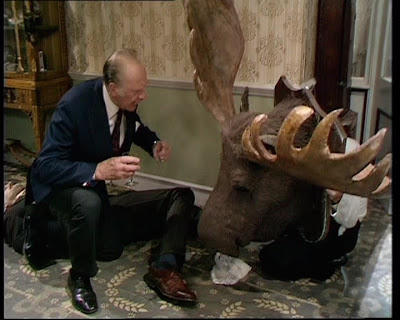
"The Germans" was the sixth episode of the classic BBC Sitcom Fawlty Towers. It is fondly remembered for its line "Don't mention the war" and "John Cleese's funny walk" when he is impersonating Adolf Hitler.
Sybil is in the hospital for three days for minor surgery to remove an ingrown toenail. When Basil visits her, she reminds him of all his tasks over the next few days: Running a fire drill, hanging a moose head, etc. Basil fights with the Sister caring for Sybil. When the Doctor tells him Sybil will be in a lot of pain after the operation, Basil is thrilled!
Back at Fawlty Towers, Basil has a confusing conversation with Major Gowen about women, a cricket game and the proper racial slurs for Indians. When the Major learns a group of German guests are coming to the hotel, he launches into an angry tirade against Germans. After the Major wanders off, Basil tries to hang the moose head, but he is interrupted by a phone call from Sybil reminding him to hang the moose head. Basil tries to ask Manuel for a hammer, but he gives up after Manuel thinks that Basil wants a hammer sandwich and wants to see his hamster, Basil leaves to get it himself. While he is gone, Manuel steps behind the front desk to tidy up and practice his English. The Major returns to hear a voice coming from behind the counter and thinks it is coming from the moose head. Basil returns and hangs the moose head, but it immediately falls on his head, and he trips over Manuel trying to get to the phone to talk to Sybil again.

The next morning, Basil hangs the moose head again, but one of the antlers keeps drooping. There are just a few minutes remaining until the fire drill, and Sybil calls to remind Basil of the drill and say the key for the fire alarm is in the safe. Basil retrieves the key, but he trips the burglar alarm, which the guests mistake for the fire alarm. As Basil tries to explain, the guests ask to hear both bells so they can tell the difference. Hearing the fire bell from the demonstration, Manuel and Polly think the fire bell means the drill has started, so Basil has to explain the situation to them, too. After the demonstration, Basil says the real drill will start in 30 seconds, so the guests stand about in the lobby, to Basil's annoyance.

In the kitchen, moments before the drill is to start, Manuel starts a real fire. The drill then commences. The panicked Manuel tries to explain the situation to Basil, but he does not understand and locks the poor waiter in the burning kitchen. Basil lets the guests back in, but Manuel's frantic banging makes him open the kitchen door. Basil sees the fire and tells the guests to exit the building again. He tries to start the alarm again, but he cannot find the key. He hurts his hand trying to smash the glass and hurls the typewriter at it with no success, so he uses the phone instead. He tries to use the fire extinguisher, but he blasts himself in the face, which temporarily blinds him. Trying to help, Manuel accidentally smacks Basil in the head with a frying pan he had been using to try to smother the flames and knocks Basil out.

Basil comes to in the hospital, where he is being treated for a concussion. The confused, disoriented Basil insults the Sister and insists on going home. The Doctor puts him to bed, but after he is gone, Basil sneaks out.
Back at Fawlty Towers, the German guests have arrived. Basil tries to speak German. However he does not understand it, since two German guests want to hire a car, but Basil thinks that they are volunteering to get some meat. Polly encourages Basil to lie down, but he insists on trying to serve lunch to the Germans. Despite warning Polly "don't mention the War", he makes multiple references to World War II accidentally at first, but eventually becoming worse as he goes on. When his references drive one German guest to tears, Basil tries to cheer her up with a joke about a bomber over Berlin. When that fails, he tries an impression – of Adolf Hitler, which involves goosestepping around the lobby. The Doctor arrives to give Basil a sedative and take him back to the hospital. Basil makes a run for it hitting Manuel to distract the Doctor, but the moose head falls on his head which knocks him out again while the moose ends up on Manuel's. Manuel complains that Mr Fawlty hit him on the head but the major walks by and says "No, you hit him on the head, you naughty moose!" The episode ends with the German guests wondering "how ever did they win?" (referring to the War).

The John Lennon Collection (1982)

John Lennon,The John Lennon Collection,USA,Promo,Deleted,POSTER,456109
The John Lennon Collection. The original 1982 US Geffen label promotional only 26" x 38"
full colour poster to promote the release of the compilation album, featuring a great shot of John
sitting on a bed barefoot playing his guitar
, along the bottom is 'The John Lennon Collection'
black & white text plus tracklisting for the album with highlighted 'Cassette Only' tracks.

Thursday, 11 August 2011

The Love Bug (1968)

The Love Bug (1968) is the first in a series of comedy films made by Walt Disney Productions that starred an anthropormorphic pearl-white, fabric-sunroofed 1963 Volkswagen racing Beetle named Herrbie. It was based on the 1961 book Car, Boy, Girl by Gordon Buford.

The movie follows the adventures of Herbie, Herbie's driver Jim Douglas (Dean Jones), and Jim's love interest, Carole Bennett (Michele Lee). It also features Buddy Hackett as Jim's enlightened, kind-hearted friend, Tennessee Steinmetz, a character who creates "art" from used car parts. English actor David Tomlinson portrays the villainous Peter Thorndyke, owner of an auto showroom and a SCCA national champion who sells Herbie to Jim and eventually becomes Jim's racing rival.

The Love Bug

Jim Douglas is a down-on-his luck racing driver, reduced to competing in Demolition Derby races against drivers half his age. Jim lives in an old fire hlouse overlooking San Fransisco Bay with his friend and mechanic, Tennessee Steinmetz, a jolly Brooklynite who constantly extols the virtues of spiritual enlightment, having spent time amongst Bhuddist Monks in Tibet, and builds 'art' from car parts. After yet another race ends in a crash (and Tennessee turns his Edsel into a sculpture), Jim finds himself without a car and heads into town in search of some cheap wheels. He is enticed into an upmarket European car showroom after setting eyes on an attractive sales assistant, Carole. Jim witnesses the dealership's British owner, Peter Thorndyke, being unnecessarily abusive towards a white Volkswagen Beetle that rolls into the showroom, and defends the car's honour, much to Thorndyke's displeasure. The following morning Jim is shocked to find that the Beetle is parked outside his house and that Thorndyke is pressing charges for grand theft. A heated argument between Jim and Thorndyke is settled when Carole persuades Thorndyke to drop the charges if Jim buys the car on a system of monthly payments.
Jim soon finds the car is prone to going completely out of his control and believes Thorndyke has conned him. Tennessee, however, believes certain inanimate objects to have hearts and minds of their own and tries to befriend the car, naming it Herbie. Jim's feelings about his new acquisition soon improve when it appears Herbie is intent on bringing him and Carole together. He also discovers Herbie to have an incredible turn of speed for a car of his size and decides to take him racing. After watching Jim and Herbie win their first race together, Thorndyke, himself a major force on the local racing scene, offers to cancel the remaining payments Jim owes on Herbie if Jim can win a race that they will both be competing in at Riverside later that month. Jim accepts, and despite Thorndyke's underhanded tactics, he and Herbie take victory. Over the next few months they go on to become the toast of the Californian racing circuit, while Thorndyke suffers increasingly humiliating defeats. Thorndyke finally snaps, and persuades Carole to take Jim out on a date while he sneaks round to Jim's house. After getting Tennessee drunk on his own Irish coffee recipe, Thorndyke proceeds to tip the remainder of the coffee into Herbie's engine. At the following day's race, an apparently hungover Herbie shudders to a halt while Thorndyke blasts to victory.
File:Deanjones withVW.jpg
That evening, Jim returns home in a brand new Lamborghini, having agreed to sell Herbie to Thorndyke to pay the remaining installments he owes on it. Jim states he needs a 'real car' for the upcoming El Dorado road race, but finds no sympathy from Tennessee, Carole, or Herbie, who jealously proceeds to smash up the Lamborghini, proving to Jim once and for all he has a mind of his own. By the time Thorndyke arrives to collect Herbie, the Volkswagen is nowhere to be found, and Jim sets off into the night hoping to find Herbie and make amends before the car is seized by Thorndyke's goons. After narrowly escaping being torn apart in Thorndyke's workshop, and a destructive spree through China Town, Herbie is about to launch himself off the Golden Gate Bridge when Jim reaches him. In his attempt to stop Herbie from driving off the bridge, Jim himself nearly falls into the water. Herbie pulls Jim back to safety, but then is impounded by the San Fransisco Police Department. There, Mr. Wu, a Chinese businessman whose store was damaged during Herbie's rampage, demands compensation that Jim can no longer afford. Using the Chinese he learnt while in Tibet, Tennessee tries to reason with Wu, and learns that he is a huge racing fan who knows all about Jim and Herbie's exploits. Wu is willing to drop the charges in exchange for becoming Herbie's new owner. Jim agrees to this, as long as Wu allows him to race the car in the El Dorado. If Jim wins, Wu will be able to keep the prize money but has to sell Herbie back for a dollar. Wu replies to this proposal in clear English: 'Now you speak my language!'.

The El Dorado runs through the Sierra Nevada mountains from Yosemite Valley and back. Before the start of the race, Thorndyke persuades Mr. Wu to make a wager with him on its outcome. Thorndyke (with his assistant Havershaw acting as co-driver) pulls every trick in the book to ensure he and his Thorndyke Special are leading at end of the first leg of the race. As a result of Thorndyke's shenanigans, Jim (with Carole and Tennessee as co-drivers) limps home last with Herbie missing two wheels and falling to pieces. Despite Tennessee's best efforts, it looks as if Herbie will be unable to start the return leg of the race the following morning. Thorndyke then arrives and claims that this makes him the new owner of the car. Wu regretfully tells Jim of the wager and that in accordance with its terms this is true. Thorndyke, thinking he is Herbie's new owner, gloats to Jim about what he's going to do to Herbie and kicks Herbies front fender, but Herbie then unexpectedly lurches into life and chases Thorndyke from the scene, showing he is more than willing to race on. Thanks to some ingenious shortcuts, Jim is able to make up for lost time in the second leg and is neck and neck with Thorndyke as the approach the finish line. In the ensuing dogfight, Herbie's hastily welded-together body splits in two. The back half of the car (carrying Tennessee and the engine) crosses the line just ahead of Thorndyke, while the front (carrying Jim and Carole) rolls over the line just behind, meaning Herbie takes both first and third place.

In accordance with the terms of the wager, Mr. Wu takes over Thorndyke's car dealership (hiring Tennessee as his assistant), while Thorndyke and Havershaw are relegated to lowly mechanics. Meanwhile, a fully repaired Herbie chauffeurs the newlywed Jim and Carole away on their honeymoon.

File:Herbie on two.jpg

The Love Bug
The Love Bug - 27 x 40 Movie Poster - Style A
Directed byRobert Stevenson
Produced byBill Walsh
Written byBill Walsh
Don DaGradi
StarringDean Jones
Michele Lee
David Tomlinson
Buddy Hackett
Music byGeorge Burns
CinematographyEdward Coleman
Editing byCotton Warburton
StudioWalt Disney Productions
Distributed byBuena Vista Distributions
Release date(s)December 24, 1968
Running time108 minutes
CountryUnited States
LanguageEnglish

The Carry On Films Calendar (2008)

Carry On Films Calendar 2008, Carry On Calendar
Carry On Calendar - The Official Carry On Films 2008 calendar - Oh what a Calendar Carry On! Sid James and Co. are back for another 12 months of typically bawdy British humour. They don’t make em’ like they used to! The 2008 Carry On Calendar features posters, scenes and pictures from Carry On Movies through the years featuring a whole host of Carry On stars such as Kenneth Williams, Jim Dale, Sidney James, Joan Sims, Kenneth Connor, Liz Fraser, Dilys Laye, Angela Douglas, Charles Hawtrey, Bill Owen and Bernard Cribbens.

Fabulous 208 (January 18th 1969)

This edition of Fabulous 208 dates back to January 18th 1969 and gracing the cover are, Simon Dupree & Jennifer Garcia. Pin ups inside include, Mick Jackson, Paul Aston, Doug McLure, The Gun & The Casuals (Double Page)

The Daleks overshadow The Doctor (1966)

Front cover of the Radio Times for 5-11 November 1966, depicting daleks outside of a space rocket.
Patrick Troughton's debut appearance as the new Doctor Who goes almost unnoticed as the Daleks are the focus for 'Radio Times'. As this was the first time 'Doctor Who' had changed its lead actor, the emphasis for this edition of the magazine is very much business as usual. The half-page feature on page 3 reassures viewers that the serial is directed by the same man who brought the Daleks to the screen in their first adventure and that the metal monsters are, once again, voiced by Peter Hawkins. Patrick Troughton's debut is almost an aside.
Article about the Doctor Who adventure Power of the Daleks.

Radio Times listing for Power of the Daleks.

Wednesday, 10 August 2011

The Spy Who Loved Me - Lotus Espirit

Click to view full size image
I remember being at school back in 1977 and the Lotus Espirit from the Bond classic, "The Spy Who Loved Me" being all the rage and the only thing spoken about on the playground. Christmas morning that year and, surprise, surprise, in my stocking was this Corgi edition of that famous Lotus!

Emmerdale Calendar (2008)

There were 12 pages of Emmerdale pictures from the scenes of Emmerdale's most memorable storylines in this official Emmerdale calendar from 2008.

Billboard Hot 100 (1964)

The Beatles,I Want To Hold Your Hand,Germany,Deleted,7
1964, February 7th the place is New York - JFK Airport, some 5000 fans are all gathered to witness the arrival of the Beatles and the beginning of the British invasion. Their first album "Please Please Me" had stayed at No1 in the U.K. for 30 consecutive weeks but the record company because of licensing problems had not released it in the U.S. Instead they released the single "I Want To Hold Your Hand" which sold 2.6 million copies in the two weeks preceding their arrival. During the course of the year they would subsequently capture nine spots on the Top 100 charts with five of them in the No1 slot (see chart below for titles).
Diana Ross,The Ultimate Collection,UK,CD ALBUM,183204
Groups from the U.K. weren't the only thing charting however, The Supreme's had their first hit with Motown Records, "Where Did Our Love Go" which was quickly followed by "Baby Love" and "Come See About Me" all three climbed to No1 on the charts. The only other multiple top spot performer was actually a early 1960's favorite, Bobby Vinton who had "There! I've Said It Again" and "Mr. Lonely" both hit No1. Another perennial favorite Frankie Valli and The Four Seasons had three huge hits with "Rag Doll", "Stay" and "Ronnie"
The Four Seasons,Entertain You,UK,Deleted,LP RECORD,175240

1964 hit music
SONGARTIST
No OF WEEKSDATE
There! I've Said It AgainBobby Vinton41/04
I Want To Hold Your HandThe Beatles72/01
She Loves YouThe Bealtes23/21
Can't Buy Me LoveThe Beatles54/04
Hello, Dolly!Louis Armstrong15/09
My GuyMary Wells25/16
Love Me DoThe Beatles15/30
Chapel Of LoveThe Dixie Cups36/06
A World Without LovePeter & Gordon16/27
I Get AroundThe Beach Boys27/04
Rag DollThe Four Seasons27/18
A Hard Day's NightThe Beatles28/01
Everybody Loves SomebodyDean Martin18/15
Where Did Our Love GoSupremes28/22
The House Of The Rising SunAnimals39/5
Oh, Pretty WomanRoy Orbison39/26
Do Wah Diddy DiddyManfred Mann210/17
Baby LoveSupremes410/31
Leader Of The PackThe Shangri-las111/28
RingoLorne Greene112/05
Mr. LonelyBobby Vinton112/12
Come See About MeSupremes212/19
I Feel FineThe Beatles312/26


Club Sandwich - Christmas 1978

Paul McCartney and Wings,Club Sandwich #12,UK,Deleted,FANZINE,543728
Paul McCartney and Wings Fanzine "Club Sandwich" No12 and was the Christmas edition for December/January 1978-79. Inside there featured a colour poster centrefold and numerous other festive treats.

It's A Knockout and the Radio Times (1966)

Radio Times Logo, 1971

Radio Times - the BBC's television and radio listings magazine - was a stoic supporter of It's A Knockout. From 1972, it awarded The Radio Times Trophy to the overall winning team at the end of each domestic series. In addition, it gave over space for features, illustrative material and even front covers to the series. .The material below is from various editions of the Radio Times dating back in 1966.

Radio Times article, Sunday 7th August 1966

(Above) Radio Times, 6th - 12th August 1966

Radio Times article, Sunday 4th September 1966
(Above) Radio Times, 3rd - 9th September 1966

Radio Times listing and Bruce Angrave illustration, Sunday 18th September 1966
(Above) Radio Times, 17th - 23rd September 1966

Nice to see ya! (1972)

Bruce Forsyth on the cover of Radio Times in 1972 for The Generation Game
The year is 1972 and Bruce Forsyth finds himself gracing the front cover of the Radio Times for the Generation Game.

Pool of London (1950)

Basil Dearden's paean to London docklands in the 1950s is as enchanting and as murky as the river: a noir-ish heist tale, liberally suffused with a fable of forbidden love and unrestrained passion. The heist element of Pool of London (1951) is well crafted and suspenseful, but the most striking aspect is Dearden's tentative venture into racial politics, with the first interracial relationship in a British film.
landscape image
Merchant seaman Johnny (Earl Cameron) is racially abused almost as soon as he sets foot on dry land by a doorman, who with unflinching disdain tells him to "hop it". Visibly shaken but without protest Johnny is about to leave when the ticket seller Pat (Susan Shaw), comes to his aid. She offers words of comfort, but only brash American Dan (Bonar Colleano) actually challenges the racist. The wonder here is why Johnny cannot defend himself. Later, Pat and Johnny go dancing, where Maisie (Moira Lister), Dan's girlfriend, refers to Johnny as 'dirty'. Again Johnny flees. Johnny's willingness to allow Dan to defend him is perhaps of his time, but a key aspect of racial politics is a rejection of the notion that a black man's justice can only be exacted through the patronage of conscientious white men. In reality, Johnny would not be able to avoid the issue forever.
landscape image
landscape image

Eventually Johnny arrives at the only standpoint where wholesale avoidance of confrontation through racism is tenable: he adopts the refuge of the outcast and the solace of the misunderstood. He speaks of not belonging and the question here perhaps is why this should be so.

Dearden works within the taboos. Johnny and Pat show all the signs of a couple falling in love, but physical contact is minimal and a romantic clinch would have been out of the question. Social mores of the day dictated that their passion should never be fulfilled.

landscape image

Earl Cameron, in his first film role, demonstrates a remarkable range. From misunderstood outsider, to would be lover and drunken brawler. It is an extraordinarily affecting performance, arguably his finest. Nine years later Dearden revisited the issue of interracial relationships with the controversial and deeply disturbing Sapphire (1959), in which Cameron also starred.

THE

MONTHLY FILM BULLETIN

Published by

THE BRITISH FILM INSTITUTE

Volume 18, No.206, March 1951, page 229

POOL OF LONDON (1950)

The Dunbar docks in the Pool of London one Friday evening, and her crew prepare to go ashore. Among them are Dan (Bonar Colleano), who has been making some easy money by smuggling, and Johnny (Earl Cameron) a young Jamaican on his last voyage before going home. Dan visits a music hall to meet his smuggling friends, and agrees for a hundred pounds to carry a mysterious package with him to Amsterdam. Johnny, meanwhile, falls in with the music hall cashier, who is kind to him when the door-man tries to throw him out. On Sunday Dan receives the package-not knowing that it contains the proceeds of a jewel raid, in which the watchman has been killed. When he shows the money to his girl friend, she insists on opening the parcel, and persuades him to keep the diamonds for himself. As Dan is already in trouble with the customs, he gives the parcel to Johnny to take aboard ship for him. Johnny, meanwhile, is falling in love with the cashier, although realising that he means nothing to her. After saying goodbye to her he returns to the ship to find that sailing has been postponed, for the police are aboard, and Dan is being hunted for murder. Johnny goes back, sees Pat with her own friends, and spends the night getting drunk. Dan, on the run, is deserted by his girl friend, but consoled by another girl who promises to wait for him if he will give himself up. Instead, he falls in again with the gang, escapes from them and from the police, but finally changes his mind and comes back, to intercept Johnny, take back the diamonds, and surrender to the police.

Pool of London is closely modelled on Dearden's earlier picture, The Blue Lamp, telling the same sort of melodramatic crime story in a realistic setting-the river landmarks, the workings of customs officers and river police. A third element is provided by the abortive love of the coloured sailor for the London girl. The mixture has not fused into a whole. The central theme advances in a curiously jerky and disorganised manner; the excitement which the story does not sustain is occasionally whipped up by artificial means - such as the crime itself, and the capture of the crooks - but this tends to produce only the effect of a series of anti-climaxes resulting in a lack of co-ordination and of rhythm. Tension, too is dissipated in pleasant but meaning-less shots of the river scenery, and in ineffectual scenes between the Negro and the girl.

This, which distracts attention from the main story, is the film's least successful element. The relationship is treated as an interlude which can have no outcome, but is not handled with that feeling or sympathy which would justify its part in the film. This is due in part to the inadequacy of the players (Earl Cameron suggests a pleasant personality, but is clearly an inexperienced actor), but more to that of the director. Dearden handles the scenes of violence in a craftsmanlike if rather contrived and artificial manner, but tenderness and feeling escape him. Pool of London has the elements of an average melodrama, but they are never satisfactorily brought together, and the result is a diffuse film, lacking shape and control.


The Monthly Film Bulletin was published by the British Film Institute between 1934 and 1991. Initially aimed at distributors and exhibitors as well as filmgoers, it carried reviews and details of all UK film releases. In 1991, the Bulletin was absorbed by Sight and Sound magazine.

Pool of London - 27 x 40 Movie Poster - Style A
Pool of London
Directed byBasil Dearden
Produced byMichael Balcon
Michael Relph (associate producer)
Written byJohn Eldridge
Jack Whittingham
StarringBonar Colleano
Earl Cameron
Susan Shaw
Music byJohn Addison
CinematographyGordon Dines
Editing byPeter Tanner
Release date(s)1951
Running time85 mins
CountryUnited Kingdom
LanguageEnglish