Friday, 9 March 2012

Radio Times - The Troubleshooters (1969)


This edition of the Radio Times dates back to 1969 and gracing the cover are the stars from the classic 1969 BBC TV series, The Troubleshooters.  The Troubleshooters (titled Mogul for the first season) was a British Television series made by the BBC between 1965 and 1972, created by John Elliot. During its run, the series made the transition from black and white to colour transmissions.........
The series was based around an international oil company – the "Mogul" of the title. The first series was mostly concerned with the internal politics within the Mogul organisation, with episodes revolving around industrial espionage, internal fraud and negligence almost leading to an accident on a North Sea oil rig.
Although Mogul was popular, it did not do as well as hoped for. However, it was renewed for a second series with the format radically changed. The title was renamed The Troubleshooters as the show altered its focus, broadening its horizons by showing the actual workings of the company. The series now focused on the younger, dynamic Mogul field agents - the eponymous "troubleshooters" - like Peter Thornton, who flew around the world to “hotspots” to protect the company’s interests.
With extensive use of BBC “stock” location filming, storylines concentrated on disasters such as explosions and earthquakes, company take-overs, racial and political tensions, the discovery of new oil fields and the negotiation of drilling rights.
As time went on, The Troubleshooters began to experiment with ongoing narratives as storylines arched over several series. Because of the nature of his profession requiring him to be away from home, Peter Thornton found his marriage to the glamorous “Steve” collapsing, whilst Brian Stead was diagnosed with a heart condition, struggling to maintain control of Mogul at the top. Ranged against him was new “troubleshooter” Alec Stewart, a young, ruthless operative keen to progress in the organisation with his eye on Stead’s position. Stead kept sending Stewart out on dangerous assignments in the hope that he would fail, but Stewart was able to work every situation to his advantage. In the latter series, a rival oil company to Mogul was introduced – Zenith.
At times, The Troubleshooters never shied away from portraying Mogul as a faceless, uncaring and profit-driven corporation. Some episodes showcased industrial crisis through the perspective of striking Teeside dockyard workers and foregrounded ecological concerns through storylines based around local opposition to a Mogul refinery in Wales and a chemical offshoot of Mogul’s, which developed a crop spray with deadly side effects. There was also no loyalty or sentimentality amongst the Mogul men – Peter Thornton, sent to the Arctic by Brian Stead to investigate possible oil concessions, nearly freezes to death and considers getting out of the oil business entirely. In another episode, Thornton is sent to Saigon, against the backdrop of the Vietnam War. Alec Stewart is arrested in Algiers as a spy and imprisoned – although eventually released, he receives little trust or support from his colleagues. Brian Stead, returning to Berlin for the first time since 1945 to oversee a natural gas drilling deal, finds his past coming back to haunt him in a nasty plot to discredit him by a rival company.

Thursday, 8 March 2012

Brookside's Finest - Barry Grant


Barry Grant was the bad boy of the now defunct Channel 4 Soap Opera Brookside. Barry was portrayed by Paul Usher and was in the series from episode one in 1982 until 1995 with several sporadic guest appearances in 1997, 1998 and the final episode in 2003.
Barry Grant is arguably the most dislikeable and feared soap villain of all time. Because of the rawness of Brookside, Grant would take things a step further than his counterparts in other UK soaps, once shoving a gun up the behind of Calum Finnegan as he attempted to rape his girlfriend (Lindsay Corkhill). Finnegan was eventually locked in a container and ended up in Kenya and subsequently had to have a kidney transplant.
Bobby and Sheila Grant raised their three children Barry, Karen and Damon on a run-down Liverpool council estate. Barry, the eldest, was always the black sheep of the family. Barry was expelled from school at age 15 for attacking a group of bullies who constantly picked on and bullied his best friend Terry Sullivan. Bobby Grant grafted for years in an effort to move away from the rough council estate flats. In 1982 Bobby and Shelia’s dream came true and they were able to buy their first home and the family moved into Brookside Close. In 1988 it is revealed that Barry Grant's real father is in fact Matty Nolan, a family friend of the Grants. Barry Grant was considerably older than his siblings. At the start of the series he was 23, compared to 15 year old Karen and 14 year old Damon.
Barry started out as a young 'scally' who, together with an often reluctant best friend Terry, was always looking for easy ways to make money. Such scams consisted of torching his Jaguar in order to claim off the insurance, stealing copper from building sites, and buying and selling stolen items. Barry was always the apple of his mother Sheila's eye but had a less sturdy relationship with his father Bobby who was eventually revealed to be his stepfather.
Although Barry was usually on the wrong side of the law, he was shown to be the more respectable of the Grant brothers in early episodes. In contrast to Damon's hot-headed recklessness, Barry was calm and responsible and made amends with the Collins after Damon vandalised their house. Barry was hard-working and smart in contrast to Damon. After Barry was stabbed in December 1982 the doctor told him to stay off work, however shortly after Bobby was out-on-strike and the Grants struggled to pay their mortgage. Despite doctors advice Barry went back to work so that his father would not have to suffer the indignity of crossing his own picket line.
In the early episodes Barry strikes up a friendship with the recently widowed Petra Taylor. The two run away for a holiday in the Isle of Man together where Petra miscarries. Barry becomes irritated by Petra's depression after the loss of her husband and unborn baby and steals charity money from Sheila before heading to London. Petra later commits suicide and Marie Jackson blames Barry for her suicide.
After losing his building job after being caught stealing materials Barry and Terry got involved with shady gangster character Tommy McArdle. In his early appearances, McArdle would drop by the close unnanounced to get Barry and Terry to do a job for him, like when he requested they valet his car to rid the back seat of what McArdle described as 'pig's blood'. In a stronger storyline, (and one of Brooksides first sensational ones) under instructions from Tommy McArdle the two provide an alibi for the perpertrators of an armed robbery. Local fireman and neighbour George Jackson is convicted for this crime instead, the key evidence being that he (foolishly) drew a map of the warehouse for McArdle, who used him for his knowledge of the place. In another scam, Barry and Terry enter in a pirate video deal with McCardle, (which also saw Barry briefly involved with Lucy Collins - daughter of residents Paul and Annabelle). This particular job went wrong for Barry, and although he had not tried to cross McArdle it ended in the beating of Barry and Terry within an inch of their lives in the tool hire shop that they ran. Barry typically made a quick recovery, but Terry was seriously hurt and spent a long time in hospital and for a while afterwards was walking with a limp. The McArdle beating one was too much for Barry to try and get revenge on and so sensing he has no friends or future in Liverpool, Barry takes a job as a shop fitter, a job that will take him all around the country.
Barry returns following the rape of his mother. This event finally splits up his parents, and with No.5 on the verge of being repossessed by the bank, Barry moved back in with his mother to try to keep up with the mortgage payments.
Barry got involved with a gangster called Sizzler. Sizzler, a southerner living on The Wirral (and depicted as having a chronic stuttering voice; particularly when words started with a 's') 'owned' Barry, once he found out that not only had he bedded his lady but had soiled his favourite bathrobe in the process. So after agreeing to work off his debt to Sizzler, Barry would do various odd jobs for him, such as when Sizzler wanted to buy a chain of amusement arcades, but the current lady owner refused to sell. Sizzler wanted Barry to kidnap her dog, cut of its head and send it to her in an effort to get her to change her mind. (The episode which ended with Barry on the verge of cutting of the dogs head prompted over 200 complaints to Channel 4). However it was revealed in the next episode that Barry couldn’t go through with it.
Barry envied the lifestyles of Tommy McArdle and Sizzler and realised that crime, does indeed, pay.
Sheila and Barry were eventually evicted from the family home, and the house was repossessed by the bank. Sheila moved in with Billy Corkhill (and later they started a relationship together) while Barry lived rough in a Vokswagen Camper van for a while. While he is homeless he and Sinbad sell toy seals as presents for Christmas 1988. They later however find them to be poisonous and spend Christmas Day trying to steal them back from children to whom they have been sold. At the end of 1989 Barry left the area once again for some work in Newcastle Upon Tyne.
Barry returned in August 1990 for the wedding of Terry and Sue. Terry and Sue allowed Barry to lodge in their house during this time. Whilst Barry had been away he had been running a series of illegal warehouse raves. This turned out to be a real money-spinner and he planned to do the same thing in Liverpool. Following a couple of successful warehouse raves in the city (and calling the police half way through the night to generate publicity for the next one) Barry planned the biggest rave yet, which required financial backing which came in the form of two cockney brothers. Together they organised a big rave night which didn’t go according to plan when Barry discovered one of the brothers dealing drugs to kids in the toilets. Barry, never a fan of drugs, decided this meant the brothers should forfeit their share of the profits and made a quick escape with the bag full of notes. The brothers were soon on Barry trail, and after seeing Barry with Sue and her little boy Danny, they assumed it was Barry’s son and so kidnapped him demanding the money back for his safe return. Barry successfully negotiated his release, but the brothers exacted further revenge by locking Barry in an industrial freezer on Christmas Day 1990. Barry made an ‘igloo’ out of frozen turkey boxes and was pulled out semi-conscious by Terry. After a few days in hospital Barry discharged himself, drove to London and planted a shotgun in one of the brothers cars before tipping off the police. Barry returned to Liverpool in high sprits to see in the new year.
Amidst all this Barry still found time to sort out Joey Goddon. Goddon had just been released from prison for the murder of Jimmy and Billy Corkhill's brother, Frankie. Goddon was hell-bent on giving the Corkhill family grief, threatening them, and dishing out general abuse. As the weeks and months went on, the war between the two families was escalating out of control but Goddon’s big mistake was to threaten Barry’s mother, Sheila. Barry drove to Goddon’s house, smashed through his back door and shoved a shotgun in his face, threatening to blow his brains out if he ever went anywhere near the Corkhill family again. During 1991 Barry made friends with a millionaire property developer, and Barry ended up 'acquiring' a new development being built near the Close. The development would consist of 4 shop units and 4 flats above. This was Barry’s big chance to 'go legit'.

Barry was unable to sustain a long-term relationship with women. He could gets girls into bed, but when they found out his true character they soon left him. Barry was jealous of the relationship Terry had with Sue. Barry was adamant that Terry could do better than Sue, and so he sets out to destroy her. After months of being deeply unpleasant to her, Barry turns on the charm and sleeps with her. Sue was wracked with guilt and threatened to tell Terry the truth. So, in October 1991, Barry pushed Sue and her young child Danny from the scaffolding on Brookside parade resulting in both their deaths. Barry has always maintained this event was an accident and he was only trying to put the ‘frighteners’ on her to stop her telling Terry their secret.

Nevertheless, Barry made sure the finger of guilt was firmly pointed towards lawyer Graeme Curtis, a work colleague of Sue’s who had an unhealthy infatuation with her. Graeme was charged and found guilty of the double murder and while in prison either took his own life or was himself murdered for being a child killer. Barry later confessed his crime to a priest.

Meanwhile Barry rented out his shops and flats. One of the flats was rented to a mysterious Asian man who paid well above the market rate for the flat in return for Barry not asking any questions and not keeping records about the tenants. With strong metal doors applied the flat and coming and goings throughout the night, curiosity soon got the better of him and Barry broke in to discover the printing of counterfeit bank notes.

By February 1992 Barry was getting tired of Fran, especially when she began to turn the screw and realised it was Barry who murdered Sue and Danny and not Graham. A desperate Barry took Fran hostage at gunpoint. Knowing he was going on the run, Barry broke into the upstairs flat and helped himself to £25,000 of counterfeit money. Barry was wracked with guilt over what he had done to Sue and Danny, and let Fran go. He took Terry to a deserted beach (suggested as being Wallasey beach) and revealed that he had slept with Sue and murdered her and Danny. Barry gave Terry a loaded shotgun with the command “Do your own justice”. This episode was notable in Brookie history for only containing Barry and Terry in it, at the beach location, with a cliffhanger ending that revealed in the next episode Terry couldn’t bring himself to kill Barry. He decided that he wanted him alive so he would have to live every day knowing what he did and so Barry fled to Spain.

In December 1992, a young lady named Jo Halsaw was opening a nightclub on the parade with Barry Grant as her business partner. Jo gave Terry a package, which contained two flight tickets to Spain and a fist full of pesetas. Terry took Sinbad along for the ride. When they arrived in Spain he met up with Barry, who wanted to know if it was safe for him to return home as he was opening a night club with Jo Halsaw.

After getting the nod from Terry, Barry returned to Liverpool a few days later. The first thing Barry did upon returning was to torch Jimmy Corkhill’s shop, Kowboy Kutz. Jimmy had been squatting in one of Barry’s shop units and could not come up with the back-rent. Jimmy refused to vacate the premises, knowing he had time on his hands for the matter to be resolved in the courts. However Barry decided to smoke him out and destroy his stock. Barry set fire to his stock and immediately called the fire brigade. However, the heating had been cut off in the shop and Jimmy was heating the place via gas bottles, which exploded the entire front of the shop out, much to Barry’s horror.

With Jimmy out of business, Barry felt slightly guilty he had destroyed his living so sent him on a course and gave him a job on the doors of the new nightclub, La Luz. This job turned out to be a change in the fortunes (and character role) of Jimmy, who becamed embroiled in various dodgy plots from this point onwards. Terry asked Barry for £500, and while Barry was trying to question him what is was for Terry just demanded the money. Barry followed him to a house, and was just about to drive off when he discovered Fran emerge carrying Barry’s offspring. Barry demanded access to his son, but Fran wanted to make sure that the boy was never to find out whom his dad was. Terry gave Fran the entire proceeds of Sue’s life insurance policy allowing her to completely disappear. Barry has never been able to track down his son, which was the ultimate revenge from Terry. The son was played by Stephen Powell. Meanwhile Jo Halsaw allowed the La Luz nightclub to become notorious for all the wrong reasons, allowing drugs and prostitution to operate out of the club and therefore the partnership between Barry and Jo never ran smoothly.
Wanting Barry out the partnership, Jo got her hired heavies to force Barry to sign the club completely over to her. Barry planned to torch the club for the insurance payout but was attacked by Jimmy Corkhill when he revealed to him that he had done it before to his shop.
Jo wanted Barry out of her way for good and so invited him to the club to talk about the future. Meanwhile Jo’s hired heavy, wearing Barry’s coat and stealing his car, runs down Jimmy Corkhill. Barry is arrested for attempted murder of Jimmy. Just when it looks like it's all over for Barry, the charges are dropped and he cautiously returns to the club, only to find his friend from Spain, Oscar Dean sitting behind the desk. Oscar has ousted Jo and bought the club himself. He immediately offers Barry a 60-40 partnership and hands the day-to-day management over to him.

Terry finds happiness again with a young Polish woman named Anna Wolska. Anna was an illegal immigrant and worked as a prostitute out of La Luz when Jo had control of the club. Anna was desperate to stay in the UK and was willing to pay a man to marry her. Anna and Terry became very close and Terry offered to marry her to ensure she could remain in the UK, however Anna didn’t want to ruin her good friendship with Terry and so declined. Barry got wind of this arrangement and offered his own deal to Anna – he would marry her if she would have his baby. (Barry was very desperate for a child of his own). Although she agreed the deal initially, it wasn’t long before she regretted it and had generally fallen in love with Terry. Terry and Anna plan a secret wedding and a new life away from Liverpool and she double crosses Barry by pretending the deal is still on but secretly taking the pill. Barry is not a man to cross and when he discovers the pills in her bag he hits her across the face and phones immigration. She was arrested and returned to Poland just before she and Terry could marry.

This event particularly broke Terry which led to his involvement with a religious cult headed by Simon Howe. The cult were squatting in number 5 Brookside Close (The Grants former residence) which Simon would call his ‘church’ and would hold regular meetings. Terry gets deeper and deeper into the cult as Barry tries to get him to see sense. Simon wanted Terry to buy the house so they could have a permanent place of worship, but before this happens Barry Grant buys the house.

Barry soon becomes impatient with Simon as he wants him out of his house, and to make things worse Simon and his followers start preaching about the perils of drinking and partying while handing out leaflets outside Barry’s night club. Barry decides to stop Simon once and for all, and with gun in hand, breaks into the house but is over powered, gagged, tied up and held hostage in one of the bedrooms. Terry starts preaching to him from the bible, but Barry doesn’t want to know. Nobody realises Barry is missing, thinking he has probably gone away on one of his many and mysterious trips ‘down south’.

Eventually Simon decides that since they can't have the house then no one can, and he builds a home-made bomb to destroy the house. They release Barry but the bomb goes off with all three still in the house. Barry and Terry are not seriously injured, but Simon ends up in hospital fighting for his life.

Terry keeps his faith and stays by Simons bedside as his injures heal. When Simon recovers he moves into a flat with Terry. Barry, not happy that Simon has not been charged with causing the explosion, breaks into the flats and attacks Simon, saying “I’ve killed before, and if you don’t disappear you'll be next”. With this Simon goes into hiding behind the Close using a few cardboard boxes for his home.

Later Simon tells Terry that their work is complete and its time to join the other side. They steal Barry’s car and drive into the woods, attaching a hose from the exhaust into the car, so that with both doors and windows shut the fumes will kill them both. However Barry arrives just in time to pull Terry from the fume filled car but leaves Simon behind to die.

Terry ends up with a serious mental disorder and is sectioned under the mental health act and taken to a psychiatric hospital. Barry refuses to let his mate waste away in an institution and illegally smuggles him abroard to have him nursed back to health by Oscar Dean's wife in Spain.

Barry left Brookside close in a hurry towards the end of 1993, when he got word of the whereabouts of Fran and his son. Finding his son was Barry's main personal agenda in life and despite the fact he was currently engaged to be married he didnt plan to stick around. Paul Usher left the show abruptly at this time and so this storyline was a bit out of the blue. All that was made of Barry's departure was a disembodied hand seen packing a suitcase and a rear shot of Barry speeding off out of the close in his Range Rover. For the next few years Barry didn’t return to Liverpool, his presence in the show was still mentioned though and he arranged for his shops, flats and nightclub to be managed by Terry, who eventually sold the club to dodgy Asian businessman Dil Parma. Terry then went on to sell rest of the complex to commercial developers. Barry eventually settled in Blaydon, Tyne and Wear off screen.

Barry returned in 1997 and began a relationship with his step-cousin, Jimmy's daughter Lindsay Corkhill, who herself was later to be involved in the same crime circles as Barry (this led to a much bigger role in the show for Lindsay) but to start with, Barry coincidentally met Jimmy Corkhill at the funeral of someone who owed a debt and after reluctantly agreeing to revisit the close for a drink in Bar Brookie, with Jimmy, he encountered Callum Finnegan, who at the same time was muscling in on Bar Brookie and the Dixons who owned it. Barry also met Lindsay for the first time on that occasion. During this period, November - December 1997, Barry agreed to protect Jacqui Dixon and Bar Brookie from the Finnegans in return for £30,000 cash. This agreement in turn led to a gang war between Barry and Callum Finnegan, culminating in the 'Lost Weekend' episode. Whilst protecting Bar Brookie, He gave Jacqui Dixon an ultimatum to pay by January 1, 1998 or he would torch the place. With little option but to pay Barry for taking care of Callum Finnegan, Jacqui agreed to be a surrogate mother for close resident Suzanna Farnham, (who was unable to conceive and was desperate for another baby). Once the £30,000 had been handed over to Barry and the Finnegans were out of the picture, Barry stuck around until the New Year, when it was revealed he was married and he disappeared to his 'house in the Midlands' - but not until having bedded Lindsay for the last time (on screen).
He stepped in to help when Jacqui Dixon, who now owned Bar Brookie was subjected to a protection racket by the Finnegans - a pair of Scottish gangster brothers (who controlled businesses such as Finnegan Security). Barry had supposedly bedded Jacqui while she was still a schoolgirl and so the two had a bit of history. Anyway, under pressure, and facing financial ruin at the hands of the Finnegans, Jacqui asked Barry for help. He initially didn't want anything to do with it but after a while he demanded thee cash in return for sorting Callum Finnegan. Initially, Barry took a beating at the hands of the Finnegan's heavies in the Bar Brookie toilets but he got his own back shortly after when he enticed Callum Finnegan into the office with an offer of "five grand a week business". Once in the office, Barry beat Finnegan and his heavy with a baseball bat and gave Callum (a suggested) ultiimatum to leave the Dixons alone. Not at all happy with this, Callum Finnegan planned to get revenge. Lindsay was then kidnapped by the Finnegans and held for ransom. This led to Barry tracking down the Finnegan hideout (on behalf of the Corkhills) and eventually finding, beating up and locking Callum Finnegan in a shipping container.
Depicted as living off the proceeds of years of crime and living in a large mansion near Newcastle Upon Tyne, Barry returned in full for Brookside's final episode in 2003 when it was revealed that he and Lindsay were to marry. At the end of the show's penultimate episode he had his heavies bundle Jimmy Corkhill into a car and driven to his mansion, where he held a gun to blindfodled Jimmy's head and in a put on brummy accent asked Jimmy if he could marry his daughter. After all that had calmed down a bit, Jimmy went on to tell Barry about Jack Michaelson. Slightly concerned that a new gangster figure was again threatening the close and the Corkhills in particular, Barry agreed to go back to the close "for old time's sake". So he returned to Brookside Close with Jimmy and Lindsay where he met Tim O'Leary. He also had a brief dialogue with Michaelson, mocking his small time criminal existence. Barry then went over to Jimmy's house - (the infamous) No. 10 Brookside Close - and advised 'Tinhead' with a way of dealing with Michaelson, reciting a story called 'The Stranger's Field'. Michaelson was later lynched from his bedroom window by three unspecified Brookside Close residents.

Saturday, 3 March 2012

The Original Queen of The Vic - Angie Watts (1985 - 1988)


The original Queen of the vic, Angie Watts was one of the finest characters to have emerged from the cess pit that has become EastEnders. Angela "Angie" Watts played superbly by Anita Dobson from the first episode of the show until 1988 when the actress decided to quit and the character was written out.
Angie was well known for her cheeky banter, her huge shaggy perm and turning to alcohol during her stormy marriage to cheating Den which ended when he handed her divorce papers on Christmas Day, in an episode watched by a record-breaking 30.1 million viewers. Despite being the loud and feisty lady of Walford, and having a close relationship with her beloved adopted daughter Sharon, she didn't have much real happiness during her time in Albert Square and alcoholism finally claimed her life in 2002 when she died of cirrhosis of the liver.
Alcoholic Angie shared a love/hate marriage to her womanising husband, Den Watts, and refused to let him go even during their rockiest times. They had been married since 18 February 1968 - exactly 17 years before the series began - and together they ran and lived in The Queen Victoria pub on Albert Square. Angie and Den doted on their spoilt, teenage, adopted daughter, Sharon, who carried on loving them despite her resentment of Den's affairs and Angie's binge drinking.
Angie was good at putting on a front for the punters, dressing to kill, screeching outrageously with the girls, but inside she was a mess. Despite all her bravado, all she really wanted was a happy marriage with Den, who she never stopped loving, despite the fact that he treated her like dirt.
Den and Angie started 1985 by celebrating their seventeenth wedding anniversary, but it soon became clear that their marriage was a sham. Behind the scenes of their great business partnership, there was not much of a relationship going on. Den had been carrying on with his posh mistress Jan Hammond for a while, a fact that Angie was all too aware of. Early in the year, Den even managed to wangle a holiday to Spain with Jan, under the pretext that he was checking out a possible time-share holiday home purchase. With Den gone, Angie did what she always did in times of trouble, she turned to alcohol to drown her sorrows. She also set about trying to seduce the men of Walford in a bid to get back at her philandering husband. Lofty Holloway, Simon Wicks and even Arthur Fowler all fell victim to Angie's not-so-subtle flirting, but her only successful conquest was local builder, Tony Carpenter. Tony fell for Angie, but she was only using him to get back at Den. The affair was conducted in secret but they were caught in a passionate clinch in the middle of The Vic by Sharon. Angie had to bribe her daughter to ensure her silence, and even informed her about Den's infidelity. Sharon was disgusted that both her parents were guilty of adultery. Upon Den's return from his holiday, Angie called off the affair, but it wasn't long before Sharon gave Den the impression that her mother had been up to no good. Den confronted Angie, and she admitted to the affair, but unfortunately for her, Den wasn't concerned about her infidelity, more about his reputation, which only sought to upset Angie even more.
Although Angie tried to stop drinking, her attempts always failed dismally and by the end of the year she'd even been arrested for drink driving when she crashed Den's car on the way home from a darts match. 1986 would prove to bring more trauma for Angie when Den's mistress, Jan, started to frequent The Vic. The physical arrival of Jan sent Angie's marriage into further decline as she was unable to contain her jealousy and anger. Angie became so depressed that she took a near lethal cocktail of booze and pills in an attempted suicide. By chance, Den returned home early following an argument with Jan, discovered Angie and rushed her to the hospital where she had her stomach pumped. Angie recovered, but was left shaken when she discovered how close to death she actually came. Upon recovering, Angie decided to play Den at his own game and so she began another affair with Andy O'Brien. Den was furious when he discovered them in bed together, but his rage was short-lived as he had more pressing things on his mind, such as the birth of his illegitimate daughter, Vicki Fowler. Angie's affair with Andy only lasted a month, ending when Andy got back with his ex-girlfriend Debbie Wilkins. Andy died in a road accident shortly afterwards.
As the year moved on, Den decided that he wanted to leave Angie so he could settle down and marry Jan. He finally got round to telling Angie his intentions in October, after which Angie became distraught. Desperate to hold on to her husband, announced that she was terminally ill and only had six months to live. Upon hearing this, Den became wracked with guilt, so he begrudgingly decided to revise his plans and stay with Angie. He set about organising a second honeymoon for them in Venice. However their holiday was ruined, when Jan turned up, and upon seeing her and Den together Angie went straight back on the gin that she'd not long given up. On the way home from Venice on the Orient Express a drunk Angie told the barman all about her big lie. Unfortunately for Angie, Den heard every word and from that moment on he reverted to his original plan to leave her, although he decided to wait a while before letting Angie know that he know about her "secret". On Christmas Day that year, Den decided to get his revenge. Thinking that her marriage was safe, Angie was happier than ever, that was until Den informed her that he'd heard her conversation with the barman on the Orient Express and then served her divorce papers as a Christmas present (this episode pulled in the highest amount of viewers the show has ever seen since its 1985 arrival - 30 million). In response, Angie and Sharon packed their bags and walked out of the pub, choosing to take the route through the public area to cause Den the most embarrassment possible.
Angie began 1987 by securing herself a job as the manageress of The Vic's rival drinking establishment, The Dagmar. Owner, James Willmott-Brown, was only too happy to have Angie's expertise on board for his new, suave wine bar. Angie and Den continued to row constantly and in a bid for revenge, Angie vowed to take Den 'to the cleaners' for her divorce settlement. In retaliation Den installed his mistress, Jan, as the new land lady of The Vic, which only sought to infuriate Angie even more. However, Den and Jan's cohabitation eventually led to the end of their relationship, when Den decided that Jan was too posh for him and so by the summer of that year he had given her her marching orders.
The Vic was floundering without Angie, a fact that she seemed to delight over, and the sheer pleasure of watching Den suffer was all she needed to make her 'grin and bear' The Dagmar's yuppie clientele. However, behind her front, Angie was a wreck, drinking more heavily than ever and going on 'over the top' shopping sprees. By May of that year the divorce papers finally came through, but it seemed that neither Den nor Angie were coping without each other, and although they both professed to be pleased about the divorce, it was obvious to everyone else that they were far from happy. Seeing her parents' misery, Sharon decided to intervene by setting up a dinner date between them, which ended with them in bed together again. Angie and Den decided to keep their reconciliation quiet for a while, but by the end of the year, Angie finally lost her patience with The Dagmar clientele, and after slapping one of the customers in the face, she marched over to The Vic and offered to come back to work, but only as a business partner this time and not a wife.
Angie began 1988 with a health scare when she was rushed to hospital with kidney-failure; brought on by her excessive alcohol abuse. Upon her recovery Angie decided to take a well-earned holiday to Spain with her friends, Sonny and Ree. This led to Angie and Sonny falling in love and embarking on an affair. Sonny made arrangements for them to start a new life together, running a bar in Spain.
Angie returned to Walford (with her plans still secret) and tried to show interest in Den's plan to move the location of The Vic, but it was plain to see that her mind was elsewhere. Den soon 'cottoned on' that she was seeing someone else, and although he didn't care that she was with another man, he was concerned for the state of his business. Den visited a solicitor and returned with papers protecting himself and his business should Angie decide to leave him again. Angie did decide to leave in May of that year, still under a cloak of secrecy and only divulging her plan to leave on the night of her departure. Unfortunately for Angie, Den had already 'second guessed' her and when she attempted to leave he cruelly informed her that he'd sorted things so she wouldn't be able to get a penny out of him. After their final showdown Angie got into her taxicab and left Walford.
This was Angie's last appearance. Later that year, while Den was in prison, Sharon decided to join Angie in Spain and arrived unannounced, only to learn from Sonny that Angie had eft him and moved to the United States. It was subsequently revealed that she moved to Miami where she remarried in February 1991. Sharon joined Angie in 1995 after the breakdown of her marriage to Grant Mitchell.
In 2001 Sharon returned to Walford, and in April 2002, news reached London that years of heavy drinking had finally caught up with Angie and she had died from cirrhosis of the liver, at the age of 52. Despite having remarried, Angie had requested to be buried next to Den, which Sharon did for her when she returned her body to London in order to reunite her two 'dead' parents. Sharon's new club was re-named Angie's Den in her and Den's honour.
In fact, the body thought to be Den's was actually that of the mysterious Mr. Vinnicombe, the boss of The Firm - who had ordered Den's assassination. 14 years after Den's disappearance, it turned out that he had not died after all, and had faked his own death in order to get away from the gangsters who had been employed to kill him. However, Den eventually met his demise at the hands of second wife Chrissie in February 2005. A body found under the basement of the Queen Vic six months later was quickly identified as Den's, and buried in his 'original' grave next to Angie.
In February 2011 Anita Dobson said that she had no regrets being in EastEnders, as it propelled her to fame, and said she believed that people were drawn to Angie because she is a survivor and funny—qualities that drew Dobson herself to Angie. She said "[Angie] could be on the floor, drunk, weeping buckets, mascara everywhere, then drag herself up the next morning in that old blue dressing gown, tidy herself up and be in the bar that night telling jokes and looking a million dollars."

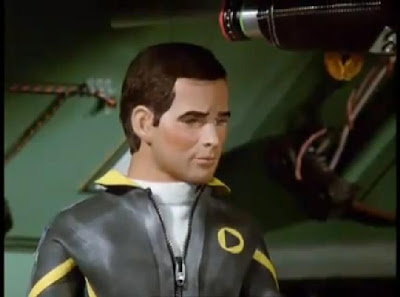
Joe 90: Episode 7 - Big Fish

"You are mad. Your son is mad. I am mad."

Joe 90 becomes one of the world's leading aquanauts and prevents
an international incident when a submarine breaks down in forbidden waters.

* * *

An advanced two-man submarine is damaged through a missile outlet fault which allows an inrush of water. The crew are rescued by helijet, but unfortunately the sub has drifted into forbidden waters and now lies in Porto Guavan territory. This threatens a tricky international situation unless the sub can be moved without discovery.

Joe 90 is therefore given the brain patterns of the world's leading aquanaut, and he and Professor McClaine visit Porto Guava, ostensibly on a fishing trip.

But they attract the suspicions of a boatman, from whom they hire his craft.

The Porto Guavan Coastal Control is also suspicious, and sail out to make inquiries just as Joe is under-water, trying to get into the stricken sub. To make matters worse, he is trapped. The authorities, believing that he must have been deliberately drowned, arrest the Professor and the boatman on suspicion of murder.

Joe, however, succeeds in freeing himself and also getting the sub safely away from the forbidden area before arriving at the jail to prove that he certainly hasn't been murdered and that there is no case against his father and the boatman!

Thursday, 1 March 2012

Kung Fu - The Original Grasshopper (1972 - 1975)


For three seasons, David Carradine starred as a half-Chinese, half-Caucasian Shaolin monk, Kwai Chang Kaine, on the ABC hit TV series Kung Fu (1972–1975) and was nominated for an Emmy and a Golden Globe Award for the role. The show, which took place in the Old West, helped to popularize the Martial Arts and Eastern Philosophy in the west and immortalized the character of Kwai Chang Caine, also referred to as "Grasshopper", in popular culture.

Although the choice of a Caucasian to play the role of Kwai Chang Caine stirred controversy, the show served as steady employment for several Asian-American actors in the U.S. In addition to Keye Luke and Philip Ahn, who held leading roles in the cast as Caine's Shaolin masters, Robert Ito, James Hong, Benson Fong, Richard Loo, and Victor Sen Young frequently appeared in the series. Kung Fu ended when Carradine quit to pursue a movie career, but he reprised the role of Kwai Chang Kaine in 1986 in Kung Fu: The Movie. Brandon Lee, son of Bruce Lee, in his acting debut, portrayed his son.

Early in the 1990s, Carradine once again reprised the role of Kwai Chang Caine in Kung Fu: The Legend Continues (1993–97) playing the grandson of the original character of the same name. Carradine starred in the programme and served as Executive Producer and Director. The programme offered him the opportunity to recreate the character for which he was most widely recognized. The show was canceled in 1997, after 4 seasons, and 88 episodes.

Davy Jones (1945 - 2012)


David Thomas "Davy" Jones (30 December 1945 – 29 February 2012) was an English singer-songwriter and actor best known as a member of The Monkees. Davy Jones was born at 20 Leamington Street, Openshaw, Manchester, (now part of Greater Manchester) on 30 December 1945. At the age of 11, he began his acting career and appeared on the British television soap opera Coronation Street, which was produced at Granada Studios by Granada Television in Manchester. In 1961 Jones played Ena Sharpoles' grandson, Colin Lomaxt. He also appeared in the BBC police series However, after the death of his mother from emphysema when he was 14 years old, he left acting and trained as a jockey with Basil Foster.

Foster was approached by a friend who worked in a theatre in the West End of London during casting for the musical Oliver!. Foster replied, "I've got the kid." Jones was cast and appeared to great acclaim as the Artful Dodger. He played the role in London and then on Broadway and was nominated for a Tony Award. On 9 February 1964, he appeared with the Broadway cast of Oliver! on The Ed Sullivan Show, the same episode on which The Beatles made their first appearance. Jones said of that night, "I watched the Beatles from the side of the stage, I saw the girls going crazy, and I said to myself, this is it, I want a piece of that." Following his Ed Sullivan appearance, Ward Sylvester of Screen Gems (then the television division of Columbia Pictures) signed Jones to a contract. A pair of American television appearances followed, as Jones received screen time in episodes of Ben Casey and The Farmer's Daughter. He also recorded a single and album for Colpix Records, which charted but were not huge hits

From 1965 to 1971, Jones was a member of The Monkees, a pop-rock group formed expressly for a television show of the same name. With Screen Gems producing the series, Jones was shortlisted for auditions, as he was the only Monkee who was signed to a deal with the studio, but still had to meet producers Bob Rafelson's and Bert Schnieder's standards. Jones sang lead vocals on many of the Monkees' recordings, including "I Wanna Be Free" and "Daydream Believer". Jones met Laramy Smith in 1967, introduced by Eirik Wangberg (then a producer and co-owner of Sound Records), and they co-produced The Children, an Austin, Texas group Jones discovered while on tour with the Monkees. A single was released on Laramie Records entitled "Picture Me", which reached Billboard at number 2 with a bullet.
After the television series went off the air, The Monkees disbanded. However, Jones continued to perform solo, while later joining with fellow Monkee Micky Dolenz and songwriters Tommy Boyce and Bobby Hart as a short-lived group called Dolenz, Boyce, Jones & Hart. He also toured throughout the years with other members as various incarnations of the Monkees.
In February 2011, Jones mentioned rumours of another Monkees reunion. "There's even talk of putting the Monkees back together again in the next year or so for a U.S. and UK tour," he told Disney's Backstage Pass newsletter. "You're always hearing all those great songs on the radio, in commercials, movies, almost everywhere." The tour came to fruition entitled, "An Evening with the Monkees: The 45th Anniversary Tour."
In 1978, he appeared with Micky Dolenz in Harry Nillson's play The Point at the Mermaid Theatre in London. Jones continued acting as he appeared in one episode of The Brady Bunch, two episodes of My Two Dads, an episode of Here Comes the Brides, and two episodes of Love, American Style. He also appeared and sang, in animated form, on an episode of The New Scooby-Doo Movies and in an episode of Hey Arnold!. Also, Jones made a cameo appearance as himself in the Sponge Bob Square Pants episode "Sponge Bob v The Big One" (his appearance was meant to be a pun on Davy Jones' Locker), a third-season episode of the sitcom Boy Meets World and the Brady Bunch spoof movie of The Brady Bunch Movie. In 1997 he guest-starred as himself on the television show Sabrina the Teenage Witch and sang "Daydream Believer" to Sabrina (Melissa Joan Hart).
In later years, Jones performed with his former bandmates in reunion tours and appeared in several productions of Oliver! as Fagin. He continued to race horses with some success in his native England, while residing in Beavertown, Pennsylvania. He owned and raced horses in the United States and served as a commercial spokesman for Colonial racetrack in Virginia. Jones maintained a residence in Indiantown as well.
In 2001, Jones released "Just Me", an album of his own songs, some written for the album and others originally on Monkees releases. In April 2006, Jones recorded the single "Your Personal Penguin", written by children's author Sandra Boynton, as a companion piece to her new board book of the same title. On 1 November 2007, the Boynton book and CD titled "Blue Moo" was released and Jones is featured in both the book and CD, singing "Your Personal Penguin". As a result of the collaboration, Jones became a close friend of Boynton. Also in 2007, Jones recorded the theme for a campy movie comedy called Sexina: Popstar PI.
In December 2008, Yahoo Music named Jones "Number 1 teen idol of all time". In 2009 Jones was rated second in a list of 10 best teen idols compiled by Fox News
In 2009, Jones released an album entitled "She" which is a collection of handpicked classics and standards from the 1940s through the 1970s. Also in 2009, Jones performed in the Flower Power Concert Series during Epcot's Flower and Garden Festival.
The Martin County Sheriff's Office stated that Jones had complained of breathing difficulties on the morning of 29 February 2012, in, Indiantown, Florida and had been transported to Martin Memorial South Hospital in Stuart, where he was pronounced dead. Jones is survived by his widow, Jessica, and four daughters.

Wednesday, 29 February 2012

Sun Hill's Finest - The Legend That Was Bob Cryer


Bob Cryer was a legend and institution to us fans of the Bill and dear old Uncle Bob played by Eric Richard was probably the show's finest character. Sgt Bob Cryer joined the Metropolitan Police in 1970 (the 1990 episode Start With The Whistlesaw a party thrown to mark his 20 year service) and arrived at Sun Hill sometime in late 1983 / early 1984 (he isn't in the original pilot episode, although it is possible that he is actually the character of Sergeant Bob Wilding with a new surname), possibly as a result of a recent promotion to Sergeant. Until the series introduced the rank of Inspector, he was the second highest ranking uniform officer in the station in the series. He had previously seen some sort of army service, unfortunately most of it leaving him with unpleasant memories.


He is considered by most fans of The Bill to be an institution. From the fourth series of the show he was always the last character to be seen during the images on the main credits (in series 2 and 3 his picture was followed by a shot of DI Galloway), and the first three series tended to revolve around himself and/or Galloway, with the two men appearing in every episode of the three series and always being the first two names on the closing credits.
Cryer is a model officer. He cares passionately about his job and hates what he considers the "touchy-feely" approach of modern policing arguing that the role of the police is to "uphold and enforce the law".
His trademark calm served him well when dealing with the harder edged visitors to the cells at Sun Hill. For many years he was a uniform sergeant. In 1991 he was briefly promoted to Duty Sergeant (an upstairs job outside of uniform) but quickly found that he had no passion for it and that it was driving his former colleagues away from him, leading to him making the swift decision to return to uniform.
His experience in all things policing led to him being in many ways the archetypical uniform officer, firm but fair to criminal and civilian alike. He was considered to be the father figure of the sergeants on the relief and a lot of the younger officers would come to him for advice on matters both professional and personal. Along the way he still discovered that you can never know everything - such as the time he shot and killed a suspect despite the suspect's gun later turning out to be unloaded.
In his own private life he had a wife and two sons, one of whom was arrested and charged in relation to a driving offence which resulted in the death of the other occupant of the car. This led to an enforced sense of separation between him and his son, a topic which Cryer would still refuse to talk about when it was raised in later years.
As time drew on, many of Cryer's contemporaries such as Sergeant Tom Penny, Sergeant Alec Peters and even DI Burnside moved on to other jobs, or retired. He increasingly found himself as something of an anachronism, and became somewhat less indulging of what he saw as the stupid mistakes of newer officers.
One exception to this was PC Dale Smith. 'Smithy' had a similar background to Cryer, with both men having served in the army. Cryer developed something of a fatherly relationship with the younger officer, and was eventually the one who encouraged Smith to apply for the firearms squad. This came back to haunt him when, during a hostage situation, PC Smith accidentally shot his friend and mentor, which led to his forced retirement in 2001.
New young Superintendent Tom Chandler did not like Bob Cryer. Everything that Cryer stood for was everything that this new broom wished to sweep away, and Cryer's injuries acted as a catalyst for this move. Typically, Cryer went out of his way to console PC Smith, and held no recrimination in his heart for the young officer.
When Dale Smith came back to Sun Hill as a sergeant in 2003, there was more than a little bit of Bob Cryer's personality about him and the way he dealt with friends and foes alike. He had learned well from his mentor.
Cryer returned to Sun Hill for the memorial service of Inspector Andrew Monroe, and to attend the funeral of Sgt Boyden. He later came back to help his niece Roberta, who was the station's front desk officer, solve a crime. His last appearance was in a 2004 episode centering around DS Roach's funeral.
Bob Cryer we Salute you!

Tuesday, 28 February 2012

Radio Times - Doomwatch (1970)


This edition of Radio Times dates back to 1970 and on the cover the classic series, Doomwatch. Doomwatch was a British Science Fiction Television programme produced by the BBC, which ran on BBC One between 1970 and 1972. The series was set in the then present-day, and dealt with a scientific government agency led by Doctor Spencer Quist (played by John Paul), responsible for investigating and combating various ecological and technological dangers.
The series was followed by a film adaptation produced by Tigon British Film Productions and released in 1972, and a revival TV movie broadcast on Channel 5 in 1999.
The programme was created by Gerry Davis and Kit Pedler, who had previously collaborated on scripts for Doctor Who, a programme on which Davis had been the story editor and Pedler the unofficial scientific adviser during the 1960s. Their interest in the problems of science changing and endangering human life had led them to create the popular alien race the Cybermen for that programme, and it was similar interests that led them to create Doomwatch, which explored all kinds of new and unusual threats to the human race, many bred out of the fear of real scientific concepts, with a "this could happen to us" fear by the public.
In the story, the actual name of the organisation was "Department for the Observation and Measurement of Scientific Work". Officially Doomwatch was an agency dedicated to preserving the world from dangers of unprincipled scientific research - "We were set up to investigate any scientific research, Public or Private, which could possibly be harmful to Man" - but the real intention was to form a body with little power meant to stifle protests and secure green votes. However the incorruptible Dr Spenser Quist and companions soon gave the agency some real power and people had to listen.
Quist had worked on the development of the atomic bomb and seen his wife die of radiation poisoning; Ridge was the secret agent type and Wren a conscientious researcher. Together they took science into people's living rooms, explaining about embryo research, subliminal messages, wonder drugs, dumping of toxic waste, noise pollution, nuclear weaponry, animal exploitation, etc.
There were other storylines such as genetic mutation creating a particularly large and vicious race of rats, and a virus that ate away at all types of plastics causing aeroplanes to fall out of the sky. There were also everyday stories like when Dr. Quist turned up at a meeting and was thought to be drunk but turned out to have severe jet lag. However, after Davis and Pedler left the show at the conclusion of the second series in 1971, it turned into a more conventional thriller drama, which the two creators openly criticised.
The first two series each consisted of thirteen episodes, and the third of twelve, of which one - titled Sex and Violence and intended to be shown as the fifth episode - was not transmitted. It has been suggested that this was because of objections to either its use of stock news footage of a public execution in Lagos, or its presentation of characters designed to be satirical analogues of Mary Whitehouse, Cliff Richard and Lord Longford. The execution footage has appeared on British television a number of times since the 1972, notably in a 1988 edition of Panorama about violence on television.
The programme was very popular and drew audiences of as high as 13.6 million at its peak for an episode called Invasion, filmed mostly in the village of Grassington in Yorkshire. The start of every series merited a cover feature on the BBC's Radio Times listings magazine, which even today is a prestigious feat for a programme. The show was also sold abroad, gaining some popularity when transmitted in Canada.
As was common at the time, the BBC wiped the Doomwatch master tapes soon after transmission, regarding them to be of little further use. Although some episodes have been returned from Canada or exist as telerecordings, many are still missing and will likely remain so, although all are being sought by the BBC Archive Treasure Hunt as a whole. However, a copy of the unbroadcast episode survives in the archives, one of only three from the final series to do so. Thanks to the Canadian returns series two is complete, but series one is missing five shows. Some of the existing episodes have had a limited release on VHS and DVD in the UK, and all - except Sex and Violence - were repeated on the satellite channel UK Gold during the 1990s, although that episode was erroneously scheduled.
Pedler and Davis re-used the plot of the first episode of the series, The Plastic Eaters, for their 1971 novel Mutant 59: The Plastic Eater, although this was not officially a Doomwatch novel and did not contain the characters from the series. The book also re-used the Radio Times cover photograph of a melted plastic aeroplane in a briefcase.